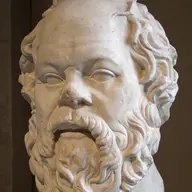
What was going on: As Plato tells it, Socrates is in a discussion at the house of Callias in Athens with Protagoras, Prodicus and Hippias. He has got them all to agree that giving in to yourself is ignorance and mastering yourself is wisdom.
Why it matters: The idea that no one does wrong willingly, which Socrates draws out in the Protagoras, became the hallmark of Socratic virtue intellectualism.
Nobody chooses what they think is bad over the good, it seems. Forced to pick between two bad things, nobody takes the worse one.
Then surely, I went on, no one willingly goes after evil or what he thinks to be evil; it is not in human nature, apparently, to do so—to wish to go after what one thinks to be evil in preference to the good; and when compelled to choose one of two evils, nobody will choose the greater when he may the lesser.
As Plato tells it. Plato, Protagoras 358c–d, translated by W. R. M. Lamb (1924)
What was going on: As Plato tells it, Socrates is in Piraeus laying out laws for the guardians of a city. He has just argued that women guardians should share all pursuits with men, and warns his listener that an even bigger wave of objections is coming.
Why it matters: The Republic is one of the world's most influential works of political theory, and Huxley's Brave New World bears a resemblance to it, with state-organized breeding in place of traditional families.
My proposed law: the guardians share their wives and children. No parent knows which child is theirs, and no child knows their parent.
The law, I said, which is the sequel of this and of all that has preceded, is to the following effect,—‘that the wives of our guardians are to be common, and their children are to be common, and no parent is to know his own child, nor any child his parent.’
As Plato tells it. Plato, Republic Book 5, translated by Benjamin Jowett (1871)
What was going on: In a dialogue by Plato, Socrates is arguing with Polus about a man who can put others to death as he likes. Socrates says doing wrong is the greatest of evils. Polus next asks if he would turn down a despot's power.
I'd want neither. But if I had to choose between doing wrong and being wronged, I'd rather be wronged.
I should wish neither, for my own part; but if it were necessary either to do wrong or to suffer it, I should choose to suffer rather than do it.
As Plato tells it. Plato, Gorgias 469c, translated by W. R. M. Lamb (1925)
What was going on: As Plato tells it, Socrates is at a gathering at Agathon's house. He is ending his speech in honor of Love, retelling what Diotima told him about seeing beauty itself.
Why it matters: Diotima's teaching on love, which Socrates sums up here, was taken up by Plotinus, the founder of Neoplatonism, and Proclus later wrote a commentary on her remarks.
Diotima told me this, and I believe it: to win this prize, the best helper human nature can find is Love.
This, Phaedrus and you others, is what Diotima told me, and I am persuaded of it; in which persuasion I pursue my neighbors, to persuade them in turn that towards this acquisition the best helper that our human nature can hope to find is Love.
As Plato tells it. Plato, Symposium 212b, translated by W. R. M. Lamb (1925)
What was going on: As Plato tells it, Phaedrus has led Socrates outside the walls of Athens to a grassy spot by the Ilissus, full of cicadas. Phaedrus teases him for acting like a stranger who never leaves the city, and wants to read him a speech from a book.
Why it matters: The Phaedrus is Plato's only dialogue that shows Socrates outside the city of Athens, out in the country.
Sorry, I love learning. Trees and fields don't teach me anything. People in the city do.
Forgive me, my dear friend. You see, I am fond of learning. Now the country places and the trees won’t teach me anything, and the people in the city do.
As Plato tells it. Plato, Phaedrus 230d, translated by Harold North Fowler (1914)
What was going on: As Plato tells it, Meno has just complained that talking with Socrates leaves his mind and tongue numb, so he can no longer say what virtue is, and has made a teasing comparison. Socrates answers, then offers to keep searching for what virtue is together.
If that numbing fish is numb itself, then I'm like it. I don't confuse people because I'm sure. I confuse them because I'm the most unsure of all.
As for me, if the torpedo is torpid itself while causing others to be torpid, I am like it, but not otherwise. For it is not from any sureness in myself that I cause others to doubt: it is from being in more doubt than anyone else that I cause doubt in others.
As Plato tells it. Plato, Meno 80c–d, translated by W. R. M. Lamb (1924)
What was going on: As Plato tells it, Socrates is talking with Cebes in 399 BCE, the year Athens condemned him to death. He is trying to explain what causes things to be as they are, and to prove that the soul is immortal.
Why it matters:Plato's account of the trial and death inspired writers, artists and philosophers to return to it. Some saw the execution as showing the defects of democracy; others as a justifiable defence of a newly restored democracy.
If someone says a thing is beautiful because of its color or shape, I ignore it. I hold, perhaps foolishly, that only beauty itself makes it beautiful.
If anyone tells me that what makes a thing beautiful is its lovely color, or its shape or anything else of the sort, I let all that go, for all those things confuse me, and I hold simply and plainly and perhaps foolishly to this, that nothing else makes it beautiful but the presence or communion (call it which you please) of absolute beauty,
As Plato tells it. Plato, Phaedo 100c–d, translated by Harold North Fowler (1914)
What was going on: As Plato tells it, Socrates is defending himself at his trial in Athens, charged with not recognising the city's gods and corrupting the young. He calls the god of Delphi as witness and tells what his late comrade Chaerephon once asked the oracle.
Why it matters: In Plato's account, Socrates says the charge that he corrupts the young began when he set out to obey this oracle.
He went to Delphi and asked the oracle whether anyone was wiser than me. The priestess answered that no one was.
Well, once he went to Delphi and made so bold as to ask the oracle this question; and, gentlemen, don’t make a disturbance at what I say; for he asked if there were anyone wiser than I. Now the Pythia replied that there was no one wiser.
As Plato tells it. Plato, Apology 21a, translated by Harold North Fowler (1914)
What was going on: As Plato tells it, Socrates is speaking to the men of Athens at his trial in 399 BCE. After an oracle called him wisest, he went to question a public man with a name for wisdom, to test the oracle, and became hated for it.
Why it matters: Socrates is known for disavowing knowledge, summed up in the saying I know that I know nothing, which is often traced to a statement in Plato's Apology.
Neither of us knows anything really worth knowing. But he thinks he does, and I know I don't. That makes me a bit wiser.
I am wiser than this man; for neither of us really knows anything fine and good, but this man thinks he knows something when he does not, whereas I, as I do not know anything, do not think I do either.
As Plato tells it. Plato, Apology 21d, translated by Harold North Fowler (1914)
What was going on: As Plato tells it, Socrates is on trial in Athens in 399 BCE, facing a death penalty. He is answering old rumors about him: that he investigated things under the earth and in the sky, and taught people to make the weaker argument win.
Why it matters:Aristophanes' comedy indicates that Athenians linked Socrates with the Sophists, and many blamed the teachings of both for making the young disrespectful of their society.
You've all seen the Socrates in Aristophanes' comedy, floating around claiming to walk on air. I know nothing about any of that.
For you yourselves saw these things in Aristophanes’ comedy, a Socrates being carried about there, proclaiming that he was treading on air and uttering a vast deal of other nonsense, about which I know nothing, either much or little.
As Plato tells it. Plato, Apology 19c, translated by Harold North Fowler (1914)
What was going on: As Plato tells it, Socrates is defending himself at his trial in Athens. Having answered his older accusers, he now turns to the sworn charge brought by Meletus and questions him in front of the jury.
Why it matters:Aristotle believed the dialogue, and especially this scene where Socrates questions Meletus, was a good use of interrogation.
He says I corrupt the young. I say he's the wrongdoer: he drags people to court over things he never cared about.
He says I am a wrongdoer because I corrupt the youth. But I, men of Athens, say Meletus is a wrongdoer, because he jokes in earnest, lightly involving people in a lawsuit, pretending to be zealous and concerned about things or which he never cared at all.
As Plato tells it. Plato, Apology 24c, translated by Harold North Fowler (1914)
What was going on: As Plato tells it, Socrates is speaking at his own trial in Athens. He says that if he disobeyed the oracle out of fear of death, then he really could be charged with not believing in gods.
Why it matters:Plato's account of the trial and death inspired writers, artists and philosophers to return to it. Some saw the execution as showing the defects of democracy; others as a justifiable defence of a newly restored democracy.
Fearing death is pretending to know what you don't. Nobody knows death isn't the best thing of all, yet people fear it as the worst.
For to fear death, gentlemen, is nothing else than to think one is wise when one is not; for it is thinking one knows what one does not know. For no one knows whether death be not even the greatest of all blessings to man, but they fear it as if they knew that it is the greatest of evils.
As Plato tells it. Plato, Apology 29, translated by Harold North Fowler (1914)
What was going on: As Plato tells it, Socrates is speaking to the jury at his trial in 399 BCE, with Meletus and Anytus against him. He says he is defending himself less for his own sake than for theirs, so they do not wrongly condemn a gift from the god.
Why it matters:Plato's account of the trial and death inspired writers, artists and philosophers to return to it. Some saw the execution as showing the defects of democracy; others as a justifiable defence of a newly restored democracy.
Kill me and you won't easily find another like me: a fly stinging a big, lazy horse of a city awake.
For if you put me to death, you will not easily find another, who, to use a rather absurd figure, attaches himself to the city as a gadfly to a horse, which, though large and well bred, is sluggish on account of his size and needs to be aroused by stinging.
As Plato tells it. Plato, Apology 30e, translated by Harold North Fowler (1914)
What was going on: As Plato tells it, Socrates is at his trial in 399 BCE, discussing what penalty he should face. He imagines someone asking why he cannot simply leave Athens and live quietly without talking. Next he offers to pay a small fine.
Why it matters:Plato's account of the trial and death inspired writers, artists and philosophers to return to it. Some saw the execution as showing the defects of democracy; others as a justifiable defence of a newly restored democracy.
Talking every day about how to be good, testing myself and others, is the best thing a person can do. A life without that isn't worth living.
…and if again I say that to talk every day about virtue and the other things about which you hear me talking and examining myself and others is the greatest good to man, and that the unexamined life is not worth living, you will believe me still less.
As Plato tells it. Plato, Apology 38a, translated by Harold North Fowler (1914)
What was going on: As Plato tells it, Socrates is speaking to his judges at the trial that ended in his death sentence. He is setting out the two things death might be, as he sees them.
Why it matters:Plato's account of the trial and death inspired writers, artists and philosophers to return to it. Some saw the execution as showing the defects of democracy; others as a justifiable defence of a newly restored democracy.
If death is like a deep sleep, it's a gain. If it's moving to a place where all the dead are, what could be better?
So if such is the nature of death, I count it a gain; for in that case, all time seems to be no longer than one night. But on the other hand, if death is, as it were, a change of habitation from here to some other place, and if what we are told is true, that all the dead are there, what greater blessing could there be, judges?
As Plato tells it. Plato, Apology 40e, translated by Harold North Fowler (1914)
What was going on: As Plato tells it, these are the closing words of Socrates' speech to the court after it condemned him to death. He has just said he is not angry with those who condemned him, and asked them to rebuke his sons as he rebuked them.
Why it matters:Plato's account of the trial and death inspired writers, artists and philosophers to return to it. Some saw the execution as showing the defects of democracy; others as a justifiable defence of a newly restored democracy.
Time to go. I go to die, you to live. Which of us is better off, only God knows.
But now the time has come to go away. I go to die, and you to live; but which of us goes to the better lot, is known to none but God.
As Plato tells it. Plato, Apology 42a, translated by Harold North Fowler (1914)
What was going on: As Plato tells it, Socrates meets Euthyphro at the King Archon's portico in Athens and presses him to define holiness. Euthyphro has just said that what all the gods love is holy, and Socrates wants to test that before accepting it.
Why it matters: The question is now called the Euthyphro dilemma, and the dialogue's unresolved ending led to one of the longest debates in theology and ethics.
Do the gods love what is holy because it is holy? Or is it holy because the gods love it?
Just consider this question:—Is that which is holy loved by the gods because it is holy, or is it holy because it is loved by the gods?
As Plato tells it. Plato, Euthyphro 10a, translated by Harold North Fowler (1914)
What was going on: As Plato tells it, Socrates is talking with Theaetetus. He compares his way of questioning to a midwife's work, except that he helps young men give birth to ideas and then tests whether each idea is real or fake.
Why it matters: Here Socrates calls his philosophical work midwifery: drawing out knowledge by questions and answers, a method later also called the Socratic method.
Like a midwife, I can't give birth to wisdom myself. People say I only ask questions and never answer. They're right: the god made me a helper, not a maker.
For I have this in common with the midwives: I am sterile in point of wisdom, and the reproach which has often been brought against me, that I question others but make no reply myself about anything, because I have no wisdom in me, is a true reproach; and the reason of it is this: the god compels me to act as midwife, but has never allowed me to bring forth.
As Plato tells it. Plato, Theaetetus 150c, translated by Harold North Fowler (1921)
What was going on: As Plato tells it, Socrates is in prison awaiting execution, talking with his friend Crito. They are weighing whether it would be right for him to escape without the permission of the Athenians.
Why it matters:Plato's account of the trial and death inspired writers, artists and philosophers to return to it. Some saw the execution as showing the defects of democracy; others as a justifiable defence of a newly restored democracy.
Let's check whether we still agree: what matters most is not living, but living well.
But, my friend, the argument we have just finished seems to me still much the same as before; and now see whether we still hold to this, or not, that it is not living, but living well which we ought to consider most important.
As Plato tells it. Plato, Crito 48b, translated by Harold North Fowler (1914)
What was going on: As Plato tells it, Socrates is in prison in Athens after being condemned to death, talking with Crito. Step by step they agree that doing wrong is always evil, even when it pays back a wrong.
Why it matters:Plato's account of the trial and death inspired writers, artists and philosophers to return to it. Some saw the execution as showing the defects of democracy; others as a justifiable defence of a newly restored democracy.
Never pay back a wrong with a wrong, or do harm to anyone, whatever they did to you.
Then we ought neither to requite wrong with wrong nor to do evil to anyone, no matter what he may have done to us.
As Plato tells it. Plato, Crito 49c, translated by Harold North Fowler (1914)
What was going on: As Plato tells it, Socrates is in prison in Athens in 399 BCE, condemned to die, and talking with Simmias. He argues that philosophers spend their lives longing for wisdom and wanting the soul apart from the body.
Why it matters: The Phaedo, where Socrates argues this, is considered a seminal text that gave classic form to pairs like soul and body, which became deeply ingrained in Western thought.
Real philosophers spend their lives practising for death, so it frightens them less than anyone.
In fact, then, Simmias, said he, the true philosophers practice dying, and death is less terrible to them than to any other men.
As Plato tells it. Plato, Phaedo 67e, translated by Harold North Fowler (1914)
What was going on: As Plato tells it, through Phaedo's account, this is the day Socrates is put to death in prison in 399 BCE. He has taken the poison, told his weeping friends to be quiet and brave, and lain down as his body goes cold from the feet up.
Why it matters:Plato's account of the trial and death inspired writers, artists and philosophers to return to it. Some saw the execution as showing the defects of democracy; others as a justifiable defence of a newly restored democracy.
His last words: Crito, we owe a rooster to Asclepius. Pay it, don't forget.
The chill had now reached the region about the groin, and uncovering his face, which had been covered, he said—and these were his last words—Crito, we owe a cock to Aesculapius. Pay it and do not neglect it.
As Plato tells it, through Phaedo's account. Plato, Phaedo 118a, translated by Harold North Fowler (1914)
What was going on: As Xenophon tells it, Socrates is answering a man named Antiphon. He asks who is better placed to help friends or the city, or to hold out under siege: someone who needs costly food, or someone content with what he can get.
Why it matters: The self-control of Xenophon's Socrates fits his role in inspiring ancient Cynicism, and the Memorabilia was particularly influential in Cynic and later Stoic philosophy.
You think happiness is luxury. I think needing nothing is godlike, and needing as little as possible is the next best thing.
You seem, Antiphon, to imagine that happiness consists in luxury and extravagance. But my belief is that to have no wants is divine; to have as few as possible comes next to the divine; and as that which is divine is supreme, so that which approaches nearest to its nature is nearest to the supreme.
As Xenophon tells it. Xenophon, Memorabilia 1.6.10, translated by E. C. Marchant (1923)
What was going on:Athens, 399 BCE: Socrates is on trial for not recognising the city's gods and corrupting the young, as Plato tells it. He has just told the men of Athens to acquit him or not; he will not change his ways even if he must die many times over.
Why it matters:Plato's account of the trial and death inspired writers, artists and philosophers to return to it. Some saw the execution as showing the defects of democracy; others as a justifiable defence of a newly restored democracy.
If you kill me, a man like me, you will harm yourselves more than me. Meletus and Anytus cannot harm me; I believe God does not let a worse man harm a better one.
For know that if you kill me, I being such a man as I say I am, you will not injure me so much as yourselves; for neither Meletus nor Anytus could injure me; that would be impossible, for I believe it is not God’s will that a better man be injured by a worse.
As Plato tells it. Plato, Apology 30c–d, translated by Harold North Fowler (1914)
What was going on: In Plato's Menexenus, which many read as satire, Socrates and Menexenus are talking about the funeral speech Athens will soon need. Socrates has just named Aspasia as his teacher of speaking, and Menexenus then begs him to repeat her speech.
Why it matters: Much of the interest in the Menexenus comes from its being one of the few surviving sources on how Athenians gave funeral speeches, even though it parodies the form.
Aspasia rehearsed a funeral speech for me yesterday. I imagine she pieced parts of it together from the one she wrote for Pericles.
…but I was listening only yesterday to Aspasia going through a funeral speech for these very people. For she had heard the report you mention, that the Athenians are going to select the speaker; and thereupon she rehearsed to me the speech in the form it should take, extemporizing in part, while other parts of it she had previously prepared, as I imagine, at the time when she was composing the funeral oration which Pericles delivered; and from this she patched together sundry fragments.
As Plato tells it; many read the Menexenus as satire. Plato, Menexenus 236b, translated by R. G. Bury (1929)