hstry

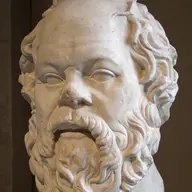
Socrates on Love as the best helper

set in 416 BCE, Athens, Agathon's house. As Plato tells it.

Where and when

set in 416 BCEAthens, Agathon's house

2,441 years ago

Explore
Socrates, c. 470 – 399 BCE3000 BCE2900 BCE2800 BCE2700 BCE2600 BCE2500 BCE2400 BCE2300 BCE2200 BCE2100 BCE2000 BCE1900 BCE1800 BCE1700 BCE1600 BCE1500 BCE1400 BCE1300 BCE1200 BCE1100 BCE1000 BCE900 BCE800 BCE700 BCE600 BCE500 BCE400 BCE300 BCE200 BCE100 BCE1 CE100 CE200 CE300 CE400 CE500 CE600 CE700 CE800 CE900 CE1000 CE1100 CE1200 CE1300 CE1400 CE1500 CE1600 CE1700 CE1800 CE1900 CE2000 CEGreat Pyramid of Giza built, c. 2600 BCERome founded (traditional date), 753 BCELast western Roman emperor deposed, 476 CEGutenberg's printing press, c. 1440 CEColumbus reaches the Americas, 1492 CEFirst people on the Moon, 1969 CEToday, 2026

Swipe the line. Bars: entries. Dots: events.

In plain words, ours

Diotima told me this, and I believe it: to win this prize, the best helper human nature can find is Love.

This, Phaedrus and you others, is what Diotima told me, and I am persuaded of it; in which persuasion I pursue my neighbors, to persuade them in turn that towards this acquisition the best helper that our human nature can hope to find is Love.

Plato, Symposium 212bTranslated by W. R. M. Lamb (1925)Read the full passage (Plato, Symposium 212b, opens scaife.perseus.org)

What was going on, our summary

As Plato tells it, Socrates is at a gathering at Agathon's house. He is ending his speech in honor of Love, retelling what Diotima told him about seeing beauty itself.

Checked claim by claim against: the passage around the quote.

Why it matters

Diotima's teaching on love, which Socrates sums up here, was taken up by Plotinus, the founder of Neoplatonism, and Proclus later wrote a commentary on her remarks.

Based on Wikipedia: Symposium (Plato)

Plotinus (d. 270), the founder of Neoplatonism, discusses Diotima's concept of Eros in his treatise On Beauty.

Proclus wrote a commentary on Diotima's remarks in the Symposium

Wikipedia, Symposium (Plato) (opens en.wikipedia.org), as of 2026-08-28. Text CC BY-SA 4.0. Our line is checked against these sentences only.

Related moments

In time order, with this one in its place. Each says why it is here.

  1. c. 441 BCEabout 25 years earlier Antigone on love, not hate Also about friendship and love
  2. c. 431–411 BCEDuring it Socrates on guardians sharing wives and children More from Socrates
  3. c. 430–405 BCEDuring it Socrates would rather suffer wrong than do it More from Socrates
  4. c. 420–413 BCEDuring it Orestes on judging a man's worth Also in Athens
  5. c. 420–413 BCEDuring it Orestes on judging a man's worth Also in Athens
  6. 416 BCESame year Athens takes Melos and kills its men Same years
  7. set in 416 BCEThis momentSocrates on Love as the best helper
  8. 415 BCE0.8999999999999773 years later Statues of Hermes are smashed across Athens Also in Athens
  9. 415 BCE1 year later The great fleet sails for Sicily Same years
  10. c. 420–410 BCEDuring it Socrates on why he stays in the city More from Socrates
  11. 413 BCE3 years later The Athenian army is destroyed in Sicily Same years
  12. by 399 BCEabout 17 years later Aspasia on honest matchmaking Also about friendship and love

Just before and after

The text around the quote, word for word from the same translation.

Show the passageHide the passage

But tell me, what would happen if one of you had the fortune to look upon essential beauty entire, pure and unalloyed; not infected with the flesh and color of humanity, and ever so much more of mortal trash? What if he could behold the divine beauty itself, in its unique form? Do you call it a pitiful life for a man to lead—looking that way, observing that vision by the proper means, and having it ever with him? Do but consider, she said, that there only will it befall him, as he sees the beautiful through that which makes it visible, to breed not illusions but true examples of virtue, since his contact is not with illusion but with truth. So when he has begotten a true virtue and has reared it up he is destined to win the friendship of Heaven; he, above all men, is immortal.

The quote: This, Phaedrus and you others, is what Diotima told me, and I am persuaded of it; in which persuasion I pursue my neighbors, to persuade them in turn that towards this acquisition the best helper that our human nature can hope to find is Love.

Wherefore I tell you now that every man should honor Love, as I myself do honor all love-matters with especial devotion, and exhort all other men to do the same; both now and always do I glorify Love’s power and valor as far as I am able. So I ask you, Phaedrus, to be so good as to consider this account as a eulogy bestowed on Love, or else to call it by any name that pleases your fancy.

Plato, Symposium 211e–212cTranslated by W. R. M. Lamb (1925)Read the full passage (opens scaife.perseus.org)

When, and whose words

Date
set in 416 BCE. Set at the party for Agathon's first tragic victory, which ancient records place at the Lenaia of 416 BCE.
Whose words
As Plato tells it.
How this post was checked
  • The plain-words line was read against the quote alone by a second, independent pass, which found it adds no claim the quote does not make (2026-10-03).
  • Each claim in the summary was checked by an independent pass against only the material it cites.
  • The quote itself is checked by the build: word for word, once, at the cited section of the stored translation.

See it among its momentsMore from SocratesSee it in the feed