hstry

Socrates as a midwife

399 BCE, Athens. As Plato tells it.

Where and when

399 BCEAthens

2,424 years ago

Explore
Socrates, c. 470 – 399 BCE3000 BCE2900 BCE2800 BCE2700 BCE2600 BCE2500 BCE2400 BCE2300 BCE2200 BCE2100 BCE2000 BCE1900 BCE1800 BCE1700 BCE1600 BCE1500 BCE1400 BCE1300 BCE1200 BCE1100 BCE1000 BCE900 BCE800 BCE700 BCE600 BCE500 BCE400 BCE300 BCE200 BCE100 BCE1 CE100 CE200 CE300 CE400 CE500 CE600 CE700 CE800 CE900 CE1000 CE1100 CE1200 CE1300 CE1400 CE1500 CE1600 CE1700 CE1800 CE1900 CE2000 CEGreat Pyramid of Giza built, c. 2600 BCERome founded (traditional date), 753 BCELast western Roman emperor deposed, 476 CEGutenberg's printing press, c. 1440 CEColumbus reaches the Americas, 1492 CEFirst people on the Moon, 1969 CEToday, 2026

Swipe the line. Bars: entries. Dots: events.

Socrates

, AthensAs Plato tells it

In plain words, ours

Like a midwife, I can't give birth to wisdom myself. People say I only ask questions and never answer. They're right: the god made me a helper, not a maker.

For I have this in common with the midwives: I am sterile in point of wisdom, and the reproach which has often been brought against me, that I question others but make no reply myself about anything, because I have no wisdom in me, is a true reproach; and the reason of it is this: the god compels me to act as midwife, but has never allowed me to bring forth.

Plato, Theaetetus 150cTranslated by Harold North Fowler (1921)Read the full passage (Plato, Theaetetus 150c, opens scaife.perseus.org)

What was going on, our summary

As Plato tells it, Socrates is talking with Theaetetus. He compares his way of questioning to a midwife's work, except that he helps young men give birth to ideas and then tests whether each idea is real or fake.

Checked claim by claim against: the passage around the quote.

Why it matters

Here Socrates calls his philosophical work midwifery: drawing out knowledge by questions and answers, a method later also called the Socratic method.

Based on Wikipedia: Theaetetus (dialogue)

Socrates considers his philosophical work as midwifery (Maieutics). This method, later also called Socratic method, consists in eliciting knowledge by a series of questions and answers.

Wikipedia, Theaetetus (dialogue) (opens en.wikipedia.org), as of 2026-09-26. Text CC BY-SA 4.0. Our line is checked against these sentences only.

Related moments

In time order, with this one in its place. Each says why it is here.

  1. 431 BCE32 years earlier Medea on being too clever Also about teaching and learning
  2. c. 429 BCEabout 30 years earlier Oedipus demands to learn his birth Also about knowing and not knowing
  3. 423 BCE24 years earlier Strepsiades on the gnat's trumpet Also about knowing and not knowing
  4. 404 BCE5 years earlier The Thirty take power in Athens Same years
  5. 403 BCE4 years earlier Democracy returns to Athens, with an amnesty Same years
  6. 399 BCESame year Socrates is tried, condemned and put to death Also in Athens
  7. 399 BCEThis momentSocrates as a midwife
  8. by 399 BCEBy this year Aspasia on honest matchmaking Also in Athens
  9. set in 399 BCESame year The charge Meletus swore against Socrates Also in Athens
  10. set in 399 BCESame year Socrates and the oracle at Delphi More from Socrates
  11. set in 399 BCESame year Socrates on what makes things beautiful More from Socrates
  12. set in 399 BCESame year Socrates on knowing that he does not know More from Socrates
  13. c. 387 BCEabout 12 years later Plato starts teaching at the Academy Also about teaching and learning

Just before and after

The text around the quote, word for word from the same translation.

Show the passageHide the passage

And yet the true midwife is the only proper match-maker. THEAET. It seems so. SOC. So great, then, is the importance of midwives; but their function is less important than mine. For women do not, like my patients, bring forth at one time real children and at another mere images which it is difficult to distinguish from the real. For if they did, the greatest and noblest part of the work of the midwives would be in distinguishing between the real and the false. Do you not think so? THEAET. Yes, I do. SOC. All that is true of their art of midwifery is true also of mine, but mine differs from theirs in being practised upon men, not women, and in tending their souls in labor, not their bodies. But the greatest thing about my art is this, that it can test in every way whether the mind of the young man is bringing forth a mere image, an imposture, or a real and genuine offspring.

The quote: For I have this in common with the midwives: I am sterile in point of wisdom, and the reproach which has often been brought against me, that I question others but make no reply myself about anything, because I have no wisdom in me, is a true reproach; and the reason of it is this: the god compels me to act as midwife, but has never allowed me to bring forth.

I am, then, not at all a wise person myself, nor have I any wise invention, the offspring born of my own soul; but those who associate with me, although at first some of them seem very ignorant, yet, as our acquaintance advances, all of them to whom the god is gracious make wonderful progress, not only in their own opinion, but in that of others as well. And it is clear that they do this, not because they have ever learned anything from me, but because they have found in themselves many fair things and have brought them forth. But the delivery is due to the god and me.

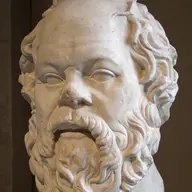
Plato, Theaetetus 150a–dTranslated by Harold North Fowler (1921)Read the full passage (opens scaife.perseus.org)

When, and whose words

Date
399 BCE. Socrates ends the dialogue leaving to answer Meletus' suit at the King's Porch, so it is set just before his trial in 399 BCE.
Whose words
As Plato tells it.
How this post was checked
  • The plain-words line was read against the quote alone by a second, independent pass, which found it adds no claim the quote does not make (2026-10-03).
  • Each claim in the summary was checked by an independent pass against only the material it cites.
  • The quote itself is checked by the build: word for word, once, at the cited section of the stored translation.

See it among its momentsMore from SocratesSee it in the feed