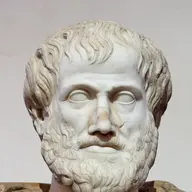
Aristotle
384 – 322 BCE, Stagira
384 – 322 BCEStagira
about 2,378 years ago

Greek philosopher and polymath (384–322 BCE) who founded the Peripatetic school at the Lyceum in Athens.
Aristotle (Ancient Greek: Ἀριστοτέλης, romanized: Aristotélēs; 384–322 BC) was an ancient Greek philosopher and polymath.
As the founder of the Peripatetic school of philosophy in the Lyceum in Athens
From Wikipedia, Aristotle (opens en.wikipedia.org), as of 2026-09-17.
Short and sourced: tap any line to see the sentences it rests on.
In short
His writings span the natural sciences, philosophy, linguistics, economics, politics, psychology and the arts.
His writings span the natural sciences, philosophy, linguistics, economics, politics, psychology, and the arts.
From Wikipedia, Aristotle (opens en.wikipedia.org), as of 2026-09-17.
He studied at Plato’s Academy in Athens and later tutored Alexander the Great.
At around eighteen years old, he joined Plato's Academy in Athens and remained there until the age of thirty seven (c. 347 BC).
Shortly after Plato died, Aristotle left Athens and, at the request of Philip II of Macedon, tutored his son Alexander the Great beginning in 343 BC.
From Wikipedia, Aristotle (opens en.wikipedia.org), as of 2026-09-17.
Medieval Muslim scholars revered him as "The First Teacher", and medieval Christians like Thomas Aquinas as "The Philosopher".
Aristotle was revered among medieval Muslim scholars as "The First Teacher", and among medieval Christians like Thomas Aquinas as simply "The Philosopher".
From Wikipedia, Aristotle (opens en.wikipedia.org), as of 2026-09-17.
Early life and the Academy
Born in 384 BCE in Stagira, the son of Nicomachus, personal physician to King Amyntas of Macedon.
Aristotle was born in 384 BC in Stagira, Chalcidice, about 55 km (34 miles) east of modern-day Thessaloniki.
He was the son of Nicomachus, the personal physician of King Amyntas of Macedon
From Wikipedia, Aristotle (opens en.wikipedia.org), as of 2026-09-17.
At seventeen or eighteen he joined Plato’s Academy in Athens; Plato nicknamed him "mind of the school".
At the age of seventeen or eighteen, Aristotle moved to Athens to continue his education at Plato's Academy.
He became distinguished as a researcher and lecturer, earning for himself the nickname "mind of the school" by his tutor Plato.
From Wikipedia, Aristotle (opens en.wikipedia.org), as of 2026-09-17.
He stayed in Athens nearly twenty years, leaving in 348/47 BCE after Plato’s death.
Aristotle remained in Athens for nearly twenty years before leaving in 348/47 BC after Plato's death.
From Wikipedia, Aristotle (opens en.wikipedia.org), as of 2026-09-17.
Tradition says he disliked the Academy under Plato’s nephew Speusippus; anti-Macedonian feeling in Athens may also have played a part.
The traditional story about his departure records that he was disappointed with the academy's direction after control passed to Plato's nephew Speusippus, although it is possible that the anti-Macedonian sentiments in Athens could have also influenced his decision.
From Wikipedia, Aristotle (opens en.wikipedia.org), as of 2026-09-17.
At Assos in Asia Minor, and later on Lesbos, he and Theophrastus did extensive research in botany and marine biology.
Aristotle left with Xenocrates to Assos in Asia Minor
While at Assos, Aristotle and his colleague Theophrastus did extensive research in botany and marine biology, which they later continued at the near-by island of Lesbos.
From Wikipedia, Aristotle (opens en.wikipedia.org), as of 2026-09-17.
Teacher of Alexander
In 343/42 BCE Philip II of Macedon invited him to Pella to tutor his thirteen-year-old son, Alexander.
In 343/42 BC, Aristotle was invited to Pella by Philip II of Macedon to become the tutor to his thirteen-year-old son Alexander
From Wikipedia, Aristotle (opens en.wikipedia.org), as of 2026-09-17.
He encouraged Alexander toward eastern conquest, counselling him to be "a leader to the Greeks and a despot to the barbarians".
Aristotle encouraged Alexander toward eastern conquest, and his own attitude towards Persia was strongly ethnocentric.
In one famous example, he counsels Alexander to be "a leader to the Greeks and a despot to the barbarians".
From Wikipedia, Aristotle (opens en.wikipedia.org), as of 2026-09-17.
Near the end of Alexander’s life the two became estranged, over issues such as the treatment of conquered peoples like the Persians.
While Alexander deeply admired Aristotle, near the end of his life, the two men became estranged having diverging opinions over issues, like the optimal administration of city-states, the treatment of conquered populations, such as the Persians
From Wikipedia, Aristotle (opens en.wikipedia.org), as of 2026-09-17.
The Lyceum and death
Back in Athens after 336 BCE, he set up his own school in a rented building, the Lyceum; as a metic he could not own property.
Aristotle returned to Athens for the second and final time a year after Philip II's assassination in 336 BC.
As a metic, Aristotle could not own property in Athens and thus rented a building known as the Lyceum (named after the sacred grove of Apollo Lykeios), in which he established his own school.
From Wikipedia, Aristotle (opens en.wikipedia.org), as of 2026-09-17.
The building’s colonnade, the peripatos, gave the school its name: Peripatetic.
The building included a gymnasium and a colonnade (peripatos), from which the school acquired the name Peripatetic.
From Wikipedia, Aristotle (opens en.wikipedia.org), as of 2026-09-17.
He is believed to have written many of his philosophical works in Athens between 335 and 323 BCE.
This period in Athens, between 335 and 323 BC, is when Aristotle is believed to have composed many of his philosophical works.
From Wikipedia, Aristotle (opens en.wikipedia.org), as of 2026-09-17.
After Alexander’s death, anti-Macedonian feeling returned to Athens; in 322 BCE Aristotle was reportedly denounced for impiety.
Following Alexander's death, anti-Macedonian sentiment in Athens was rekindled.
In 322 BC, Demophilus and Eurymedon the Hierophant reportedly denounced Aristotle for impiety
From Wikipedia, Aristotle (opens en.wikipedia.org), as of 2026-09-17.
He fled to Chalcis, said to have stated "I will not allow the Athenians to sin twice against philosophy", meaning Socrates’ execution.
prompting him to flee to his mother's family estate in Chalcis, Euboea, at which occasion he was said to have stated "I will not allow the Athenians to sin twice against philosophy" – a reference to Athens's trial and execution of Socrates.
From Wikipedia, Aristotle (opens en.wikipedia.org), as of 2026-09-17.
He died of natural causes in Chalcis later in 322 BCE, having asked in his will to be buried next to his wife.
In 322 BC, Demophilus and Eurymedon the Hierophant reportedly denounced Aristotle for impiety
He died in Chalcis, Euboea of natural causes later that same year, having named his student Antipater as his chief executor and left a will in which he asked to be buried next to his wife.
From Wikipedia, Aristotle (opens en.wikipedia.org), as of 2026-09-17.
Ideas
He is credited with the earliest systematic study of logic, and his version was the main Western logic until the 19th century.
With the Prior Analytics, Aristotle is credited with the earliest systematic study of logic, and his conception of it was the dominant form of Western logic until 19th-century advances in mathematical logic.
From Wikipedia, Aristotle (opens en.wikipedia.org), as of 2026-09-17.
He was the first to study biology systematically, spending two years observing the animals of Lesbos and its seas.
Aristotle was the first person to study biology systematically, and biology forms a large part of his writings.
He spent two years observing and describing the zoology of Lesbos and the surrounding seas
From Wikipedia, Aristotle (opens en.wikipedia.org), as of 2026-09-17.
Unlike Plato, he held that a form, such as that of an apple, exists within each thing rather than in a separate world of forms.
Where Plato spoke of the forms as existing separately from the things that participate in them, Aristotle maintained that universals are multiply located.
So, according to Aristotle, the form of apple exists within each apple, rather than in the world of the forms.
From Wikipedia, Aristotle (opens en.wikipedia.org), as of 2026-09-17.
He named the aim of all deliberate human action eudaimonia, usually translated as happiness: the soul acting at the mean between vices.
Aristotle identified such an optimum activity (the virtuous mean, between the accompanying vices of excess or deficiency) of the soul as the aim of all human deliberate action, eudaimonia, generally translated as "happiness" or sometimes "well-being".
From Wikipedia, Aristotle (opens en.wikipedia.org), as of 2026-09-17.
He stated that "man is by nature a political animal" and considered the city a natural community.
He famously stated that "man is by nature a political animal" and argued that humanity's defining factor among others in the animal kingdom is its rationality.
Aristotle considered the city to be a natural community.
From Wikipedia, Aristotle (opens en.wikipedia.org), as of 2026-09-17.
How we know
Details of his life are not well established: ancient biographies are often speculative, and historians agree on only a few points.
In general, the details of Aristotle's life are not well-established.
The biographies written in ancient times are often speculative and historians only agree on a few salient points.
From Wikipedia, Aristotle (opens en.wikipedia.org), as of 2026-09-17.
Only about a third of his output survives, none of it meant for publication; the surviving treatises are thought to be lecture aids.
only around a third of his original output has survived, none of it intended for publication
they are generally thought to be lecture aids for his students.
From Wikipedia, Aristotle (opens en.wikipedia.org), as of 2026-09-17.
An ancient rumour that he played a role in Alexander’s death rests only on an unlikely claim made some six years later.
A widespread speculation in antiquity suggested that Aristotle played a role in Alexander's death, but the only evidence of this is an unlikely claim made some six years after the death.
From Wikipedia, Aristotle (opens en.wikipedia.org), as of 2026-09-17.
Aristotle on hstry
- c. 335–322 BCEAristotle on one swallow and happiness
- c. 335–322 BCEAristotle on becoming just by just acts
- c. 335–322 BCEAristotle on being angry the right way
- c. 335–322 BCEAristotle on friendship
- c. 335–322 BCEAristotle on friendship taking time
- c. 335–322 BCEAristotle on why amusement is not the goal
- c. 335–322 BCEAristotle puts truth before friends
- c. 335–322 BCEAristotle on man as a political animal
- c. 335–322 BCEAristotle on the one who lives outside the city
- c. 335–322 BCEAristotle on the wisdom of the many
- c. 335–322 BCEAristotle on what is held in common
- c. 335–322 BCEAristotle answers Plato's Republic
- c. 335–322 BCEAristotle defines tragedy
- c. 335–322 BCEAristotle on poetry and history
- c. 335–322 BCEAristotle on Sophocles and Euripides
- c. 335–322 BCEAristotle on metaphor
Related
People
 Platoc. 428 – 348 BCE. On this page
 Alexander356 – 323 BCE. On this page
 Xenophonc. 430 – c. 354 BCE. Alive at the same time
 Diogenesc. 412 – 323 BCE. Alive at the same time
Places
During Aristotle's life
- 399 BCESocrates is tried, condemned and put to death
- c. 367 BCEAristotle, aged about seventeen, joins Plato's Academy
- c. 348/347 BCEPlato dies, aged about eighty
- 338 BCEPhilip of Macedon defeats Athens and Thebes at Chaeronea
- 336 BCEAlexander becomes king of Macedon at twenty
- 335/334 BCEAristotle opens his school at the Lyceum
- 323 BCEAlexander dies in Babylon
- c. 324–321 BCEDiogenes the Cynic dies in Corinth
- 322 BCEAristotle dies at Chalcis
Periods
Every line here is ours, written from Wikipedia, Aristotle (opens en.wikipedia.org) (text CC BY-SA 4.0) and checked line by line against the sentences it cites. Where Wikipedia relies on Plutarch or another ancient writer, so do we, and we say so.