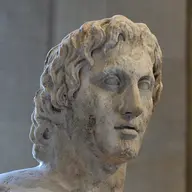
What was going on: As Plutarch tells it, centuries later, the boy Alexander once hosted envoys from the Persian king while his father Philip was away, quizzing them about roads and the Persian army. Plutarch says he wanted excellence and fame, not wealth or pleasure.
Why it matters: Alexander's relationship with his father forged his competitive side; he worried Philip would leave him no great or brilliant achievement to show the world.
Every time his father took a city or won a battle, he told his friends: Dad will do everything first and leave nothing great for me.
…as often as tidings were brought that Philip had either taken a famous city or been victorious in some celebrated battle, Alexander was not very glad to hear them, but would say to his comrades: Boys, my father will anticipate everything; and for me he will leave no great or brilliant achievement to be displayed to the world with your aid.
As Plutarch tells it, centuries later. Plutarch, Life of Alexander 5.2, translated by Bernadotte Perrin (1919)
What was going on: As Plutarch tells it, centuries later, the Greeks had just met at the Isthmus and named Alexander leader of a war against Persia. Statesmen and philosophers came to congratulate him, but Diogenes, staying in Corinth, ignored him, so Alexander went to see him in person.
Why it matters: Alexander's encounter with Diogenes, during his stay in Corinth, became famous.
Alexander came to see Diogenes, who was lying in the sun, greeted him, and asked if he wanted anything.
Alexander went in person to see him; and he found him lying in the sun. Diogenes raised himself up a little when he saw so many persons coming towards him, and fixed his eyes upon Alexander. And when that monarch addressed him with greetings, and asked if he wanted anything,
As Plutarch tells it, centuries later. Plutarch, Life of Alexander 14.2, translated by Bernadotte Perrin (1919)
What was going on: As Plutarch tells it, centuries later, Alexander went to see Diogenes in Corinth when the philosopher did not come to congratulate him. He found him lying in the sun, asked if he wanted anything, and was told to stand out of his sun.
His men were laughing at the philosopher. Alexander said: if I weren't Alexander, I would be Diogenes.
…he said to his followers, who were laughing and jesting about the philosopher as they went away, But verily, if I were not Alexander, I would be Diogenes.
As Plutarch tells it, centuries later. Plutarch, Life of Alexander 14.3, translated by Bernadotte Perrin (1919)
What was going on: Plutarch, writing centuries later, copies a letter he says Alexander sent his old teacher Aristotle after crossing into Asia. Alexander had learned that Aristotle had published books on deep teachings that philosophers share with only a few pupils, and that Alexander had been taught.
You shouldn't have published your private teachings. How will I stand out if everyone knows them? I'd rather excel in knowing the best things than in power.
Thou hast not done well to publish thy acroamatic doctrines; for in what shall I surpass other men if those doctrines wherein I have been trained are to be all men’s common property? But I had rather excel in my acquaintance with the best things than in my power.
As Plutarch tells it, centuries later. Plutarch, Life of Alexander 7.4, translated by Bernadotte Perrin (1919)