hstry

Aristotle on being angry the right way

c. 335–322 BCE, Athens (Lyceum). His own words, in the Nicomachean Ethics.

Where and when

c. 335–322 BCEAthens (Lyceum)

about 2,353 years ago

Explore
Aristotle, 384 – 322 BCE3000 BCE2900 BCE2800 BCE2700 BCE2600 BCE2500 BCE2400 BCE2300 BCE2200 BCE2100 BCE2000 BCE1900 BCE1800 BCE1700 BCE1600 BCE1500 BCE1400 BCE1300 BCE1200 BCE1100 BCE1000 BCE900 BCE800 BCE700 BCE600 BCE500 BCE400 BCE300 BCE200 BCE100 BCE1 CE100 CE200 CE300 CE400 CE500 CE600 CE700 CE800 CE900 CE1000 CE1100 CE1200 CE1300 CE1400 CE1500 CE1600 CE1700 CE1800 CE1900 CE2000 CEGreat Pyramid of Giza built, c. 2600 BCERome founded (traditional date), 753 BCELast western Roman emperor deposed, 476 CEGutenberg's printing press, c. 1440 CEColumbus reaches the Americas, 1492 CEFirst people on the Moon, 1969 CEToday, 2026sometime in these 13 years

Swipe the line. Bars: entries. Dots: events.

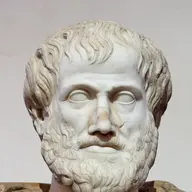
Aristotle

, Athens (Lyceum)His own words, in the Nicomachean Ethics

In plain words, ours

Anyone can get angry or spend money. Doing it with the right person, the right amount, at the right time, for the right reason, the right way: that's hard.

So also anybody can become angry—that is easy, and so it is to give and spend money; but to be angry with or give money to the right person, and to the right amount, and at the right time, and for the right purpose, and in the right way—this is not within everybody’s power and is not easy;

Aristotle, Nicomachean Ethics 2.9.2Translated by H. Rackham (1926)Read the full passage (Aristotle, Nicomachean Ethics 2.9.2, opens scaife.perseus.org)

What was going on, our summary

In his Nicomachean Ethics, Aristotle has just argued that good character is a middle point between two faults, one of too much and one of too little. That, he says, is why being good is hard, like finding the center of a circle.

Checked claim by claim against: the passage around the quote.

Related moments

In time order, with this one in its place. Each says why it is here.

  1. by 348 BCEabout 20 years earlier Plato answers Diogenes Also about how to live well
  2. c. 348/347 BCEabout 19.5 years earlier Plato dies, aged about eighty Also in Athens
  3. 335/334 BCEabout 7 years earlier Aristotle opens his school at the Lyceum Also in Athens
  4. 336–323 BCEDuring it Diogenes meets Alexander Same years
  5. 334–323 BCEDuring it Alexander writes to Aristotle Same years
  6. c. 335–322 BCEThis momentAristotle on being angry the right way
  7. c. 335–322 BCEDuring it Aristotle on becoming just by just acts More from Aristotle
  8. c. 335–322 BCEDuring it Aristotle on friendship More from Aristotle
  9. c. 335–322 BCEDuring it Aristotle on one swallow and happiness More from Aristotle
  10. 323 BCEabout 4.5 years later Alexander dies in Babylon Same years
  11. c. 324–321 BCEabout 5 years later Diogenes the Cynic dies in Corinth Same years
  12. by 323 BCEabout 5 years later Diogenes throws away his cup Also about how to live well
  13. by 323 BCEabout 5 years later Diogenes makes a tub his home Also in Athens

Just before and after

The text around the quote, word for word from the same translation.

Show the passageHide the passage

For example, we are of ourselves more inclined to pleasure, which is why we are prone to Profligacy [more than to Propriety]. We therefore rather call those things the contrary of the mean, into which we are more inclined to lapse; and hence Profligacy, the excess, is more particularly the contrary of Temperance. Enough has now been said to show that moral virtue is a mean, and in what sense this is so, namely that it is a mean between two vices, one of excess and the other of defect; and that it is such a mean because it aims at hitting the middle point in feelings and in actions. This is why it is a hard task to be good, for it is hard to find the middle point in anything: for instance, not everybody can find the center of a circle, but only someone who knows geometry.

The quote: So also anybody can become angry—that is easy, and so it is to give and spend money; but to be angry with or give money to the right person, and to the right amount, and at the right time, and for the right purpose, and in the right way—this is not within everybody’s power and is not easy;

so that to do these things properly is rare, praiseworthy, and noble. Hence the first rule in aiming at the mean is to avoid that extreme which is the more opposed to the mean, as Calypso advises— Steer the ship clear of yonder spray and surge. For of the two extremes one is a more serious error than the other. Hence, inasmuch as to hit the mean extremely well is difficult, the second best way to sail, as the saying goes, is to take the least of the evils; and the best way to do this will be the way we enjoin.

Aristotle, Nicomachean Ethics 2.8.8–2.9.4Translated by H. Rackham (1926)Read the full passage (opens scaife.perseus.org)

When, and whose words

Date
c. 335–322 BCE. His works are hard to date; they are usually placed in his Lyceum years in Athens, 335–322 BCE.
Whose words
His own words, in the Nicomachean Ethics. Who was Aristotle?
How this post was checked
  • The plain-words line was read against the quote alone by a second, independent pass, which found it adds no claim the quote does not make (2026-10-03).
  • Each claim in the summary was checked by an independent pass against only the material it cites.
  • The quote itself is checked by the build: word for word, once, at the cited section of the stored translation.

See it among its momentsMore from AristotleSee it in the feed