hstry

Diogenes makes a tub his home

by 323 BCE, Athens. Diogenes Laertius, describing him, centuries later.

Where and when

by 323 BCEAthens

about 2,348 years ago

Explore
Diogenes, c. 412 – 323 BCE3000 BCE2900 BCE2800 BCE2700 BCE2600 BCE2500 BCE2400 BCE2300 BCE2200 BCE2100 BCE2000 BCE1900 BCE1800 BCE1700 BCE1600 BCE1500 BCE1400 BCE1300 BCE1200 BCE1100 BCE1000 BCE900 BCE800 BCE700 BCE600 BCE500 BCE400 BCE300 BCE200 BCE100 BCE1 CE100 CE200 CE300 CE400 CE500 CE600 CE700 CE800 CE900 CE1000 CE1100 CE1200 CE1300 CE1400 CE1500 CE1600 CE1700 CE1800 CE1900 CE2000 CEGreat Pyramid of Giza built, c. 2600 BCERome founded (traditional date), 753 BCELast western Roman emperor deposed, 476 CEGutenberg's printing press, c. 1440 CEColumbus reaches the Americas, 1492 CEFirst people on the Moon, 1969 CEToday, 2026

Swipe the line. Bars: entries. Dots: events.

Diogenes

, AthensDiogenes Laertius, describing him, centuries later

In plain words, ours

He asked someone to find him a small house. It was taking too long, so he moved into the tub at the Metroön instead.

He had written to some one to try and procure a cottage for him. When this man was a long time about it, he took for his abode the tub in the Metroön, as he himself explains in his letters.

Diogenes Laertius, Lives of Eminent Philosophers 6.23Translated by R. D. Hicks (1925)Read the full passage (Diogenes Laertius, Lives of Eminent Philosophers 6.23, opens scaife.perseus.org)

What was going on, our summary

Diogenes Laertius, writing centuries later, describes how Diogenes the Cynic lived in Athens: sleeping in his folded cloak, carrying his food in a bag, and using any public place to eat, sleep or talk.

Checked claim by claim against: the passage around the quote.

Why it matters

Living in a large jar is one of the unconventional habits Diogenes became famous for, and a family and genus of hermit crabs are named after his jar.

Based on Wikipedia: Diogenes

he became famous for his unconventional, shameless behaviors that openly challenged societal norms, such as living in a large ceramic jar

The Diogenidae family and Diogenes genus of hermit crabs have been named in reference to Diogenes's jar.

Wikipedia, Diogenes (opens en.wikipedia.org), as of 2026-09-11. Text CC BY-SA 4.0. Our line is checked against these sentences only.

Related moments

In time order, with this one in its place. Each says why it is here.

  1. by 348 BCEabout 25 years earlier Diogenes tramples Plato's carpets Same passage
  2. by 348 BCEabout 25 years earlier Plato answers Diogenes Same passage
  3. c. 335–322 BCEDuring it Aristotle on being angry the right way Also in Athens
  4. c. 335–322 BCEDuring it Aristotle on becoming just by just acts Also in Athens
  5. c. 335–322 BCEDuring it Aristotle on one swallow and happiness Also in Athens
  6. 323 BCE0.5 years earlier Alexander dies in Babylon Same years
  7. c. 324–321 BCEDuring it Diogenes the Cynic dies in Corinth Same years
  8. by 323 BCEThis momentDiogenes makes a tub his home
  9. by 323 BCEBy this year Diogenes throws away his cup More from Diogenes
  10. by 323 BCEBy this year Diogenes, citizen of the world More from Diogenes
  11. by 323 BCEBy this year Diogenes searches for a man with a lamp More from Diogenes
  12. 322 BCE1 year later Aristotle dies at Chalcis Same years

Just before and after

The text around the quote, word for word from the same translation.

Show the passageHide the passage

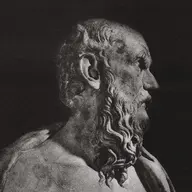
He was the first, say some, to fold his cloak because he was obliged to sleep in it as well, and he carried a wallet to hold his victuals, and he used any place for any purpose, for breakfasting, sleeping, or conversing. And then he would say, pointing to the portico of Zeus and the Hall of Processions, that the Athenians had provided him with places to live in. He did not lean upon a staff until he grew infirm; but afterwards he would carry it everywhere, not indeed in the city, but when walking along the road with it and with his wallet; so say Olympiodorus, once a magistrate at Athens, Polyeuctus the orator, and Lysanias the son of Aeschrio.

The quote: He had written to some one to try and procure a cottage for him. When this man was a long time about it, he took for his abode the tub in the Metroön, as he himself explains in his letters.

And in summer he used to roll in it over hot sand, while in winter he used to embrace statues covered with snow, using every means of inuring himself to hardship. He was great at pouring scorn on his contemporaries. The school of Euclides he called bilious, and Plato’s lectures waste of time, the performances at the Dionysia great peep-shows for fools, and the demagogues the mob’s lacqueys.

Diogenes Laertius, Lives of Eminent Philosophers 6.22–24Translated by R. D. Hicks (1925)Read the full passage (opens scaife.perseus.org)

When, and whose words

Date
by 323 BCE. Undated; before Diogenes' death (323 BCE, as commonly given). Diogenes Laertius wrote around the 3rd century CE.
Whose words
Diogenes Laertius, describing him, centuries later.
How this post was checked
  • The plain-words line was read against the quote alone by a second, independent pass, which found it adds no claim the quote does not make (2026-10-03).
  • Each claim in the summary was checked by an independent pass against only the material it cites.
  • The quote itself is checked by the build: word for word, once, at the cited section of the stored translation.

See it among its momentsMore from DiogenesSee it in the feed