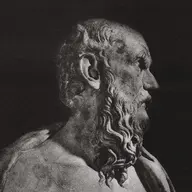
What was going on: Diogenes Laertius, writing centuries later, collects sayings and jokes of Diogenes the Cynic. Here, Plato had defined man as a two-legged animal without feathers and was applauded for it.
He plucked a chicken, brought it to the lecture and said: here's Plato's human. After that, with broad nails was added to the definition.
Diogenes plucked a fowl and brought it into the lecture-room with the words, Here is Plato’s man. In consequence of which there was added to the definition, having broad nails.
As Diogenes Laertius tells it, centuries later. Diogenes Laertius, Lives of Eminent Philosophers 6.40, translated by R. D. Hicks (1925)
What was going on: Diogenes Laertius, writing centuries later, collects stories of Diogenes the Cynic needling Plato, from mocking his trip to Sicily to a joke about shared figs. In this one, Plato's guests have come from Dionysius, and Plato replies that Diogenes shows pride of another sort.
Plato had friends over who came from Dionysius. Diogenes walked all over his carpets: I'm trampling on Plato's vanity.
And one day when Plato had invited to his house friends coming from Dionysius, Diogenes trampled upon his carpets and said, I trample upon Plato’s vainglory.
As Diogenes Laertius tells it, centuries later. Diogenes Laertius, Lives of Eminent Philosophers 6.26, translated by R. D. Hicks (1925)
What was going on: Diogenes Laertius, writing centuries later, passes on a story from Dionysius the Stoic. In 338 BCE Philip of Macedon had just beaten Athens and Thebes at Chaeronea, and Diogenes the Cynic was brought before him as a captive.
Why it matters: The battle has been called one of the most decisive of the ancient world. In its wake the League of Corinth made the Greek states allies of Macedon and of each other, with Philip as guarantor of the peace.
One story, from Dionysius the Stoic: seized and brought to Philip, he was asked who he was. A spy on your endless greed, he said, and was set free.
Dionysius the Stoic says that after Chaeronea he was seized and dragged off to Philip, and being asked who he was, replied, A spy upon your insatiable greed. For this he was admired and set free.
As Diogenes Laertius tells it, centuries later. Diogenes Laertius, Lives of Eminent Philosophers 6.43, translated by R. D. Hicks (1925)
What was going on: As Plutarch tells it, centuries later, the Greeks had just voted Alexander leader of an expedition against Persia. Many came to congratulate him, but Diogenes kept lying in the sun near Corinth, so Alexander went to him and asked if he wanted anything.
Why it matters: Memorable encounters like this one with Alexander made Diogenes a lasting symbol of philosophical defiance of established authority.
Yes: move over a little, you're blocking my sun.
Yes, said Diogenes, stand a little out of my sun.
As Plutarch tells it, centuries later. Plutarch, Life of Alexander 14.2, translated by Bernadotte Perrin (1919)
What was going on: Diogenes Laertius, writing centuries later, records this meeting among many sharp replies by the Cynic. Alexander had become king of Macedon at twenty, in 336 BCE.
Why it matters: In the reign that began here, Alexander had by the age of 30 created one of the largest empires in history, stretching from Greece to northwestern India.
Alexander walked up and said: I am Alexander, the great king. And I, he answered, am Diogenes the Cynic.
Alexander once came and stood opposite him and said, I am Alexander the great king. And I, said he, am Diogenes the Cynic.
As Diogenes Laertius tells it, centuries later. Diogenes Laertius, Lives of Eminent Philosophers 6.60, translated by R. D. Hicks (1925)
What was going on: Diogenes Laertius, writing centuries later, describes how Diogenes the Cynic lived in Athens: sleeping in his folded cloak, carrying his food in a bag, and using any public place to eat, sleep or talk.
Why it matters: Living in a large jar is one of the unconventional habits Diogenes became famous for, and a family and genus of hermit crabs are named after his jar.
He asked someone to find him a small house. It was taking too long, so he moved into the tub at the Metroön instead.
He had written to some one to try and procure a cottage for him. When this man was a long time about it, he took for his abode the tub in the Metroön, as he himself explains in his letters.
Diogenes Laertius, describing him, centuries later. Diogenes Laertius, Lives of Eminent Philosophers 6.23, translated by R. D. Hicks (1925)
What was going on: Diogenes Laertius, writing centuries later, collects stories about how simply Diogenes the Cynic lived. He also says Diogenes threw away his bowl after seeing a child eat lentils from a hollowed piece of bread.
Why it matters: Diogenes famously threw away his cup after watching a boy drink from his hands, one of the stories of a man who practiced asceticism and minimalism.
He saw a child drinking from his hands and threw away his own cup: a child has beaten me at living simply.
One day, observing a child drinking out of his hands, he cast away the cup from his wallet with the words, A child has beaten me in plainness of living.
As Diogenes Laertius tells it, centuries later. Diogenes Laertius, Lives of Eminent Philosophers 6.37, translated by R. D. Hicks (1925)
What was going on: Diogenes Laertius, writing centuries later, strings together anecdotes about Diogenes the Cynic, such as plucking a chicken to mock Plato's definition of man and calling popular leaders the lackeys of the people. This is one more of those stories.
Why it matters: Walking about with a lit lamp in daylight, looking for a man, meaning a wise man, is one of the behaviours that made Diogenes famous for challenging social norms.
He walked around in broad daylight carrying a lit lamp, saying: I'm looking for a human being.
He lit a lamp in broad daylight and said, as he went about, I am looking for a man.
As Diogenes Laertius tells it, centuries later. Diogenes Laertius, Lives of Eminent Philosophers 6.41, translated by R. D. Hicks (1925)
What was going on: Diogenes Laertius, writing centuries later, gives a long run of quick replies he credits to Diogenes. This one comes just after Diogenes says that philosophy taught him to be ready for every kind of fortune.
Why it matters: Diogenes invented an early form of cosmopolitanism, and probably the word itself, which was his one-word answer when asked where he came from.
Asked where he was from, he said: I'm a citizen of the world.
Asked where he came from, he said, I am a citizen of the world.
As Diogenes Laertius tells it, centuries later. Diogenes Laertius, Lives of Eminent Philosophers 6.63, translated by R. D. Hicks (1925)
What was going on: Diogenes Laertius, writing centuries later, strings together sharp replies by Diogenes the Cynic, who mocked musicians, speakers and athletes, and begged for alms when he was poor.
Why it matters: His exile marked a turning point for Diogenes, a moment of profound spiritual conversion, and Plutarch too says its hardships made him a philosopher.
Mocked for being exiled, he said exile is what made him a philosopher. They banished me? I sentenced them to stay home.
When some one reproached him with his exile, his reply was, Nay, it was through that, you miserable fellow, that I came to be a philosopher. Again, when some one reminded him that the people of Sinope had sentenced him to exile, And I them, said he, to home-staying.
As Diogenes Laertius tells it, centuries later. Diogenes Laertius, Lives of Eminent Philosophers 6.49, translated by R. D. Hicks (1925)
What was going on: Diogenes Laertius, writing centuries later, says Diogenes was captured by pirates on a voyage to Aegina, taken to Crete and put up for sale as a slave. His buyer, Xeniades, later put him in charge of his children and household in Corinth.
At the auction, asked what he was good at, he said: ruling people. Then he pointed at a man in a fine purple-bordered robe: sell me to him, he needs a master.
When the auctioneer asked in what he was proficient, he replied, In ruling men. Thereupon he pointed to a certain Corinthian with a fine purple border to his robe, the man named Xeniades above-mentioned, and said, Sell me to this man; he needs a master.
As Diogenes Laertius tells it, centuries later. Diogenes Laertius, Lives of Eminent Philosophers 6.74, translated by R. D. Hicks (1925)
What was going on: Diogenes Laertius, writing centuries later, collects sayings of Diogenes the Cynic, and this reply comes from late in his life. Stories nearby have him walking barefoot on snow, trying to eat raw meat, and mocking the orator Demosthenes.
Told he was old and should rest, he said: if I were running a race, would I slow down near the finish? Shouldn't I speed up?
To those who said to him, You are an old man; take a rest, What? he replied, if I were running in the stadium, ought I to slacken my pace when approaching the goal? ought I not rather to put on speed?
As Diogenes Laertius tells it, centuries later. Diogenes Laertius, Lives of Eminent Philosophers 6.34, translated by R. D. Hicks (1925)
What was going on: Diogenes Laertius, writing centuries later, collects one-line replies by Diogenes the Cynic. He says Diogenes at first begged for alms because he was poor.
He asked a statue for money. Why? To get practice at being turned down.
He once begged alms of a statue, and, when asked why he did so, replied, To get practice in being refused.
As Diogenes Laertius tells it, centuries later. Diogenes Laertius, Lives of Eminent Philosophers 6.49, translated by R. D. Hicks (1925)