hstry

Diogenes sold as a slave

by 323 BCE, Crete. As Diogenes Laertius tells it, centuries later.

Where and when

by 323 BCECrete

about 2,348 years ago

Explore
Diogenes, c. 412 – 323 BCE3000 BCE2900 BCE2800 BCE2700 BCE2600 BCE2500 BCE2400 BCE2300 BCE2200 BCE2100 BCE2000 BCE1900 BCE1800 BCE1700 BCE1600 BCE1500 BCE1400 BCE1300 BCE1200 BCE1100 BCE1000 BCE900 BCE800 BCE700 BCE600 BCE500 BCE400 BCE300 BCE200 BCE100 BCE1 CE100 CE200 CE300 CE400 CE500 CE600 CE700 CE800 CE900 CE1000 CE1100 CE1200 CE1300 CE1400 CE1500 CE1600 CE1700 CE1800 CE1900 CE2000 CEGreat Pyramid of Giza built, c. 2600 BCERome founded (traditional date), 753 BCELast western Roman emperor deposed, 476 CEGutenberg's printing press, c. 1440 CEColumbus reaches the Americas, 1492 CEFirst people on the Moon, 1969 CEToday, 2026

Swipe the line. Bars: entries. Dots: events.

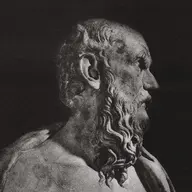
Diogenes

, CreteAs Diogenes Laertius tells it, centuries later

In plain words, ours

At the auction, asked what he was good at, he said: ruling people. Then he pointed at a man in a fine purple-bordered robe: sell me to him, he needs a master.

When the auctioneer asked in what he was proficient, he replied, In ruling men. Thereupon he pointed to a certain Corinthian with a fine purple border to his robe, the man named Xeniades above-mentioned, and said, Sell me to this man; he needs a master.

Diogenes Laertius, Lives of Eminent Philosophers 6.74Translated by R. D. Hicks (1925)Read the full passage (Diogenes Laertius, Lives of Eminent Philosophers 6.74, opens scaife.perseus.org)

What was going on, our summary

Diogenes Laertius, writing centuries later, says Diogenes was captured by pirates on a voyage to Aegina, taken to Crete and put up for sale as a slave. His buyer, Xeniades, later put him in charge of his children and household in Corinth.

Checked claim by claim against: the passage around the quote.

Related moments

In time order, with this one in its place. Each says why it is here.

  1. 323 BCE0.5 years earlier Alexander dies in Babylon Same years
  2. c. 324–321 BCEDuring it Diogenes the Cynic dies in Corinth Same years
  3. by 323 BCEThis momentDiogenes sold as a slave
  4. by 323 BCEBy this year Diogenes throws away his cup More from Diogenes
  5. by 323 BCEBy this year Diogenes searches for a man with a lamp More from Diogenes
  6. by 323 BCEBy this year Diogenes makes a tub his home More from Diogenes
  7. 322 BCE1 year later Aristotle dies at Chalcis Same years

Just before and after

The text around the quote, word for word from the same translation.

Show the passageHide the passage

This he makes plain in the Thyestes, if the tragedies are really his and not the work of his friend Philiscus of Aegina or of Pasiphon, the son of Lucian, who according to Favorinus in his Miscellaneous History wrote them after the death of Diogenes. He held that we should neglect music, geometry, astronomy, and the like studies, as useless and unnecessary. He became very ready also at repartee in verbal debates, as is evident from what has been said above. Further, when he was sold as a slave, he endured it most nobly. For on a voyage to Aegina he was captured by pirates under the command of Scirpalus, conveyed to Crete and exposed for sale.

The quote: When the auctioneer asked in what he was proficient, he replied, In ruling men. Thereupon he pointed to a certain Corinthian with a fine purple border to his robe, the man named Xeniades above-mentioned, and said, Sell me to this man; he needs a master.

Thus Xeniades came to buy him, and took him to Corinth and set him over his own children and entrusted his whole household to him. And he administered it in all respects in such a manner that Xeniades used to go about saying, A good genius has entered my house.

Diogenes Laertius, Lives of Eminent Philosophers 6.73–74Translated by R. D. Hicks (1925)Read the full passage (opens scaife.perseus.org)

When, and whose words

Date
by 323 BCE. Undated; before Diogenes' death (323 BCE, as commonly given). Diogenes Laertius wrote around the 3rd century CE.
Whose words
As Diogenes Laertius tells it, centuries later.
How this post was checked
  • The plain-words line was read against the quote alone by a second, independent pass, which found it adds no claim the quote does not make (2026-10-03).
  • Each claim in the summary was checked by an independent pass against only the material it cites.
  • The quote itself is checked by the build: word for word, once, at the cited section of the stored translation.

See it among its momentsMore from DiogenesSee it in the feed