hstry

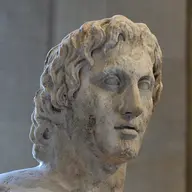
Diogenes meets Alexander

336–323 BCE. As Diogenes Laertius tells it, centuries later.

Where and when

336–323 BCEAthens and the Greek world

about 2,355 years ago

Explore
Diogenes, c. 412 – 323 BCE3000 BCE2900 BCE2800 BCE2700 BCE2600 BCE2500 BCE2400 BCE2300 BCE2200 BCE2100 BCE2000 BCE1900 BCE1800 BCE1700 BCE1600 BCE1500 BCE1400 BCE1300 BCE1200 BCE1100 BCE1000 BCE900 BCE800 BCE700 BCE600 BCE500 BCE400 BCE300 BCE200 BCE100 BCE1 CE100 CE200 CE300 CE400 CE500 CE600 CE700 CE800 CE900 CE1000 CE1100 CE1200 CE1300 CE1400 CE1500 CE1600 CE1700 CE1800 CE1900 CE2000 CEGreat Pyramid of Giza built, c. 2600 BCERome founded (traditional date), 753 BCELast western Roman emperor deposed, 476 CEGutenberg's printing press, c. 1440 CEColumbus reaches the Americas, 1492 CEFirst people on the Moon, 1969 CEToday, 2026sometime in these 13 years

Swipe the line. Bars: entries. Dots: events.

Diogenes

As Diogenes Laertius tells it, centuries later

In plain words, ours

Alexander walked up and said: I am Alexander, the great king. And I, he answered, am Diogenes the Cynic.

Alexander once came and stood opposite him and said, I am Alexander the great king. And I, said he, am Diogenes the Cynic.

Diogenes Laertius, Lives of Eminent Philosophers 6.60Translated by R. D. Hicks (1925)Read the full passage (Diogenes Laertius, Lives of Eminent Philosophers 6.60, opens scaife.perseus.org)

What was going on, our summary

Diogenes Laertius, writing centuries later, records this meeting among many sharp replies by the Cynic. Alexander had become king of Macedon at twenty, in 336 BCE.

Checked claim by claim against: Alexander becomes king of Macedon at twenty, the passage around the quote.

Why it matters

About the event it belongs to: Alexander becomes king of Macedon at twenty

In the reign that began here, Alexander had by the age of 30 created one of the largest empires in history, stretching from Greece to northwestern India.

Based on Wikipedia: Alexander the Great

Alexander spent most of his reign conducting a lengthy military campaign throughout Asia and Egypt, and by the age of 30, he had created one of the largest empires in history, stretching from Greece to northwestern India.

Wikipedia, Alexander the Great (opens en.wikipedia.org), as of 2026-10-03. Text CC BY-SA 4.0. Our line is checked against these sentences only.

Related moments

In time order, with this one in its place. Each says why it is here.

  1. 336 BCEabout 6 years earlier Alexander becomes king of Macedon at twenty The event behind it
  2. c. 336 BCEabout 6 years earlier Diogenes asks Alexander to step out of his sun More from Diogenes
  3. 335/334 BCEabout 5 years earlier Aristotle opens his school at the Lyceum Same years
  4. 336–323 BCEThis momentDiogenes meets Alexander
  5. 334–323 BCEDuring it Alexander writes to Aristotle Same years
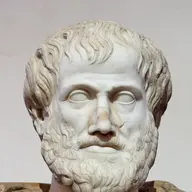
  6. c. 335–322 BCEDuring it Aristotle on one swallow and happiness Same years
  7. by 323 BCEabout 7 years later Diogenes begs from a statue Same passage
  8. by 323 BCEabout 7 years later Diogenes throws away his cup More from Diogenes
  9. by 323 BCEabout 7 years later Diogenes, citizen of the world Same passage
  10. by 323 BCEabout 7 years later Diogenes makes a tub his home More from Diogenes

Just before and after

The text around the quote, word for word from the same translation.

Show the passageHide the passage

When he came back and said next day, I went and am none the worse for it, Diogenes said, Not Worse-man (Chiron), but Lax-man (Eurytion). He was asking alms of a bad-tempered man, who said, Yes, if you can persuade me. If I could have persuaded you, said Diogenes, I would have persuaded you to hang yourself. He was returning from Lacedaemon to Athens; and on some one asking, Whither and whence? he replied, From the men’s apartments to the women’s. He was returning from Olympia, and when somebody inquired whether there was a great crowd, Yes, he said, a great crowd, but few who could be called men. Libertines he compared to figtrees growing upon a cliff: whose fruit is not enjoyed by any man, but is eaten by ravens and vultures. When Phryne set up a golden statue of Aphrodite in Delphi, Diogenes is said to have written upon it: From the licentiousness of Greece.

The quote: Alexander once came and stood opposite him and said, I am Alexander the great king. And I, said he, am Diogenes the Cynic.

Being asked what he had done to be called a hound, he said, I fawn on those who give me anything, I yelp at those who refuse, and I set my teeth in rascals. He was gathering figs, and was told by the keeper that not long before a man had hanged himself on that very fig-tree. Then, said he, I will now purge it. Seeing an Olympian victor casting repeated glances at a courtesan, See, he said, yonder ram frenzied for battle, how he is held fast by the neck fascinated by a common minx. Handsome courtesans he would compare to a deadly honeyed potion.

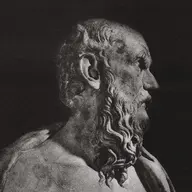
Diogenes Laertius, Lives of Eminent Philosophers 6.59–61Translated by R. D. Hicks (1925)Read the full passage (opens scaife.perseus.org)

When, and whose words

Date
336–323 BCE. Alexander calls himself king, so after he took the throne (336 BCE) and before both men died (323 BCE). Diogenes Laertius wrote around the 3rd century CE.
Whose words
As Diogenes Laertius tells it, centuries later.
How this post was checked
  • The plain-words line was read against the quote alone by a second, independent pass, which found it adds no claim the quote does not make (2026-10-03).
  • Each claim in the summary was checked by an independent pass against only the material it cites.
  • The quote itself is checked by the build: word for word, once, at the cited section of the stored translation.

See it among its momentsMore from DiogenesSee it in the feed