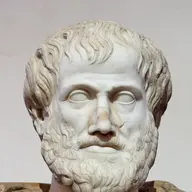
What was going on: Aristotle, teaching at the Lyceum in Athens, is sketching in his Ethics what the good is for a person. He calls this a rough outline, to be filled in with details later.
Why it matters: The Lyceum is best known for the Peripatetic school Aristotle founded there. It carried on under a series of leaders after his lifetime until Sulla destroyed it in 86 BC.
Happiness takes a whole life. One swallow doesn't make spring, and one good day or a short good spell doesn't make you truly happy.
Moreover, to be happy takes a complete lifetime; for one swallow does not make spring, nor does one fine day; and similarly one day or a brief period of happiness does not make a man supremely blessed and happy.
His own words, in the Nicomachean Ethics. Aristotle, Nicomachean Ethics 1.7.16, translated by H. Rackham (1926)
What was going on: In the Nicomachean Ethics, Aristotle is explaining where good character comes from. He argues that nature only gives us the ability, and that we gain virtues by practising them, the same way people learn a craft. Lawgivers, he adds, try to train citizens into good habits.
You become a builder by building and a harpist by playing. In the same way you become fair, self-controlled or brave by acting that way.
…men become builders by building houses, harpers by playing on the harp. Similarly we become just by doing just acts, temperate by doing temperate acts, brave by doing brave acts.
His own words, in the Nicomachean Ethics. Aristotle, Nicomachean Ethics 2.1.4, translated by H. Rackham (1926)
What was going on: In his Nicomachean Ethics, Aristotle has just argued that good character is a middle point between two faults, one of too much and one of too little. That, he says, is why being good is hard, like finding the center of a circle.
Anyone can get angry or spend money. Doing it with the right person, the right amount, at the right time, for the right reason, the right way: that's hard.
So also anybody can become angry—that is easy, and so it is to give and spend money; but to be angry with or give money to the right person, and to the right amount, and at the right time, and for the right purpose, and in the right way—this is not within everybody’s power and is not easy;
His own words, in the Nicomachean Ethics. Aristotle, Nicomachean Ethics 2.9.2, translated by H. Rackham (1926)
What was going on: In the Nicomachean Ethics, Aristotle has just finished discussing pleasure, pain and self-control. This line opens his discussion of friendship, which he goes on to apply to the rich, to rulers and to the poor.
Friendship is a virtue, or comes with one, and life can't do without it. No one would pick a life with every other good thing but no friends.
For friendship is a virtue, or involves virtue; and also it is one of the most indispensable requirements of life. For no one would choose to live without friends, but possessing all other good things.
His own words, in the Nicomachean Ethics. Aristotle, Nicomachean Ethics 8.1.1, translated by H. Rackham (1926)
What was going on: In his Ethics, Aristotle is discussing friendship between good people, which he says is the fullest kind and rare, because such people are few. He adds that you cannot really be friends until each has shown the other he is worthy and won his trust.
They take time and closeness. As the saying goes, you can't know someone until you've eaten a lot of salt together.
Moreover they require time and intimacy: as the saying goes, you cannot get to know a man till you have consumed the proverbial amount of salt in his company;
His own words, in the Nicomachean Ethics. Aristotle, Nicomachean Ethics 8.3.8, translated by H. Rackham (1926)
What was going on: In the Nicomachean Ethics, Aristotle is asking what happiness really is. He has just argued that it is not found in amusements, and goes on to say that play is a kind of rest, which we need only so we can get back to work.
It would be strange if fun were the point of life, if we worked hard our whole lives just so we could be entertained.
Indeed it would be strange that amusement should be our End—that we should toil and moil all our life long in order that we may amuse ourselves.
His own words, in the Nicomachean Ethics. Aristotle, Nicomachean Ethics 10.6.6, translated by H. Rackham (1926)
What was going on: In his Nicomachean Ethics, Aristotle is searching for the highest good. He has set aside the life of money-making, and next takes on the Theory of Ideas, arguing there cannot be one single Idea of Good.
Why it matters: The line comes from a famous digression in which Aristotle appears to question his friends who introduced the forms, meaning Plato and his school.
Questioning this theory feels wrong, because its authors are our friends. But both friends and truth are dear to us, and our duty is to put truth first.
But perhaps it is desirable that we should examine the notion of a Universal Good, and review the difficulties that it involves, although such an inquiry goes against the grain because of our friendship for the authors of the Theory of Ideas. Still perhaps it would appear desirable, and indeed it would seem to be obligatory, especially for a philosopher, to sacrifice even one’s closest personal ties in defense of the truth. Both are dear to us, yet ’tis our duty to prefer the truth.
His own words, in the Nicomachean Ethics. Aristotle, Nicomachean Ethics 1.6.1, translated by H. Rackham (1926)
What was going on: In the Politics, Aristotle explains how villages join together to form a city. He argues a city is first founded so people can live, and continues so they can live happily.
Why it matters: Aristotle's statement that man is by nature a political animal is a famous one, made in the Politics, where he treated the city as a natural community.
The city grows out of nature, and humans are by nature political animals. Someone unfit for society by nature is either less or more than human.
Hence it is evident that a city is a natural production, and that man is naturally a political animal, and that whosoever is naturally and not accidentally unfit for society, must be either inferior or superior to man:
His own words, in the Politics. Aristotle, Politics 1.2, translated by William Ellis (1912)
What was going on: In his Politics, Aristotle is arguing that the city comes before the individual, the way a whole body comes before a hand or a foot. No single person, he says, is enough on their own to make a complete state.
Someone who can't live with others, or needs no one at all, is no part of a city. They're a beast or a god.
…but he that is incapable of society, or so complete in himself as not to want it, makes no part of a city, as a beast or a god.
His own words, in the Politics. Aristotle, Politics 1.2, translated by William Ellis (1912)
What was going on: In the Politics, Aristotle is weighing who should hold supreme power in a state: the many, or the few best people. He argues that even if no single person among the many is fit to rule, together they may do better, just as a shared public supper can beat one paid for by a single host.
When many people come together, each brings some goodness and sense. Together they're like one person with many feet, hands and minds.
…for, as they are many, each person brings in his share of virtue and wisdom; and thus, coming together, they are like one man made up of a multitude, with many feet, many hands, and many intelligences:
His own words, in the Politics. Aristotle, Politics 3.11, translated by William Ellis (1912)
What was going on: In his Politics, Aristotle is arguing against a proposal that citizens should have wives and children in common. He says that if every child were everyone's child, all of them would be neglected.
What belongs to everyone gets looked after least. People care more about what's theirs than what they share, and neglect the shared things.
…for what is common to many is taken least care of; for all men regard more what is their own than what others share with them in, to which they pay less attention than is incumbent on every one:
His own words, in the Politics. Aristotle, Politics 2.3, translated by William Ellis (1912)
What was going on: In the Politics, Aristotle is weighing the plan in Plato's Republic, where Socrates says citizens should hold wives, children and goods in common. Aristotle doubts the plan is reasonable or could work.
I agree with Socrates that a city should be as united as it can be. But squeeze it too far and it stops being a city: it shrinks to a family, then one person.
Now I also am willing to agree with Socrates in the principle which he proceeds upon, and admit that the city ought to be one as much as possible; and yet it is evident that if it is contracted too much, it will be no longer a city, for that necessarily supposes a multitude; so that if we proceed in this manner, we shall reduce a city to a family, and a family to a single person:
His own words, in the Politics. Aristotle, Politics 2.2, translated by William Ellis (1912)
What was going on: In the Poetics, Aristotle compares tragedy with epic poetry: tragedy tries to keep its story within about one day, while epic has no time limit. Here he gives his formal definition of tragedy, then explains its terms, such as song and spectacle.
Why it matters: The definition comes from the Poetics, the earliest surviving work of Greek dramatic theory and the first extant philosophical treatise to focus solely on literary theory.
One common reading: a tragedy acts out a serious, complete story in fine language, and through pity and fear it releases those very feelings.
Tragedy, then, is an imitation of an action that is serious, complete, and of a certain magnitude; in language embellished with each kind of artistic ornament, the several kinds being found in separate parts of the play; in the form of action, not of narrative; through pity and fear effecting the proper purgation of these emotions.
His own words, in the Poetics. Aristotle, Poetics 6, translated by S. H. Butcher (1895)
What was going on: In the Poetics, Aristotle is explaining how a poet differs from a historian. He says the difference is not verse or prose, since the work of Herodotus put into verse would still be history: history tells what has happened, poetry what may happen.
Why it matters: The contrast between poetry and history is a famous distinction of Aristotle's; he concluded that poetry was more philosophical than history in so far as it approximates a knowledge of universals.
Poetry is deeper and higher than history: poetry tends to say what's true in general, history what happened in one case.
Poetry, therefore, is a more philosophical and a higher thing than history: for poetry tends to express the universal, history the particular.
His own words, in the Poetics. Aristotle, Poetics 9, translated by S. H. Butcher (1895)
What was going on: In his Poetics, Aristotle is listing ways a poet can answer critics, for example when a description seems impossible or not true to fact.
If a poem isn't true to life, the poet might say it shows things as they should be. Sophocles said he drew people as they should be; Euripides, as they are.
Further, if it be objected that the description is not true to fact, the poet may perhaps reply,--'But the objects are as they ought to be': just as Sophocles said that he drew men as they ought to be; Euripides, as they are.
His own words, in the Poetics. Aristotle, Poetics 25, translated by S. H. Butcher (1895)
What was going on: In the Poetics, Aristotle is discussing how a poet chooses words: compound words, rare words and metaphors, and which kind suits which type of poetry.
The greatest gift by far is a talent for metaphor. No one can teach it; it marks genius, because good metaphors need an eye for likenesses.
But the greatest thing by far is to have a command of metaphor. This alone cannot be imparted by another; it is the mark of genius, for to make good metaphors implies an eye for resemblances.
His own words, in the Poetics. Aristotle, Poetics 22, translated by S. H. Butcher (1895)