hstry

Aristotle puts truth before friends

c. 335–322 BCE, Athens (Lyceum). His own words, in the Nicomachean Ethics.

Where and when

c. 335–322 BCEAthens (Lyceum)

about 2,353 years ago

Explore
Aristotle, 384 – 322 BCE3000 BCE2900 BCE2800 BCE2700 BCE2600 BCE2500 BCE2400 BCE2300 BCE2200 BCE2100 BCE2000 BCE1900 BCE1800 BCE1700 BCE1600 BCE1500 BCE1400 BCE1300 BCE1200 BCE1100 BCE1000 BCE900 BCE800 BCE700 BCE600 BCE500 BCE400 BCE300 BCE200 BCE100 BCE1 CE100 CE200 CE300 CE400 CE500 CE600 CE700 CE800 CE900 CE1000 CE1100 CE1200 CE1300 CE1400 CE1500 CE1600 CE1700 CE1800 CE1900 CE2000 CEGreat Pyramid of Giza built, c. 2600 BCERome founded (traditional date), 753 BCELast western Roman emperor deposed, 476 CEGutenberg's printing press, c. 1440 CEColumbus reaches the Americas, 1492 CEFirst people on the Moon, 1969 CEToday, 2026sometime in these 13 years

Swipe the line. Bars: entries. Dots: events.

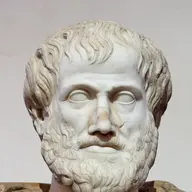
Aristotle

, Athens (Lyceum)His own words, in the Nicomachean Ethics
Answering Socrates, as Plato tells it, set in 399 BCEIf anyone tells me that what makes a thing beautiful is its lovely color, or its shape or anything else of the sort, I let all that go, for all those things confuse me,…

How we know they are linked: Aristotle answers the Theory of Ideas (the Forms) and credits it to friends of his, not by name; it is Plato's theory, which Plato's Socrates voices in the Phaedo.

In plain words, ours

Questioning this theory feels wrong, because its authors are our friends. But both friends and truth are dear to us, and our duty is to put truth first.

But perhaps it is desirable that we should examine the notion of a Universal Good, and review the difficulties that it involves, although such an inquiry goes against the grain because of our friendship for the authors of the Theory of Ideas. Still perhaps it would appear desirable, and indeed it would seem to be obligatory, especially for a philosopher, to sacrifice even one’s closest personal ties in defense of the truth. Both are dear to us, yet ’tis our duty to prefer the truth.

Aristotle, Nicomachean Ethics 1.6.1Translated by H. Rackham (1926)Read the full passage (Aristotle, Nicomachean Ethics 1.6.1, opens scaife.perseus.org)

What was going on, our summary

In his Nicomachean Ethics, Aristotle is searching for the highest good. He has set aside the life of money-making, and next takes on the Theory of Ideas, arguing there cannot be one single Idea of Good.

Checked claim by claim against: the passage around the quote.

Why it matters

The line comes from a famous digression in which Aristotle appears to question his friends who introduced the forms, meaning Plato and his school.

Based on Wikipedia: Nicomachean Ethics

I.6 contains a famous digression in which Aristotle appears to question his "friends" who "introduced the forms".

This refers to Plato and his school, and their Theory of Forms.

Wikipedia, Nicomachean Ethics (opens en.wikipedia.org), as of 2026-09-27. Text CC BY-SA 4.0. Our line is checked against these sentences only.

Related moments

In time order, with this one in its place. Each says why it is here.

  1. set in 416 BCEabout 88 years earlier Socrates on Love as the best helper Also about friendship and love
  2. by 399 BCEabout 71 years earlier Aspasia on honest matchmaking Also about friendship and love
  3. set in 399 BCEabout 71 years earlier Socrates on what makes things beautiful Answering Socrates
  4. by 348 BCEabout 20 years earlier Plato defines man as a featherless biped Also about knowing and not knowing
  5. c. 348/347 BCEabout 19.5 years earlier Plato dies, aged about eighty Also in Athens
  6. 335/334 BCEabout 7 years earlier Aristotle opens his school at the Lyceum Also in Athens
  7. 336–323 BCEDuring it Diogenes meets Alexander Same years
  8. 334–323 BCEDuring it Alexander writes to Aristotle Also about knowing and not knowing
  9. c. 335–322 BCEThis momentAristotle puts truth before friends
  10. c. 335–322 BCEDuring it Aristotle on being angry the right way More from Aristotle
  11. c. 335–322 BCEDuring it Aristotle on becoming just by just acts More from Aristotle
  12. c. 335–322 BCEDuring it Aristotle on one swallow and happiness More from Aristotle
  13. 323 BCEabout 4.5 years later Alexander dies in Babylon Same years
  14. c. 324–321 BCEabout 5 years later Diogenes the Cynic dies in Corinth Same years
  15. by 323 BCEabout 5 years later Diogenes makes a tub his home Also in Athens

Just before and after

The text around the quote, word for word from the same translation.

Show the passageHide the passage

But we need not pursue this subject, since it has been sufficiently treated in the ordinary discussions. The third type of life is the Life of Contemplation, which we shall consider in the sequel. The Life of Money-making is a constrained kind of life, and clearly wealth is not the Good we are in search of, for it is only good as being useful, a means to something else. On this score indeed one might conceive the ends before mentioned to have a better claim, for they are approved for their own sakes. But even they do not really seem to be the Supreme Good; however, many arguments against them have been disseminated, so we may dismiss them.

The quote: But perhaps it is desirable that we should examine the notion of a Universal Good, and review the difficulties that it involves, although such an inquiry goes against the grain because of our friendship for the authors of the Theory of Ideas. Still perhaps it would appear desirable, and indeed it would seem to be obligatory, especially for a philosopher, to sacrifice even one’s closest personal ties in defense of the truth. Both are dear to us, yet ’tis our duty to prefer the truth.

The originators of this theory, then, used not to postulate Ideas of groups of things in which they posited an order of priority and posteriority (for which reason they did not construct an Idea of numbers in general). But Good is predicated alike in the Categories of Substance, of Quality, and Relation; yet the Absolute, or Substance, is prior in nature to the Relative, which seems to be a sort of offshoot or accident of Substance; so that there cannot be a common Idea corresponding to the absolutely good and the relatively good.

Aristotle, Nicomachean Ethics 1.5.6–1.6.2Translated by H. Rackham (1926)Read the full passage (opens scaife.perseus.org)

When, and whose words

Date
c. 335–322 BCE. His works are hard to date; they are usually placed in his Lyceum years in Athens, 335–322 BCE.
Whose words
His own words, in the Nicomachean Ethics. Who was Aristotle?
How this post was checked
  • The plain-words line was read against the quote alone by a second, independent pass, which found it adds no claim the quote does not make (2026-10-03).
  • Each claim in the summary was checked by an independent pass against only the material it cites.
  • The quote itself is checked by the build: word for word, once, at the cited section of the stored translation.

See it among its momentsMore from AristotleSee it in the feed