hstry

Aristotle on man as a political animal

c. 335–322 BCE, Athens (Lyceum). His own words, in the Politics.

Where and when

c. 335–322 BCEAthens (Lyceum)

about 2,353 years ago

Explore
Aristotle, 384 – 322 BCE3000 BCE2900 BCE2800 BCE2700 BCE2600 BCE2500 BCE2400 BCE2300 BCE2200 BCE2100 BCE2000 BCE1900 BCE1800 BCE1700 BCE1600 BCE1500 BCE1400 BCE1300 BCE1200 BCE1100 BCE1000 BCE900 BCE800 BCE700 BCE600 BCE500 BCE400 BCE300 BCE200 BCE100 BCE1 CE100 CE200 CE300 CE400 CE500 CE600 CE700 CE800 CE900 CE1000 CE1100 CE1200 CE1300 CE1400 CE1500 CE1600 CE1700 CE1800 CE1900 CE2000 CEGreat Pyramid of Giza built, c. 2600 BCERome founded (traditional date), 753 BCELast western Roman emperor deposed, 476 CEGutenberg's printing press, c. 1440 CEColumbus reaches the Americas, 1492 CEFirst people on the Moon, 1969 CEToday, 2026sometime in these 13 years

Swipe the line. Bars: entries. Dots: events.

Aristotle

, Athens (Lyceum)His own words, in the Politics

In plain words, ours

The city grows out of nature, and humans are by nature political animals. Someone unfit for society by nature is either less or more than human.

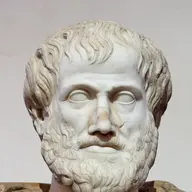
Hence it is evident that a city is a natural production, and that man is naturally a political animal, and that whosoever is naturally and not accidentally unfit for society, must be either inferior or superior to man:

Aristotle, Politics 1.2Translated by William Ellis (1912)Read the full passage (Aristotle, Politics 1.2, opens gutenberg.org)

What was going on, our summary

In the Politics, Aristotle explains how villages join together to form a city. He argues a city is first founded so people can live, and continues so they can live happily.

Checked claim by claim against: the passage around the quote.

Why it matters

Aristotle's statement that man is by nature a political animal is a famous one, made in the Politics, where he treated the city as a natural community.

Based on Wikipedia: Aristotle

He famously stated that "man is by nature a political animal" and argued that humanity's defining factor among others in the animal kingdom is its rationality.

Aristotle considered the city to be a natural community.

Wikipedia, Aristotle (opens en.wikipedia.org), as of 2026-09-17. Text CC BY-SA 4.0. Our line is checked against these sentences only.

Related moments

In time order, with this one in its place. Each says why it is here.

  1. c. 348/347 BCEabout 19.5 years earlier Plato dies, aged about eighty Also in Athens
  2. 335/334 BCEabout 7 years earlier Aristotle opens his school at the Lyceum Also in Athens
  3. 336–323 BCEDuring it Diogenes meets Alexander Same years
  4. 334–323 BCEDuring it Alexander writes to Aristotle Same years
  5. c. 335–322 BCEThis momentAristotle on man as a political animal
  6. c. 335–322 BCEDuring it Aristotle on being angry the right way More from Aristotle
  7. c. 335–322 BCEDuring it Aristotle on the one who lives outside the city Same passage
  8. c. 335–322 BCEDuring it Aristotle on becoming just by just acts More from Aristotle
  9. c. 335–322 BCEDuring it Aristotle on one swallow and happiness More from Aristotle
  10. 323 BCEabout 4.5 years later Alexander dies in Babylon Same years
  11. c. 324–321 BCEabout 5 years later Diogenes the Cynic dies in Corinth Same years
  12. by 323 BCEabout 5 years later Diogenes makes a tub his home Also in Athens

Just before and after

The text around the quote, word for word from the same translation.

Show the passageHide the passage

And when many villages so entirely join themselves together as in every respect to form but one society, that society is a city, and contains in itself, if I may so speak, the end and perfection of government: first founded that we might live, but continued that we may live happily. For which reason every city must be allowed to be the work of nature, if we admit that the original society between male and female is; for to this as their end all subordinate societies tend, and the end of everything is the nature of it. For what every being is in its most perfect state, that certainly is the nature of that being, whether it be a man, a horse, or a house: besides, whatsoever produces the final cause and the end which we [1253a] desire, must be best; but a government complete in itself is that final cause and what is best.

The quote: Hence it is evident that a city is a natural production, and that man is naturally a political animal, and that whosoever is naturally and not accidentally unfit for society, must be either inferior or superior to man:

thus the man in Homer, who is reviled for being "without society, without law, without family." Such a one must naturally be of a quarrelsome disposition, and as solitary as the birds. The gift of speech also evidently proves that man is a more social animal than the bees, or any of the herding cattle: for nature, as we say, does nothing in vain, and man is the only animal who enjoys it.

Aristotle, Politics 1.2Translated by William Ellis (1912)Read the full passage (opens gutenberg.org)

When, and whose words

Date
c. 335–322 BCE. His works are hard to date; they are usually placed in his Lyceum years in Athens, 335–322 BCE.
Whose words
His own words, in the Politics. Who was Aristotle?
How this post was checked
  • The plain-words line was read against the quote alone by a second, independent pass, which found it adds no claim the quote does not make (2026-10-03).
  • Each claim in the summary was checked by an independent pass against only the material it cites.
  • The quote itself is checked by the build: word for word, once, at the cited section of the stored translation.

See it among its momentsMore from AristotleSee it in the feed