hstry

Aristotle on poetry and history

c. 335–322 BCE, Athens (Lyceum). His own words, in the Poetics.

Where and when

c. 335–322 BCEAthens (Lyceum)

about 2,353 years ago

Explore
Aristotle, 384 – 322 BCE3000 BCE2900 BCE2800 BCE2700 BCE2600 BCE2500 BCE2400 BCE2300 BCE2200 BCE2100 BCE2000 BCE1900 BCE1800 BCE1700 BCE1600 BCE1500 BCE1400 BCE1300 BCE1200 BCE1100 BCE1000 BCE900 BCE800 BCE700 BCE600 BCE500 BCE400 BCE300 BCE200 BCE100 BCE1 CE100 CE200 CE300 CE400 CE500 CE600 CE700 CE800 CE900 CE1000 CE1100 CE1200 CE1300 CE1400 CE1500 CE1600 CE1700 CE1800 CE1900 CE2000 CEGreat Pyramid of Giza built, c. 2600 BCERome founded (traditional date), 753 BCELast western Roman emperor deposed, 476 CEGutenberg's printing press, c. 1440 CEColumbus reaches the Americas, 1492 CEFirst people on the Moon, 1969 CEToday, 2026sometime in these 13 years

Swipe the line. Bars: entries. Dots: events.

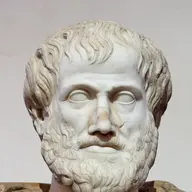
Aristotle

, Athens (Lyceum)His own words, in the Poetics

In plain words, ours

Poetry is deeper and higher than history: poetry tends to say what's true in general, history what happened in one case.

Poetry, therefore, is a more philosophical and a higher thing than history: for poetry tends to express the universal, history the particular.

Aristotle, Poetics 9Translated by S. H. Butcher (1895)Read the full passage (Aristotle, Poetics 9, opens gutenberg.org)

What was going on, our summary

In the Poetics, Aristotle is explaining how a poet differs from a historian. He says the difference is not verse or prose, since the work of Herodotus put into verse would still be history: history tells what has happened, poetry what may happen.

Checked claim by claim against: the passage around the quote.

Why it matters

The contrast between poetry and history is a famous distinction of Aristotle's; he concluded that poetry was more philosophical than history in so far as it approximates a knowledge of universals.

Based on Wikipedia: Poetics (Aristotle)

Aristotle also draws a famous distinction between the tragic mode of poetry and the type of history-writing practiced among the Greeks.

In this sense, he concluded, such poetry was more philosophical than history was in so far as it approximates a knowledge of universals.

Wikipedia, Poetics (Aristotle) (opens en.wikipedia.org), as of 2026-07-30. Text CC BY-SA 4.0. Our line is checked against these sentences only.

Related moments

In time order, with this one in its place. Each says why it is here.

  1. c. 431–400 BCEabout 87 years earlier Thucydides on how he wrote the speeches Also about how history gets told
  2. by 348 BCEabout 20 years earlier Plato's Second Letter on writing nothing down Also about how history gets told
  3. c. 348/347 BCEabout 19.5 years earlier Plato dies, aged about eighty Also in Athens
  4. 335/334 BCEabout 7 years earlier Aristotle opens his school at the Lyceum Also in Athens
  5. 336–323 BCEDuring it Diogenes meets Alexander Same years
  6. 334–323 BCEDuring it Alexander writes to Aristotle Same years
  7. c. 335–322 BCEThis momentAristotle on poetry and history
  8. c. 335–322 BCEDuring it Aristotle on being angry the right way More from Aristotle
  9. c. 335–322 BCEDuring it Aristotle on becoming just by just acts More from Aristotle
  10. c. 335–322 BCEDuring it Aristotle on one swallow and happiness More from Aristotle
  11. 323 BCEabout 4.5 years later Alexander dies in Babylon Same years
  12. c. 324–321 BCEabout 5 years later Diogenes the Cynic dies in Corinth Same years
  13. by 323 BCEabout 5 years later Diogenes makes a tub his home Also in Athens

Just before and after

The text around the quote, word for word from the same translation.

Show the passageHide the passage

For a thing whose presence or absence makes no visible difference, is not an organic part of the whole. It is, moreover, evident from what has been said, that it is not the function of the poet to relate what has happened, but what may happen,--what is possible according to the law of probability or necessity. The poet and the historian differ not by writing in verse or in prose. The work of Herodotus might be put into verse, and it would still be a species of history, with metre no less than without it. The true difference is that one relates what has happened, the other what may happen.

The quote: Poetry, therefore, is a more philosophical and a higher thing than history: for poetry tends to express the universal, history the particular.

By the universal, I mean how a person of a certain type will on occasion speak or act, according to the law of probability or necessity; and it is this universality at which poetry aims in the names she attaches to the personages. The particular is--for example--what Alcibiades did or suffered. In Comedy this is already apparent: for here the poet first constructs the plot on the lines of probability, and then inserts characteristic names;--unlike the lampooners who write about particular individuals.

Aristotle, Poetics 8–9Translated by S. H. Butcher (1895)Read the full passage (opens gutenberg.org)

When, and whose words

Date
c. 335–322 BCE. His works are hard to date; they are usually placed in his Lyceum years in Athens, 335–322 BCE.
Whose words
His own words, in the Poetics. Who was Aristotle?
How this post was checked
  • The plain-words line was read against the quote alone by a second, independent pass, which found it adds no claim the quote does not make (2026-10-03).
  • Each claim in the summary was checked by an independent pass against only the material it cites.
  • The quote itself is checked by the build: word for word, once, at the cited section of the stored translation.

See it among its momentsMore from AristotleSee it in the feed