hstry

Aristotle defines tragedy

c. 335–322 BCE, Athens (Lyceum). His own words, in the Poetics.

Where and when

c. 335–322 BCEAthens (Lyceum)

about 2,353 years ago

Explore
Aristotle, 384 – 322 BCE3000 BCE2900 BCE2800 BCE2700 BCE2600 BCE2500 BCE2400 BCE2300 BCE2200 BCE2100 BCE2000 BCE1900 BCE1800 BCE1700 BCE1600 BCE1500 BCE1400 BCE1300 BCE1200 BCE1100 BCE1000 BCE900 BCE800 BCE700 BCE600 BCE500 BCE400 BCE300 BCE200 BCE100 BCE1 CE100 CE200 CE300 CE400 CE500 CE600 CE700 CE800 CE900 CE1000 CE1100 CE1200 CE1300 CE1400 CE1500 CE1600 CE1700 CE1800 CE1900 CE2000 CEGreat Pyramid of Giza built, c. 2600 BCERome founded (traditional date), 753 BCELast western Roman emperor deposed, 476 CEGutenberg's printing press, c. 1440 CEColumbus reaches the Americas, 1492 CEFirst people on the Moon, 1969 CEToday, 2026sometime in these 13 years

Swipe the line. Bars: entries. Dots: events.

Aristotle

, Athens (Lyceum)His own words, in the Poetics

In plain words, ours

One common reading: a tragedy acts out a serious, complete story in fine language, and through pity and fear it releases those very feelings.

Tragedy, then, is an imitation of an action that is serious, complete, and of a certain magnitude; in language embellished with each kind of artistic ornament, the several kinds being found in separate parts of the play; in the form of action, not of narrative; through pity and fear effecting the proper purgation of these emotions.

Aristotle, Poetics 6Translated by S. H. Butcher (1895)Read the full passage (Aristotle, Poetics 6, opens gutenberg.org)

What was going on, our summary

In the Poetics, Aristotle compares tragedy with epic poetry: tragedy tries to keep its story within about one day, while epic has no time limit. Here he gives his formal definition of tragedy, then explains its terms, such as song and spectacle.

Checked claim by claim against: the passage around the quote.

Why it matters

The definition comes from the Poetics, the earliest surviving work of Greek dramatic theory and the first extant philosophical treatise to focus solely on literary theory.

Based on Wikipedia: Poetics (Aristotle)

is the earliest surviving work of Greek dramatic theory and the first extant philosophical treatise to solely focus on literary theory

Wikipedia, Poetics (Aristotle) (opens en.wikipedia.org), as of 2026-07-30. Text CC BY-SA 4.0. Our line is checked against these sentences only.

Related moments

In time order, with this one in its place. Each says why it is here.

  1. c. 348/347 BCEabout 19.5 years earlier Plato dies, aged about eighty Also in Athens
  2. 335/334 BCEabout 7 years earlier Aristotle opens his school at the Lyceum Also in Athens
  3. 336–323 BCEDuring it Diogenes meets Alexander Same years
  4. 334–323 BCEDuring it Alexander writes to Aristotle Same years
  5. c. 335–322 BCEThis momentAristotle defines tragedy
  6. c. 335–322 BCEDuring it Aristotle on being angry the right way More from Aristotle
  7. c. 335–322 BCEDuring it Aristotle on becoming just by just acts More from Aristotle
  8. c. 335–322 BCEDuring it Aristotle on one swallow and happiness More from Aristotle
  9. 323 BCEabout 4.5 years later Alexander dies in Babylon Same years
  10. c. 324–321 BCEabout 5 years later Diogenes the Cynic dies in Corinth Same years
  11. by 323 BCEabout 5 years later Diogenes makes a tub his home Also in Athens

Just before and after

The text around the quote, word for word from the same translation.

Show the passageHide the passage

They differ, again, in their length: for Tragedy endeavours, as far as possible, to confine itself to a single revolution of the sun, or but slightly to exceed this limit; whereas the Epic action has no limits of time. This, then, is a second point of difference; though at first the same freedom was admitted in Tragedy as in Epic poetry. Of their constituent parts some are common to both, some peculiar to Tragedy, whoever, therefore, knows what is good or bad Tragedy, knows also about Epic poetry. All the elements of an Epic poem are found in Tragedy, but the elements of a Tragedy are not all found in the Epic poem. Of the poetry which imitates in hexameter verse, and of Comedy, we will speak hereafter. Let us now discuss Tragedy, resuming its formal definition, as resulting from what has been already said.

The quote: Tragedy, then, is an imitation of an action that is serious, complete, and of a certain magnitude; in language embellished with each kind of artistic ornament, the several kinds being found in separate parts of the play; in the form of action, not of narrative; through pity and fear effecting the proper purgation of these emotions.

By 'language embellished,' I mean language into which rhythm, 'harmony,' and song enter. By 'the several kinds in separate parts,' I mean, that some parts are rendered through the medium of verse alone, others again with the aid of song. Now as tragic imitation implies persons acting, it necessarily follows, in the first place, that Spectacular equipment will be a part of Tragedy. Next, Song and Diction, for these are the medium of imitation. By 'Diction' I mean the mere metrical arrangement of the words: as for 'Song,' it is a term whose sense every one understands.

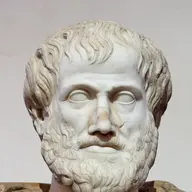
Aristotle, Poetics 5–6Translated by S. H. Butcher (1895)Read the full passage (opens gutenberg.org)

When, and whose words

Date
c. 335–322 BCE. His works are hard to date; they are usually placed in his Lyceum years in Athens, 335–322 BCE.
Whose words
His own words, in the Poetics. Who was Aristotle?
How this post was checked
  • The plain-words line was read against the quote alone by a second, independent pass, which found it adds no claim the quote does not make (2026-10-03).
  • Each claim in the summary was checked by an independent pass against only the material it cites.
  • The quote itself is checked by the build: word for word, once, at the cited section of the stored translation.

See it among its momentsMore from AristotleSee it in the feed