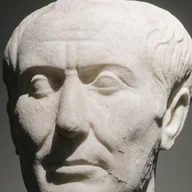
What was going on: As Plutarch tells it, over a century later: in 47 BCE Caesar left Cleopatra on the throne of Egypt and went on through Syria and Asia. There he heard that Pharnaces, son of Mithridates, had beaten Domitius and was seizing Bithynia and Cappadocia.
He won a big battle fast and wiped out the enemy army. Writing home to a friend, he summed it up in three words: came, saw, conquered.
At once, therefore, Caesar marched against him with three legions, fought a great battle with him near the city of Zela, drove him in flight out of Pontus, and annihilated his army. In announcing the swiftness and fierceness of this battle to one of his friends at Rome, Amantius, Caesar wrote three words Came, saw, conquered.
As Plutarch tells it, over a century later. Plutarch, Life of Caesar 50.2, translated by Bernadotte Perrin (1919)
What was going on: As Plutarch tells it, over a century later, this is Cleopatra on her way to meet Antony in 41 BCE, bringing gifts and money but trusting most in herself. The year before, Antony and Octavian had beaten Caesar's killers at Philippi.
Why it matters: After this meeting at Tarsos, Cleopatra had an affair with Antony that produced three children.
He kept writing to summon her. She laughed at him and sailed up the river in a barge with a gilded stern with purple sails and silver oars, to music.
Though she received many letters of summons both from Antony himself and from his friends, she so despised and laughed the man to scorn as to sail up the river Cydnus in a barge with gilded poop, its sails spread purple, its rowers urging it on with silver oars to the sound of the flute blended with pipes and lutes.
Plutarch, describing her, over a century later. Plutarch, Life of Antony 26.1, translated by Bernadotte Perrin (1920)
What was going on: As Plutarch tells it, writing over a century later, in Asia Minor in 41 BCE Cleopatra hosts Antony at a feast lit by countless lamps, and his attempt to outdo her the next day falls short. Plutarch then stops to describe what made her so striking.
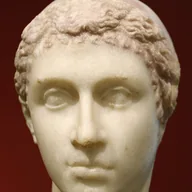
Her looks alone were not stunning, people said. It was talking with her that was irresistible: her presence, her persuasiveness, her character.
For her beauty, as we are told, was in itself not altogether incomparable, nor such as to strike those who saw her; but converse with her had an irresistible charm, and her presence, combined with the persuasiveness of her discourse and the character which was somehow diffused about her behaviour towards others, had something stimulating about it.
Plutarch, describing her, over a century later. Plutarch, Life of Antony 27.2, translated by Bernadotte Perrin (1920)
97–180 CE: The high empire and the Stoic emperor
, Asia Minor
The empire is at its largest when Trajan dies
Trajan conquers Dacia and pushes into Mesopotamia. When he dies, the Roman Empire covers more land than it ever will again.