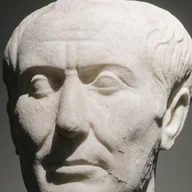
What was going on: These are the opening lines of Caesar's own account of his war in Gaul, which he fought as governor from 58 BCE and wrote up himself, in the third person. He begins by mapping the land and its peoples, river by river.
Why it matters: The opening phrase is frequently quoted, and the book has long been a mainstay in Latin instruction due to its simple, direct prose.
Gaul is split into three parts, each held by a different people. They all differ in language, customs and laws.
All Gaul is divided into three parts, one of which the Belgae inhabit, the Aquitani another, those who in their own language are called Celts, in our Gauls, the third. All these differ from each other in language, customs and laws.
His own words. Caesar, The Gallic War 1.1, translated by W. A. McDevitte and W. S. Bohn (1869)
What was going on: In 55 BCE, with only a short part of summer left, Caesar has just come back to Gaul after eighteen days across the Rhine. Writing of himself, he says he decided to cross to Britain because it had sent help to his enemies in almost every war with the Gauls.
Why it matters: No information about harbours or landing-places was available to the Romans before these expeditions, and it is likely the intelligence gathered was later used by Claudius in planning his landings.
Even if there was too little of the season left for a war, just landing on the island would teach me about its people, harbours and landing places.
…even if the time of year should be insufficient for carrying on the war, yet he thought it would be of great service to him if he only entered the island, and saw into the character of the people, and got knowledge of their localities, harbors, and landing-places, all which were for the most part unknown to the Gauls.
His own words, writing of himself as 'Caesar'. Caesar, The Gallic War 4.20, translated by W. A. McDevitte and W. S. Bohn (1869)
What was going on: On Caesar's first landing in Britain, his warships have pushed the enemy on the shore back a little, but his men hesitate to jump into the deep sea. Caesar tells it himself, writing of himself in the third person.
Why it matters: Caesar achieved no significant gains in Britain, but simply landing there was a notable feat, and a propaganda victory he chronicled in his Commentaries.
The soldier carrying the legion’s eagle shouted for the others to jump unless they wanted to lose it to the enemy, then leapt from the ship himself.
…he who carried the eagle of the tenth legion, after supplicating the gods that the matter might turn out favorably to the legion, exclaimed, "Leap, fellow soldiers, unless you wish to betray your eagle to the enemy. I, for my part, will perform my duty to the commonwealth and my general." When he had said this with a loud voice, he leaped from the ship and proceeded to bear the eagle toward the enemy.
His own words, writing of himself as 'Caesar'. Caesar, The Gallic War 4.25, translated by W. A. McDevitte and W. S. Bohn (1869)
What was going on: On his second trip to Britain in 54 BCE, Caesar pauses his story to describe the island: its size, the people of Kent who live much like the Gauls, and inland people who live on milk and meat and dress in skins. Soon after, his cavalry clash with British horsemen and chariots.
Why it matters: Caesar's accounts are the earliest surviving significant eyewitness descriptions of Britain's people, culture and geography, effectively the start of the island's written history, or at least its protohistory.
The Britons all dye themselves blue with woad, which makes them look more frightening in battle. They wear their hair long.
All the Britains, indeed, dye themselves with woad, which occasions a bluish color, and thereby have a more terrible appearance in fight. They wear their hair long, and have every part of their body shaved except their head and upper lip.
His own words. Caesar, The Gallic War 5.14, translated by W. A. McDevitte and W. S. Bohn (1869)
What was going on:Alesia, 52 BCE: Caesar has the Gallic leader Vercingetorix shut inside this hill town. The Gauls inside decide that everyone too old or sick to fight must leave, while a Gallic relief army arrives and camps on a hill nearby. Caesar tells it himself.
Why it matters:Alesia marked the end of Gallic independence in what is now France and Belgium. It is considered one of Caesar's greatest military achievements and a classic example of siege warfare.
The townspeople were sent out with their wives and children. Weeping, they begged the soldiers to take them as slaves and feed them. I posted guards and refused them.
The Mandubii, who had admitted them into the town, are compelled to go forth with their wives and children. When these came to the Roman fortifications, weeping, they begged of the soldiers by every entreaty to receive them as slaves and relieve them with food. But Caesar, placing guards on the rampart, forbade them to be admitted.
His own words, writing of himself as 'Caesar'. Caesar, The Gallic War 7.78, translated by W. A. McDevitte and W. S. Bohn (1869)
What was going on:Alesia, 52 BCE. Caesar's army has beaten off the Gauls, who flee their camp. Caesar writes that the next day Vercingetorix told his council he would let them hand him to the Romans, dead or alive, and envoys were sent to Caesar.
Why it matters:Alesia marked the end of Gallic independence in what is now France and Belgium. It is considered one of Caesar's greatest military achievements and a classic example of siege warfare.
They sent envoys to me. I ordered their weapons and leaders handed over, sat in front of my camp, and they gave up Vercingetorix.
Embassadors are sent to Caesar on this subject. He orders their arms to be surrendered, and their chieftains delivered up. He seated himself at the head of the lines in front of the camp, the Gallic chieftains are brought before him. They surrender Vercingetorix, and lay down their arms.
His own words, writing of himself as 'Caesar'. Caesar, The Gallic War 7.89, translated by W. A. McDevitte and W. S. Bohn (1869)
What was going on: 49 BCE: civil war has begun between Caesar and Pompey's side. Go-betweens such as the praetor Roscius bring Caesar Pompey's proposals, and Caesar asks them to carry his reply back. This is Caesar's own account.
Why it matters: The crossing set off a civil war that eventually made Caesar dictator for life. It also gave us the idiom crossing the Rubicon, meaning passing the point of no return.
I have always put the honour of the state first, above my own life. I was angry that my enemies were snatching back what the people had granted me.
As for myself, he said, I have always reckoned the dignity of the republic of first importance and preferable to life. I was indignant that a benefit conferred on me by the Roman people was being insolently wrested from me by my enemies, and that, robbed of my six months’ command, I was being dragged back to the city, when the people had directed that I should be allowed to be a candidate in absence at the next election.
His own words, giving his own message to Pompeius. Caesar, The Civil War 1.9, translated by A. G. Peskett (1914)
What was going on: As Suetonius tells it, over a century later: after the tribunes who spoke for Caesar fled Rome, he set off by night and got lost on the way. At the Rubicon, the edge of his province, he stopped. Crossing it with an army, which the law forbade, began a civil war with Pompey and the Senate.
Why it matters: The crossing set off a civil war that eventually made Caesar dictator for life. It also gave us the idiom crossing the Rubicon, meaning passing the point of no return.
At the river that bordered his province, he stopped to think, then said: we can still turn back, but once we cross this little bridge, we have to fight it out.
Coming up with his troops on the banks of the Rubicon, which was the boundary of his province, he halted for a while, and, revolving in his mind the importance of the step he was on the point of taking, he turned to those about him, and said: “We may still retreat; but if we pass this little bridge, nothing is left for us but to fight it out in arms.”
As Suetonius tells it, over a century later. Suetonius, Life of Julius 31, translated by Alexander Thomson, revised by T. Forester (1889)
What was going on: Caesar reaches the Rubicon, the river between Cisalpine Gaul and the rest of Italy, and stops to argue it out with himself and his friends. Leading an army across was against the law and started a civil war. Plutarch tells it over a century later.
Why it matters: The crossing set off a civil war that eventually made Caesar dictator for life. It also gave us the idiom crossing the Rubicon, meaning passing the point of no return.
At last, as if giving up on calculation, he said what people say before a reckless plunge, let the die be cast, crossed the river and took Ariminum before dawn.
But finally, with a sort of passion, as if abandoning calculation and casting himself upon the future, and uttering the phrase with which men usually prelude their plunge into desperate and daring fortunes, Let the die be cast, he hastened to cross the river; and going at full speed now for the rest of the time, before daybreak he dashed into Ariminum and took possession of it.
As Plutarch tells it, over a century later. Plutarch, Life of Caesar 32.6, translated by Bernadotte Perrin (1919)
What was going on:Pharsalus, 48 BCE, just before Caesar's army fights Pompey's. Caesar, writing about himself, says he reminded his men how hard he had tried to make peace. Then a veteran centurion, Crastinus, called on his old comrades to follow him into battle.
Why it matters: It was the decisive battle of Caesar's civil war. The historian Paul K. Davis writes that the victory took Caesar to the pinnacle of power, effectively ending the Republic.
I told my men I never wanted to waste their blood. They were eager to fight, and I had the trumpet sound the attack.
He had never, he said, wished to squander the blood of his soldiers or to deprive the republic of either of its armies. After delivering this speech, the soldiers clamouring for action and burning with zeal for the fight, he gave the signal with a trumpet.
His own words, writing of himself as 'Caesar'. Caesar, The Civil War 3.90, translated by A. G. Peskett (1914)
What was going on: 48 BCE: beaten by Caesar at Pharsalus in Greece, Pompey has fled to Egypt. Caesar writes that the men running the kingdom for the young king publicly invited Pompey to visit, but secretly sent Achillas and Septimius to kill him.
Why it matters: Caesar, pursuing Pompey, reached Alexandria, learned of the murder there, and was then embroiled in a dynastic dispute between Ptolemy XIII and Cleopatra.
He was greeted politely, drawn in because he knew a man who had once served under him, stepped into a small boat with a few friends, and was murdered.
And he, being courteously addressed by them and being lured forth by some previous knowledge of Septimius, because he had been a centurion under him in the pirate war, embarked in a little boat with a few of his friends, and is thereupon assassinated by Achillas and Septimius.
His own words. Caesar, The Civil War 3.104, translated by A. G. Peskett (1914)
What was going on: As Plutarch tells it, over a century later: in 47 BCE Caesar left Cleopatra on the throne of Egypt and went on through Syria and Asia. There he heard that Pharnaces, son of Mithridates, had beaten Domitius and was seizing Bithynia and Cappadocia.
He won a big battle fast and wiped out the enemy army. Writing home to a friend, he summed it up in three words: came, saw, conquered.
At once, therefore, Caesar marched against him with three legions, fought a great battle with him near the city of Zela, drove him in flight out of Pontus, and annihilated his army. In announcing the swiftness and fierceness of this battle to one of his friends at Rome, Amantius, Caesar wrote three words Came, saw, conquered.
As Plutarch tells it, over a century later. Plutarch, Life of Caesar 50.2, translated by Bernadotte Perrin (1919)
What was going on: As Plutarch tells it, over a century later: in 46 BCE, after Caesar beat the Republicans in Africa, Cato stayed in Utica, sent the others away, and took his own life. Caesar had been hurrying there with his army.
Why it matters: By choosing death over Caesar's pardon, Cato made himself a martyr for and a symbol of the Republic. Eulogies by Cicero and Brutus began to present him as a great Stoic philosopher.
We are told that on hearing Cato was dead, he said only this: Cato, I resent your death, because you denied me the chance to spare your life.
When, however, he heard of his death, he said thus much only, as we are told: O Cato, I begrudge thee thy death; for thou didst begrudge me the sparing of thy life.
As Plutarch tells it, over a century later. Plutarch, Life of Cato the Younger 72.2, translated by Bernadotte Perrin (1919)
What was going on: Plutarch, writing over a century later, sets this the day before the Ides of March, 44 BCE, when Caesar was stabbed to death at a Senate meeting. He also passes on a story, told by many, that a seer had warned Caesar about that day. Now Caesar is at supper with Marcus Lepidus, signing letters.
Why it matters: The killing failed to restore the Republic. Instead it led to Caesar's deification and a civil war between his supporters and his killers, which became a stage in the Republic's collapse.
At dinner the talk turned to what kind of death is best. Before anyone else could answer, he said: the one you don’t see coming.
Moreover, on the day before, when Marcus Lepidus was entertaining him at supper, Caesar chanced to be signing letters, as his custom was, while reclining at table, and the discourse turned suddenly upon the question what sort of death was the best; before any one else could answer Caesar cried out: That which is unexpected.
As Plutarch tells it, over a century later. Plutarch, Life of Caesar 63.4, translated by Bernadotte Perrin (1919)
What was going on: As Suetonius tells it, over a century later: after bad omens and his wife Calpurnia's dream, Caesar nearly stayed home, but Decimus Brutus talked him into going to the Senate. A warning about the plot was pushed into his hand on the way. Inside, senators were waiting to kill him.
Why it matters: The killing failed to restore the Republic. Instead it led to Caesar's deification and a civil war between his supporters and his killers, which became a stage in the Republic's collapse.
Ignoring the bad omens, he walked in and teased the soothsayer: the Ides have come and nothing happened. The reply: they have come, but not passed.
Victim after victim was slain, without any favourable appearances in the entrails; but still, disregarding all omens, he entered the senate-house, laughing at Spurinna as a false prophet, because the ides of March were come, without any mischief having befallen him. To which the soothsayer replied, “They are come, indeed, but not past.”
Suetonius, describing him, over a century later. Suetonius, Life of Julius 81, translated by Alexander Thomson, revised by T. Forester (1889)
What was going on: 44 BCE, at a Senate meeting in Rome. Senators led by Brutus and Cassius crowd round Caesar as if to ask favours, then attack him with daggers. Suetonius, writing over a century later, describes it blow by blow.
Why it matters: Caesar's death precipitated the end of the Roman Republic, a result his killers did not foresee. The words some authors report here differ slightly from the more famous Et tu, Brute of Shakespeare's Julius Caesar.
He was stabbed 23 times, groaning at the first blow without a cry. Some writers say that when Brutus attacked, he said: you too? You, my son!
He was stabbed with three and twenty wounds, uttering a groan only, but no cry, at the first wound; although some authors relate, that when Marcus Brutus fell upon him, he exclaimed, “What! art thou, too, one of them? Thou, my son!”
As Suetonius tells it, over a century later. Suetonius, Life of Julius 82, translated by Alexander Thomson, revised by T. Forester (1889)