hstry

Caesar crosses the Rubicon, as Plutarch tells it

49 BCE, the Rubicon. As Plutarch tells it, over a century later.

Where and when

49 BCEthe Rubicon

2,074 years ago

Explore
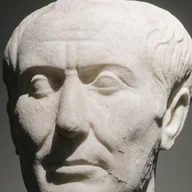
Julius Caesar, 100 – 44 BCE3000 BCE2900 BCE2800 BCE2700 BCE2600 BCE2500 BCE2400 BCE2300 BCE2200 BCE2100 BCE2000 BCE1900 BCE1800 BCE1700 BCE1600 BCE1500 BCE1400 BCE1300 BCE1200 BCE1100 BCE1000 BCE900 BCE800 BCE700 BCE600 BCE500 BCE400 BCE300 BCE200 BCE100 BCE1 CE100 CE200 CE300 CE400 CE500 CE600 CE700 CE800 CE900 CE1000 CE1100 CE1200 CE1300 CE1400 CE1500 CE1600 CE1700 CE1800 CE1900 CE2000 CEGreat Pyramid of Giza built, c. 2600 BCERome founded (traditional date), 753 BCELast western Roman emperor deposed, 476 CEGutenberg's printing press, c. 1440 CEColumbus reaches the Americas, 1492 CEFirst people on the Moon, 1969 CEToday, 2026

Swipe the line. Bars: entries. Dots: events.

Julius Caesar

, the RubiconAs Plutarch tells it, over a century later

In plain words, ours

At last, as if giving up on calculation, he said what people say before a reckless plunge, let the die be cast, crossed the river and took Ariminum before dawn.

But finally, with a sort of passion, as if abandoning calculation and casting himself upon the future, and uttering the phrase with which men usually prelude their plunge into desperate and daring fortunes, Let the die be cast, he hastened to cross the river; and going at full speed now for the rest of the time, before daybreak he dashed into Ariminum and took possession of it.

Plutarch, Life of Caesar 32.6Translated by Bernadotte Perrin (1919)Read the full passage (Plutarch, Life of Caesar 32.6, opens scaife.perseus.org)

What was going on, our summary

Caesar reaches the Rubicon, the river between Cisalpine Gaul and the rest of Italy, and stops to argue it out with himself and his friends. Leading an army across was against the law and started a civil war. Plutarch tells it over a century later.

Checked claim by claim against: Caesar crosses the Rubicon with his army, the passage around the quote.

Why it matters

About the event it belongs to: Caesar crosses the Rubicon with his army

The crossing set off a civil war that eventually made Caesar dictator for life. It also gave us the idiom crossing the Rubicon, meaning passing the point of no return.

Based on Wikipedia: Crossing the Rubicon

The crossing precipitated a civil war, which eventually led to Caesar becoming dictator for life (dictator perpetuo).

The phrase "crossing the Rubicon" is an idiom meaning "passing the point of no return".

Wikipedia, Crossing the Rubicon (opens en.wikipedia.org), as of 2026-08-19. Text CC BY-SA 4.0. Our line is checked against these sentences only.

Related moments

In time order, with this one in its place. Each says why it is here.

  1. 52 BCE3 years earlier Vercingetorix surrenders to Caesar at Alesia Same years
  2. 49 BCESame year Caesar crosses the Rubicon with his army The event behind itAlso in the RubiconAlso about war and empire
  3. 49 BCEThis momentCaesar crosses the Rubicon, as Plutarch tells it
  4. 49 BCESame year Caesar puts the republic's dignity before life More from Julius Caesar
  5. 49 BCESame year Caesar at the Rubicon, as Suetonius tells it More from Julius Caesar
  6. 48 BCE1 year later Caesar defeats Pompey at Pharsalus Also about war and empire
  7. 48–47 BCE1 year later Caesar takes Cleopatra's side in Egypt Same years
  8. 48 BCE1 year later Caesar on his speech before Pharsalus More from Julius Caesar
  9. 46 BCE3 years later Cato kills himself rather than accept Caesar's pardon Same years

Just before and after

The text around the quote, word for word from the same translation.

Show the passageHide the passage

He himself mounted one of his hired carts and drove at first along another road, then turned towards Ariminum. When he came to the river which separates Cisalpine Gaul from the rest of Italy (it is called the Rubicon), and began to reflect, now that he drew nearer to the fearful step and was agitated by the magnitude of his ventures, he checked his speed. Then, halting in his course, he communed with himself a long time in silence as his resolution wavered back and forth, and his purpose then suffered change after change. For a long time, too, he discussed his perplexities with his friends who were present, among whom was Asinius Pollio, estimating the great evils for all mankind which would follow their passage of the river, and the wide fame of it which they would leave to posterity.

The quote: But finally, with a sort of passion, as if abandoning calculation and casting himself upon the future, and uttering the phrase with which men usually prelude their plunge into desperate and daring fortunes, Let the die be cast, he hastened to cross the river; and going at full speed now for the rest of the time, before daybreak he dashed into Ariminum and took possession of it.

It is said, moreover, that on the night before he crossed the river he had an unnatural dream; he thought, namely, that he was having incestuous intercourse with his own mother.

Plutarch, Life of Caesar 32.4–6Translated by Bernadotte Perrin (1919)Read the full passage (opens scaife.perseus.org)

When, and whose words

Date
49 BCE. The crossing of the Rubicon, January 49 BCE; Plutarch wrote c. 100–120 CE.
Whose words
As Plutarch tells it, over a century later.
How this post was checked
  • The plain-words line was read against the quote alone by a second, independent pass, which found it adds no claim the quote does not make (2026-10-03).
  • Each claim in the summary was checked by an independent pass against only the material it cites.
  • The quote itself is checked by the build: word for word, once, at the cited section of the stored translation.

See it among its momentsMore from Julius CaesarSee it in the feed