hstry

Caesar at the Rubicon, as Suetonius tells it

49 BCE, the Rubicon. As Suetonius tells it, over a century later.

Where and when

49 BCEthe Rubicon

2,074 years ago

Explore
Julius Caesar, 100 – 44 BCE3000 BCE2900 BCE2800 BCE2700 BCE2600 BCE2500 BCE2400 BCE2300 BCE2200 BCE2100 BCE2000 BCE1900 BCE1800 BCE1700 BCE1600 BCE1500 BCE1400 BCE1300 BCE1200 BCE1100 BCE1000 BCE900 BCE800 BCE700 BCE600 BCE500 BCE400 BCE300 BCE200 BCE100 BCE1 CE100 CE200 CE300 CE400 CE500 CE600 CE700 CE800 CE900 CE1000 CE1100 CE1200 CE1300 CE1400 CE1500 CE1600 CE1700 CE1800 CE1900 CE2000 CEGreat Pyramid of Giza built, c. 2600 BCERome founded (traditional date), 753 BCELast western Roman emperor deposed, 476 CEGutenberg's printing press, c. 1440 CEColumbus reaches the Americas, 1492 CEFirst people on the Moon, 1969 CEToday, 2026

Swipe the line. Bars: entries. Dots: events.

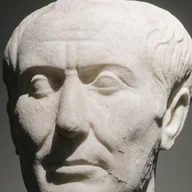
Julius Caesar

, the RubiconAs Suetonius tells it, over a century later

In plain words, ours

At the river that bordered his province, he stopped to think, then said: we can still turn back, but once we cross this little bridge, we have to fight it out.

Coming up with his troops on the banks of the Rubicon, which was the boundary of his province, he halted for a while, and, revolving in his mind the importance of the step he was on the point of taking, he turned to those about him, and said: “We may still retreat; but if we pass this little bridge, nothing is left for us but to fight it out in arms.”

Suetonius, Life of Julius 31Translated by Alexander Thomson, revised by T. Forester (1889)Read the full passage (Suetonius, Life of Julius 31, opens gutenberg.org)

What was going on, our summary

As Suetonius tells it, over a century later: after the tribunes who spoke for Caesar fled Rome, he set off by night and got lost on the way. At the Rubicon, the edge of his province, he stopped. Crossing it with an army, which the law forbade, began a civil war with Pompey and the Senate.

Checked claim by claim against: Caesar crosses the Rubicon with his army, the passage around the quote.

Why it matters

About the event it belongs to: Caesar crosses the Rubicon with his army

The crossing set off a civil war that eventually made Caesar dictator for life. It also gave us the idiom crossing the Rubicon, meaning passing the point of no return.

Based on Wikipedia: Crossing the Rubicon

The crossing precipitated a civil war, which eventually led to Caesar becoming dictator for life (dictator perpetuo).

The phrase "crossing the Rubicon" is an idiom meaning "passing the point of no return".

Wikipedia, Crossing the Rubicon (opens en.wikipedia.org), as of 2026-08-19. Text CC BY-SA 4.0. Our line is checked against these sentences only.

Related moments

In time order, with this one in its place. Each says why it is here.

  1. 52 BCE3 years earlier Vercingetorix surrenders to Caesar at Alesia Same years
  2. 49 BCESame year Caesar crosses the Rubicon with his army The event behind itAlso in the RubiconAlso about war and empire
  3. 49 BCEThis momentCaesar at the Rubicon, as Suetonius tells it
  4. 49 BCESame year Caesar puts the republic's dignity before life More from Julius Caesar
  5. 49 BCESame year Caesar crosses the Rubicon, as Plutarch tells it More from Julius Caesar
  6. 48 BCE1 year later Caesar defeats Pompey at Pharsalus Also about war and empire
  7. 48–47 BCE1 year later Caesar takes Cleopatra's side in Egypt Same years
  8. 48 BCE1 year later Caesar on his speech before Pharsalus More from Julius Caesar
  9. 46 BCE3 years later Cato kills himself rather than accept Caesar's pardon Same years

Just before and after

The text around the quote, word for word from the same translation.

Show the passageHide the passage

When intelligence, therefore, was received, that the interposition of the tribunes in his favour had been utterly rejected, and that they themselves had fled from the city, he immediately sent forward some cohorts, but privately, to prevent any suspicion of his design; and, to keep up appearances, attended at a public spectacle, examined the model of a fencing-school which he proposed to build, and, as usual, sat down to table with a numerous party of his friends. But after sun-set, mules being put to his carriage from a neighbouring mill, he set forward on his journey with all possible privacy, and a small retinue. The lights going out, he lost his way, and wandered about a long time, until at length, by the help of a guide, whom he found towards day-break, he proceeded on foot through some narrow paths, and again reached the road.

The quote: Coming up with his troops on the banks of the Rubicon, which was the boundary of his province, he halted for a while, and, revolving in his mind the importance of the step he was on the point of taking, he turned to those about him, and said: “We may still retreat; but if we pass this little bridge, nothing is left for us but to fight it out in arms.”

While he was thus hesitating, the following incident occurred. A person remarkable for his noble mien and graceful aspect, appeared close at hand, sitting and playing upon a pipe. When, not only the shepherds, but a number of soldiers also flocked from their posts to listen to him, and some trumpeters among them, he snatched a trumpet from one of them, ran to the river with it, and sounding the advance with a piercing blast, crossed to the other side. Upon this, Caesar exclaimed, “Let us go whither the omens of the Gods and the iniquity of our enemies call us.

Suetonius, Life of Julius 31–32Translated by Alexander Thomson, revised by T. Forester (1889)Read the full passage (opens gutenberg.org)

When, and whose words

Date
49 BCE. The crossing of the Rubicon, January 49 BCE; Suetonius wrote c. 121 CE.
Whose words
As Suetonius tells it, over a century later.
How this post was checked
  • The plain-words line was read against the quote alone by a second, independent pass, which found it adds no claim the quote does not make (2026-10-03).
  • Each claim in the summary was checked by an independent pass against only the material it cites.
  • The quote itself is checked by the build: word for word, once, at the cited section of the stored translation.

See it among its momentsMore from Julius CaesarSee it in the feed