hstry

Caesar's eagle-bearer leaps in Britain

55 BCE, Britain. His own words, writing of himself as 'Caesar'.

Where and when

55 BCEBritain

2,080 years ago

Explore
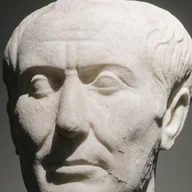
Julius Caesar, 100 – 44 BCE3000 BCE2900 BCE2800 BCE2700 BCE2600 BCE2500 BCE2400 BCE2300 BCE2200 BCE2100 BCE2000 BCE1900 BCE1800 BCE1700 BCE1600 BCE1500 BCE1400 BCE1300 BCE1200 BCE1100 BCE1000 BCE900 BCE800 BCE700 BCE600 BCE500 BCE400 BCE300 BCE200 BCE100 BCE1 CE100 CE200 CE300 CE400 CE500 CE600 CE700 CE800 CE900 CE1000 CE1100 CE1200 CE1300 CE1400 CE1500 CE1600 CE1700 CE1800 CE1900 CE2000 CEGreat Pyramid of Giza built, c. 2600 BCERome founded (traditional date), 753 BCELast western Roman emperor deposed, 476 CEGutenberg's printing press, c. 1440 CEColumbus reaches the Americas, 1492 CEFirst people on the Moon, 1969 CEToday, 2026

Swipe the line. Bars: entries. Dots: events.

Julius Caesar

, BritainHis own words, writing of himself as 'Caesar'

In plain words, ours

The soldier carrying the legion’s eagle shouted for the others to jump unless they wanted to lose it to the enemy, then leapt from the ship himself.

…he who carried the eagle of the tenth legion, after supplicating the gods that the matter might turn out favorably to the legion, exclaimed, "Leap, fellow soldiers, unless you wish to betray your eagle to the enemy. I, for my part, will perform my duty to the commonwealth and my general." When he had said this with a loud voice, he leaped from the ship and proceeded to bear the eagle toward the enemy.

Caesar, The Gallic War 4.25Translated by W. A. McDevitte and W. S. Bohn (1869)Read the full passage (Caesar, The Gallic War 4.25, opens scaife.perseus.org)

What was going on, our summary

On Caesar's first landing in Britain, his warships have pushed the enemy on the shore back a little, but his men hesitate to jump into the deep sea. Caesar tells it himself, writing of himself in the third person.

Checked claim by claim against: Caesar crosses the sea to Britain, Caesar begins the conquest of Gaul, the passage around the quote.

Why it matters

Caesar achieved no significant gains in Britain, but simply landing there was a notable feat, and a propaganda victory he chronicled in his Commentaries.

Based on Wikipedia: Julius Caesar's invasions of Britain

While he had achieved no significant gains in Britain, he had accomplished a notable feat simply by landing there.

It was a propaganda victory as well, which was chronicled in Caesar's ongoing Commentarii de Bello Gallico.

Wikipedia, Julius Caesar's invasions of Britain (opens en.wikipedia.org), as of 2026-09-22. Text CC BY-SA 4.0. Our line is checked against these sentences only.

Related moments

In time order, with this one in its place. Each says why it is here.

  1. 58–50 BCEDuring it Caesar begins the conquest of Gaul The event behind itAlso about war and empire
  2. 58 BCE3 years earlier Caesar maps Gaul and its peoples More from Julius Caesar
  3. 58–57 BCEabout 3 years earlier Cicero in exile, as Plutarch tells it Same years
  4. 55–54 BCEBegins this year Caesar crosses the sea to Britain The event behind itAlso in BritainAlso about war and empire
  5. 55 BCEThis momentCaesar's eagle-bearer leaps in Britain
  6. 55 BCESame year Caesar on why he would cross to Britain Same passageMore from Julius Caesar
  7. 54 BCE1 year later Caesar on Britons dyed with woad More from Julius Caesar
  8. 52 BCE3 years later Vercingetorix surrenders to Caesar at Alesia Same years
  9. 43 CE97 years later Claudius invades Britain Also in Britain
  10. c. 60–61 CEabout 114 years later Boudica leads a British revolt against Rome Also in Britain

Just before and after

The text around the quote, word for word from the same translation.

Show the passageHide the passage

When Caesar observed this, he ordered the ships of war, the appearance of which was somewhat strange to the barbarians and the motion more ready for service, to be withdrawn a little from the transport vessels, and to be propelled by their oars, and be stationed toward the open flank of the enemy, and the enemy to be beaten off and driven away, with slings, arrows, and engines: which plan was of great service to our men; for the barbarians being startled by the form of our ships and the motions of our oars and the nature of our engines, which was strange to them, stopped, and shortly after retreated a little. And while our men were hesitating [whether they should advance to the shore], chiefly on account of the depth of the sea,

The quote: he who carried the eagle of the tenth legion, after supplicating the gods that the matter might turn out favorably to the legion, exclaimed, "Leap, fellow soldiers, unless you wish to betray your eagle to the enemy. I, for my part, will perform my duty to the commonwealth and my general." When he had said this with a loud voice, he leaped from the ship and proceeded to bear the eagle toward the enemy.

Then our men, exhorting one another that so great a disgrace should not be incurred, all leaped from the ship. When those in the nearest vessels saw them, they speedily followed and approached the enemy. The battle was maintained vigorously on both sides. Our men, however, as they could neither keep their ranks, nor get firm footing, nor follow their standards, and as one from one ship and another from another assembled around whatever standards they met, were thrown into great confusion.

Caesar, The Gallic War 4.25–26Translated by W. A. McDevitte and W. S. Bohn (1869)Read the full passage (opens scaife.perseus.org)

When, and whose words

Date
55 BCE. The first landing in Britain, 55 BCE; written up c. 52–51 BCE.
Whose words
His own words, writing of himself as 'Caesar'.
How this post was checked
  • The plain-words line was read against the quote alone by a second, independent pass, which found it adds no claim the quote does not make (2026-10-03).
  • Each claim in the summary was checked by an independent pass against only the material it cites.
  • The quote itself is checked by the build: word for word, once, at the cited section of the stored translation.

See it among its momentsMore from Julius CaesarSee it in the feed