hstry

Caesar maps Gaul and its peoples

58 BCE, Gaul. His own words.

Where and when

58 BCEGaul

2,083 years ago

Explore
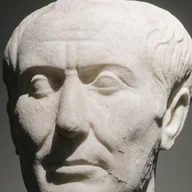
Julius Caesar, 100 – 44 BCE3000 BCE2900 BCE2800 BCE2700 BCE2600 BCE2500 BCE2400 BCE2300 BCE2200 BCE2100 BCE2000 BCE1900 BCE1800 BCE1700 BCE1600 BCE1500 BCE1400 BCE1300 BCE1200 BCE1100 BCE1000 BCE900 BCE800 BCE700 BCE600 BCE500 BCE400 BCE300 BCE200 BCE100 BCE1 CE100 CE200 CE300 CE400 CE500 CE600 CE700 CE800 CE900 CE1000 CE1100 CE1200 CE1300 CE1400 CE1500 CE1600 CE1700 CE1800 CE1900 CE2000 CEGreat Pyramid of Giza built, c. 2600 BCERome founded (traditional date), 753 BCELast western Roman emperor deposed, 476 CEGutenberg's printing press, c. 1440 CEColumbus reaches the Americas, 1492 CEFirst people on the Moon, 1969 CEToday, 2026

Swipe the line. Bars: entries. Dots: events.

In plain words, ours

Gaul is split into three parts, each held by a different people. They all differ in language, customs and laws.

All Gaul is divided into three parts, one of which the Belgae inhabit, the Aquitani another, those who in their own language are called Celts, in our Gauls, the third. All these differ from each other in language, customs and laws.

Caesar, The Gallic War 1.1Translated by W. A. McDevitte and W. S. Bohn (1869)Read the full passage (Caesar, The Gallic War 1.1, opens scaife.perseus.org)

What was going on, our summary

These are the opening lines of Caesar's own account of his war in Gaul, which he fought as governor from 58 BCE and wrote up himself, in the third person. He begins by mapping the land and its peoples, river by river.

Checked claim by claim against: Caesar begins the conquest of Gaul, the passage around the quote.

Why it matters

The opening phrase is frequently quoted, and the book has long been a mainstay in Latin instruction due to its simple, direct prose.

Based on Wikipedia: Commentarii de Bello Gallico

Commentarii de Bello Gallico has long been a mainstay in Latin instruction due to its simple, direct prose.

It begins with the frequently quoted phrase Gallia est omnis divisa in partes tres, meaning "Gaul is a whole divided into three parts".

Wikipedia, Commentarii de Bello Gallico (opens en.wikipedia.org), as of 2026-10-02. Text CC BY-SA 4.0. Our line is checked against these sentences only.

Related moments

In time order, with this one in its place. Each says why it is here.

  1. c. 60 BCEabout 2 years earlier Caesar, Pompey and Crassus join forces Same years
  2. 59 BCE1 year earlier Cato dragged to prison, as Plutarch tells it Same years
  3. 58–50 BCEBegins this year Caesar begins the conquest of Gaul The event behind itAlso in Gaul
  4. 58 BCEThis momentCaesar maps Gaul and its peoples
  5. 58–57 BCEBegins this year Cicero in exile, as Plutarch tells it Same years
  6. 55–54 BCEabout 3 years later Caesar crosses the sea to Britain Same years
  7. 55 BCE3 years later Caesar's eagle-bearer leaps in Britain More from Julius Caesar
  8. 55 BCE3 years later Caesar on why he would cross to Britain More from Julius Caesar
  9. 54 BCE4 years later Caesar on Britons dyed with woad More from Julius Caesar

Just before and after

The text around the quote, word for word from the same translation.

Show the passageHide the passage

The quote: All Gaul is divided into three parts, one of which the Belgae inhabit, the Aquitani another, those who in their own language are called Celts, in our Gauls, the third. All these differ from each other in language, customs and laws.

The river Garonne separates the Gauls from the Aquitani; the Marne and the Seine separate them from the Belgae.

Caesar, The Gallic War 1.1Translated by W. A. McDevitte and W. S. Bohn (1869)Read the full passage (opens scaife.perseus.org)

When, and whose words

Date
58 BCE. Opens his account of his first year in Gaul, 58 BCE; he wrote it up c. 52–51 BCE.
Whose words
His own words.
How this post was checked
  • The plain-words line was read against the quote alone by a second, independent pass, which found it adds no claim the quote does not make (2026-10-03).
  • Each claim in the summary was checked by an independent pass against only the material it cites.
  • The quote itself is checked by the build: word for word, once, at the cited section of the stored translation.

See it among its momentsMore from Julius CaesarSee it in the feed