hstry

Cicero in exile, as Plutarch tells it

58–57 BCE. Plutarch, describing him, over a century later.

Where and when

58–57 BCERome and its world

about 2,083 years ago

Explore
Cicero, 106 – 43 BCE3000 BCE2900 BCE2800 BCE2700 BCE2600 BCE2500 BCE2400 BCE2300 BCE2200 BCE2100 BCE2000 BCE1900 BCE1800 BCE1700 BCE1600 BCE1500 BCE1400 BCE1300 BCE1200 BCE1100 BCE1000 BCE900 BCE800 BCE700 BCE600 BCE500 BCE400 BCE300 BCE200 BCE100 BCE1 CE100 CE200 CE300 CE400 CE500 CE600 CE700 CE800 CE900 CE1000 CE1100 CE1200 CE1300 CE1400 CE1500 CE1600 CE1700 CE1800 CE1900 CE2000 CEGreat Pyramid of Giza built, c. 2600 BCERome founded (traditional date), 753 BCELast western Roman emperor deposed, 476 CEGutenberg's printing press, c. 1440 CEColumbus reaches the Americas, 1492 CEFirst people on the Moon, 1969 CEToday, 2026sometime in these 1 years

Swipe the line. Bars: entries. Dots: events.

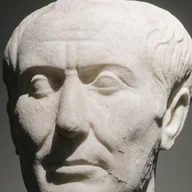
Cicero

Plutarch, describing him, over a century later

In plain words, ours

Many visited him and Greek cities sent envoys, yet he spent most of his time in grief, gazing toward Italy like a heartbroken lover.

But although many people visited him out of goodwill, and the Greek cities vied with one another in sending him deputations, still, he passed his time for the most part in dejection and great grief, looking off towards Italy like a disconsolate lover,

Plutarch, Life of Cicero 32.4Translated by Bernadotte Perrin (1919)Read the full passage (Plutarch, Life of Cicero 32.4, opens scaife.perseus.org)

What was going on, our summary

Plutarch, writing over a century later, describes Cicero's exile, 58–57 BCE. Sailing from Brundisium, he was driven back by a counter-wind, set out again and put in at Dyrrhachium, where, it is said, an earthquake struck as he was about to land.

Checked claim by claim against: the passage around the quote.

Related moments

In time order, with this one in its place. Each says why it is here.

  1. 63 BCEabout 5 years earlier Cicero denounces Catiline to his face More from Cicero
  2. 63 BCEabout 5 years earlier Cicero turns on Catiline in the Senate More from Cicero
  3. 63 BCEabout 5 years earlier Cicero advises Catiline to leave Rome More from Cicero
  4. c. 60 BCEabout 2 years earlier Caesar, Pompey and Crassus join forces Same years
  5. 59 BCE1 year earlier Cato dragged to prison, as Plutarch tells it Same years
  6. 58–50 BCEBegins this year Caesar begins the conquest of Gaul Same years
  7. 58–57 BCEThis momentCicero in exile, as Plutarch tells it
  8. 58 BCEAbout the same year Caesar maps Gaul and its peoples Same years
  9. 55–54 BCEabout 3 years later Caesar crosses the sea to Britain Same years

Just before and after

The text around the quote, word for word from the same translation.

Show the passageHide the passage

Disheartened at this treatment, he set out for Brundisium, and from there tried to cross to Dyrrhachium with a fair breeze, but since he met a counter-wind at sea he came back the next day, and then set sail again. It is said, too, that after he had put in at Dyrrhachium and was about to land, there was an earthquake accompanied by a violent convulsion of the sea. Wherefore the soothsayers conjectured that his exile would not be lasting, since these were signs of change.

The quote: But although many people visited him out of goodwill, and the Greek cities vied with one another in sending him deputations, still, he passed his time for the most part in dejection and great grief, looking off towards Italy like a disconsolate lover,

while his spirit he became very petty and mean by reason of his misfortune, and was more humbled than one would have expected in a man who had enjoyed so lofty a discipline as his. And yet he often asked his friends not to call him an orator, but a philosopher, because he had chosen philosophy as an occupation, but used oratory merely as an instrument for attaining the needful ends of a political career.


Plutarch, Life of Cicero 32.3–5Translated by Bernadotte Perrin (1919)Read the full passage (opens scaife.perseus.org)

When, and whose words

Date
58–57 BCE. His exile, from the vote of banishment in 58 BCE until his recall in 57 BCE.
Whose words
Plutarch, describing him, over a century later.
How this post was checked
  • The plain-words line was read against the quote alone by a second, independent pass, which found it adds no claim the quote does not make (2026-10-03).
  • Each claim in the summary was checked by an independent pass against only the material it cites.
  • The quote itself is checked by the build: word for word, once, at the cited section of the stored translation.

See it among its momentsMore from CiceroSee it in the feed