hstry

Caesar and the soothsayer, in Suetonius

44 BCE, Rome (the Senate). Suetonius, describing him, over a century later.

Where and when

44 BCERome (the Senate)

2,069 years ago

Explore
Julius Caesar, 100 – 44 BCE3000 BCE2900 BCE2800 BCE2700 BCE2600 BCE2500 BCE2400 BCE2300 BCE2200 BCE2100 BCE2000 BCE1900 BCE1800 BCE1700 BCE1600 BCE1500 BCE1400 BCE1300 BCE1200 BCE1100 BCE1000 BCE900 BCE800 BCE700 BCE600 BCE500 BCE400 BCE300 BCE200 BCE100 BCE1 CE100 CE200 CE300 CE400 CE500 CE600 CE700 CE800 CE900 CE1000 CE1100 CE1200 CE1300 CE1400 CE1500 CE1600 CE1700 CE1800 CE1900 CE2000 CEGreat Pyramid of Giza built, c. 2600 BCERome founded (traditional date), 753 BCELast western Roman emperor deposed, 476 CEGutenberg's printing press, c. 1440 CEColumbus reaches the Americas, 1492 CEFirst people on the Moon, 1969 CEToday, 2026

Swipe the line. Bars: entries. Dots: events.

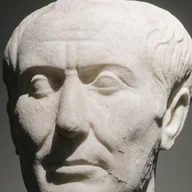
Julius Caesar

, Rome (the Senate)Suetonius, describing him, over a century later

In plain words, ours

Ignoring the bad omens, he walked in and teased the soothsayer: the Ides have come and nothing happened. The reply: they have come, but not passed.

Victim after victim was slain, without any favourable appearances in the entrails; but still, disregarding all omens, he entered the senate-house, laughing at Spurinna as a false prophet, because the ides of March were come, without any mischief having befallen him. To which the soothsayer replied, “They are come, indeed, but not past.”

Suetonius, Life of Julius 81Translated by Alexander Thomson, revised by T. Forester (1889)Read the full passage (Suetonius, Life of Julius 81, opens gutenberg.org)

What was going on, our summary

As Suetonius tells it, over a century later: after bad omens and his wife Calpurnia's dream, Caesar nearly stayed home, but Decimus Brutus talked him into going to the Senate. A warning about the plot was pushed into his hand on the way. Inside, senators were waiting to kill him.

Checked claim by claim against: Caesar is stabbed to death in the Senate, the passage around the quote.

Why it matters

About the event it belongs to: Caesar is stabbed to death in the Senate

The killing failed to restore the Republic. Instead it led to Caesar's deification and a civil war between his supporters and his killers, which became a stage in the Republic's collapse.

Based on Wikipedia: Assassination of Julius Caesar

The assassination failed to achieve its immediate objective of restoring the Republic's institutions.

Instead, it precipitated Caesar's posthumous deification and was followed by the Liberators' civil war (43–42 BC) between his supporters and the conspirators, which became a stage in the collapse of the Republic.

Wikipedia, Assassination of Julius Caesar (opens en.wikipedia.org), as of 2026-09-29. Text CC BY-SA 4.0. Our line is checked against these sentences only.

Related moments

In time order, with this one in its place. Each says why it is here.

  1. c. 50 BCEabout 6 years earlier Cato warns the Senate about Caesar, in Plutarch Also in Rome
  2. 46 BCE2 years earlier Cato kills himself rather than accept Caesar's pardon Same years
  3. 46 BCE2 years earlier Caesar on Cato's death, as Plutarch tells it More from Julius Caesar
  4. 44 BCESame year Caesar is stabbed to death in the Senate The event behind itAlso in Rome
  5. 44 BCEThis momentCaesar and the soothsayer, in Suetonius
  6. 44 BCESame year Antony at Caesar's funeral, in Plutarch Also in Rome
  7. 44 BCESame year Caesar on the best death, as Plutarch tells it More from Julius Caesar
  8. 44 BCESame year The stabbing of Caesar, as Suetonius tells it Same passageMore from Julius Caesar
  9. 43 BCE1 year later Cicero is killed on Antony's orders Same years
  10. 42 BCE2 years later Antony and Octavian defeat Caesar's killers at Philippi Same years

Just before and after

The text around the quote, word for word from the same translation.

Show the passageHide the passage

His wife Calpurnia fancied in her sleep that the pediment of the house was falling down, and her husband stabbed on her bosom; immediately upon which the chamber doors flew open. On account of these omens, as well as his infirm health, he was in some doubt whether he should not remain at home, and defer to some other opportunity the business which he intended to propose to the senate; but Decimus Brutus advising him not to disappoint the senators, who were numerously assembled, and waited his coming, he was prevailed upon to go, and accordingly set forward about the fifth hour. In his way, some person having thrust into his hand a paper, warning him against the plot, he mixed it with some other documents which he held in his left hand, intending to read it at leisure.

The quote: Victim after victim was slain, without any favourable appearances in the entrails; but still, disregarding all omens, he entered the senate-house, laughing at Spurinna as a false prophet, because the ides of March were come, without any mischief having befallen him. To which the soothsayer replied, “They are come, indeed, but not past.”

When he had taken his seat, the conspirators stood round him, under colour of paying their compliments; and immediately Tullius Cimber, who had engaged to commence the assault, advancing nearer than the rest, as if he had some favour to request, Caesar made signs that he should defer his petition to some other time. Tullius immediately seized him by the toga, on both shoulders; at which Caesar crying out, “Violence is meant!” one of the Cassii wounded him a little below the throat.

Suetonius, Life of Julius 81–82Translated by Alexander Thomson, revised by T. Forester (1889)Read the full passage (opens gutenberg.org)

When, and whose words

Date
44 BCE. The Ides of March (15 March), 44 BCE; Suetonius wrote c. 121 CE.
Whose words
Suetonius, describing him, over a century later.
How this post was checked
  • The plain-words line was read against the quote alone by a second, independent pass, which found it adds no claim the quote does not make (2026-10-03).
  • Each claim in the summary was checked by an independent pass against only the material it cites.
  • The quote itself is checked by the build: word for word, once, at the cited section of the stored translation.

See it among its momentsMore from Julius CaesarSee it in the feed