hstry

Caesar on Cato's death, as Plutarch tells it

46 BCE. As Plutarch tells it, over a century later.

Where and when

46 BCERome and its world

2,071 years ago

Explore
Julius Caesar, 100 – 44 BCE3000 BCE2900 BCE2800 BCE2700 BCE2600 BCE2500 BCE2400 BCE2300 BCE2200 BCE2100 BCE2000 BCE1900 BCE1800 BCE1700 BCE1600 BCE1500 BCE1400 BCE1300 BCE1200 BCE1100 BCE1000 BCE900 BCE800 BCE700 BCE600 BCE500 BCE400 BCE300 BCE200 BCE100 BCE1 CE100 CE200 CE300 CE400 CE500 CE600 CE700 CE800 CE900 CE1000 CE1100 CE1200 CE1300 CE1400 CE1500 CE1600 CE1700 CE1800 CE1900 CE2000 CEGreat Pyramid of Giza built, c. 2600 BCERome founded (traditional date), 753 BCELast western Roman emperor deposed, 476 CEGutenberg's printing press, c. 1440 CEColumbus reaches the Americas, 1492 CEFirst people on the Moon, 1969 CEToday, 2026

Swipe the line. Bars: entries. Dots: events.

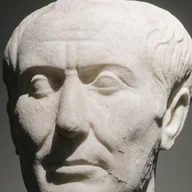
Julius Caesar

As Plutarch tells it, over a century later

In plain words, ours

We are told that on hearing Cato was dead, he said only this: Cato, I resent your death, because you denied me the chance to spare your life.

When, however, he heard of his death, he said thus much only, as we are told: O Cato, I begrudge thee thy death; for thou didst begrudge me the sparing of thy life.

Plutarch, Life of Cato the Younger 72.2Translated by Bernadotte Perrin (1919)Read the full passage (Plutarch, Life of Cato the Younger 72.2, opens scaife.perseus.org)

What was going on, our summary

As Plutarch tells it, over a century later: in 46 BCE, after Caesar beat the Republicans in Africa, Cato stayed in Utica, sent the others away, and took his own life. Caesar had been hurrying there with his army.

Checked claim by claim against: Cato kills himself rather than accept Caesar's pardon, the passage around the quote.

Why it matters

About the event it belongs to: Cato kills himself rather than accept Caesar's pardon

By choosing death over Caesar's pardon, Cato made himself a martyr for and a symbol of the Republic. Eulogies by Cicero and Brutus began to present him as a great Stoic philosopher.

Based on Wikipedia: Cato the Younger

he chose to take his own life rather than accept what he saw as Caesar's tyrannical pardon, turning himself into a martyr for and a symbol of the Republic

Cato's death triggered a series of eulogies, of which both Cicero and Brutus were authors, starting to identify Cato as a great Stoic philosopher.

Wikipedia, Cato the Younger (opens en.wikipedia.org), as of 2026-08-19. Text CC BY-SA 4.0. Our line is checked against these sentences only.

Related moments

In time order, with this one in its place. Each says why it is here.

  1. 49 BCE3 years earlier Caesar crosses the Rubicon with his army Same years
  2. 48 BCE2 years earlier Caesar defeats Pompey at Pharsalus Same years
  3. 48–47 BCEabout 2 years earlier Caesar takes Cleopatra's side in Egypt Same years
  4. 48 BCE2 years earlier Caesar on his speech before Pharsalus More from Julius Caesar
  5. 48 BCE2 years earlier Caesar on Pompey's killing in Egypt More from Julius Caesar
  6. 47 BCE1 year earlier Caesar's three words, as Plutarch tells it More from Julius Caesar
  7. 46 BCESame year Cato kills himself rather than accept Caesar's pardon The event behind itAlso about death
  8. 46 BCEThis momentCaesar on Cato's death, as Plutarch tells it
  9. 46 BCESame year Cato's death at Utica, as Plutarch tells it About Cato the Younger
  10. 46 BCESame year Cato's last night, as Plutarch tells it Same passage
  11. 46 BCESame year Cato's last night, as Plutarch tells it Same passageAlso about death
  12. 44 BCE2 years later Caesar is stabbed to death in the Senate Same years

Just before and after

The text around the quote, word for word from the same translation.

Show the passageHide the passage

And this they continued to do even when word was brought that Caesar was approaching. But neither fear of the conqueror, nor a desire to flatter him, nor their mutual strife and dissension, could blunt their desire to honour Cato. They decked his body in splendid fashion, gave it an illustrious escort, and buried it near the sea, where a statue of him now stands, sword in hand. Then they turned their thoughts to their own salvation and that of their city. When Caesar learned from people who came to him that Cato was remaining in Utica and not trying to escape, but that he was sending off the rest, while he himself, his companions, and his son, were fearlessly going up and down, he thought it difficult to discern the purpose of the man, but since he made the greatest account of him, he came on with his army in all haste.

The quote: When, however, he heard of his death, he said thus much only, as we are told: O Cato, I begrudge thee thy death; for thou didst begrudge me the sparing of thy life.

For, in reality, if Cato could have consented to have his life spared by Caesar, he would not be thought to have defiled his own fair fame, but rather to have adorned that of Caesar. However, what would have happened is uncertain; though the milder course is to be conjectured on the part of Caesar. When Cato died, he was forty-eight years old. His son received no harm at the hands of Caesar, but he was of an easy disposition, as we are told, and in his relations with women not blameless.

Plutarch, Life of Cato the Younger 71.2–73.1Translated by Bernadotte Perrin (1919)Read the full passage (opens scaife.perseus.org)

When, and whose words

Date
46 BCE. The news of Cato's death at Utica, 46 BCE.
Whose words
As Plutarch tells it, over a century later.
How this post was checked
  • The plain-words line was read against the quote alone by a second, independent pass, which found it adds no claim the quote does not make (2026-10-03).
  • Each claim in the summary was checked by an independent pass against only the material it cites.
  • The quote itself is checked by the build: word for word, once, at the cited section of the stored translation.

See it among its momentsMore from Julius CaesarSee it in the feed