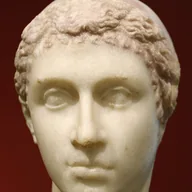
What was going on: As Plutarch tells it, over a century later, this is Cleopatra on her way to meet Antony in 41 BCE, bringing gifts and money but trusting most in herself. The year before, Antony and Octavian had beaten Caesar's killers at Philippi.
Why it matters: After this meeting at Tarsos, Cleopatra had an affair with Antony that produced three children.
He kept writing to summon her. She laughed at him and sailed up the river in a barge with a gilded stern with purple sails and silver oars, to music.
Though she received many letters of summons both from Antony himself and from his friends, she so despised and laughed the man to scorn as to sail up the river Cydnus in a barge with gilded poop, its sails spread purple, its rowers urging it on with silver oars to the sound of the flute blended with pipes and lutes.
Plutarch, describing her, over a century later. Plutarch, Life of Antony 26.1, translated by Bernadotte Perrin (1920)
What was going on: As Plutarch tells it, writing over a century later, in Asia Minor in 41 BCE Cleopatra hosts Antony at a feast lit by countless lamps, and his attempt to outdo her the next day falls short. Plutarch then stops to describe what made her so striking.
Her looks alone were not stunning, people said. It was talking with her that was irresistible: her presence, her persuasiveness, her character.
For her beauty, as we are told, was in itself not altogether incomparable, nor such as to strike those who saw her; but converse with her had an irresistible charm, and her presence, combined with the persuasiveness of her discourse and the character which was somehow diffused about her behaviour towards others, had something stimulating about it.
Plutarch, describing her, over a century later. Plutarch, Life of Antony 27.2, translated by Bernadotte Perrin (1920)
What was going on: Plutarch, writing over a century later, tells this from Antony's time with Cleopatra in Alexandria. Antony had secretly had divers fasten fish to his hook to impress her. She saw through it and invited her friends to watch him fish the next day.
She had a servant hook a salted fish on his line; everyone laughed, and she told him: leave fishing to the fishermen; your sport is hunting cities, kingdoms and continents.
…when Antony had let down his line, she ordered one of her own attendants to get the start of him by swimming to his hook and fastening on it a salted Pontic herring. Antony thought he had caught something, and pulled it up, whereupon there was great laughter, as was natural, and Cleopatra said: Imperator, hand over thy fishing-rod to the fishermen of Pharos and Canopus; thy sport is the hunting of cities, realms, and continents.
As Plutarch tells it, over a century later. Plutarch, Life of Antony 29.4, translated by Bernadotte Perrin (1920)
What was going on: Plutarch, writing over a century later, describes Cleopatra at the time she and Antony took turns throwing feasts for each other. He says her beauty alone was not what struck people; it was talking with her. Egypt's kings before her, he adds, had not even tried to learn the native language.
Why it matters: Cleopatra spoke many languages, and was the first Ptolemaic ruler known to have learned Egyptian; the dynasty before her refused to learn it.
Her voice was sweet, and she could switch to almost any language. She rarely needed an interpreter and answered most foreign visitors herself.
There was sweetness also in the tones of her voice; and her tongue, like an instrument of many strings, she could readily turn to whatever language she pleased, so that in her interviews with Barbarians she very seldom had need of an interpreter, but made her replies to most of them herself and unassisted, whether they were Ethiopians, Troglodytes, Hebrews, Arabians, Syrians, Medes or Parthians.
Plutarch, describing her, over a century later. Plutarch, Life of Antony 27.3, translated by Bernadotte Perrin (1920)
What was going on: As Plutarch tells it, over a century later: Antony is dead and Cleopatra is closely guarded in Alexandria, 30 BCE. Told that Octavian means to send her and her children away within three days, she asks to pour offerings at Antony's tomb, and speaks to the urn with his ashes.
Why it matters: With Antony dead, Octavian became the undisputed master of the Roman world. After Cleopatra's death Egypt became a Roman province, marking the end of the Hellenistic period.
These are my last offerings to you. Nothing parted us in life, but in death we may swap places: you buried here, and me in Italy.
Do not expect other honours or libations; these are the last from Cleopatra the captive. For though in life nothing could part us from each other, in death we are likely to change places; thou, the Roman, lying buried here, while I, the hapless woman, lie in Italy, and get only so much of thy country as my portion.
As Plutarch tells it, over a century later. Plutarch, Life of Antony 84.3, translated by Bernadotte Perrin (1920)
What was going on:Alexandria, 30 BCE, with Octavian at the city. Messengers open Cleopatra's room and find her dead on a golden couch, Iras, one of her women, dying at her feet. Plutarch, writing over a century later, gives the story people told and admits no one knows how she died.
Why it matters: With Antony dead, Octavian became the undisputed master of the Roman world. After Cleopatra's death Egypt became a Roman province, marking the end of the Hellenistic period.
It is said a snake was hidden under figs and leaves. When she saw it, she said: there it is, and held out her arm for the bite.
It is said that the asp was brought with those figs and leaves and lay hidden beneath them, for thus Cleopatra had given orders, that the reptile might fasten itself upon her body without her being aware of it. But when she took away some of the figs and saw it, she said: There it is, you see, and baring her arm she held it out for the bite.
As Plutarch tells it, over a century later. Plutarch, Life of Antony 86.1, translated by Bernadotte Perrin (1920)