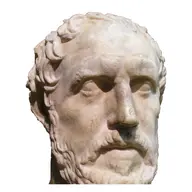
What was going on: Thucydides opens his history here. The war began in 431 BCE when a Theban force slipped into Plataea, an ally of Athens, at night, and soon a Spartan army invaded the farmland around Athens.
Why it matters: These are the opening words of a history widely considered a classic and one of the earliest scholarly works of history, which has been enormously influential in ancient and modern historiography.
I started writing about this war the moment it began, because I thought it would be a great war, more worth telling than any before it.
Thucydides, an Athenian, wrote the history of the war between the Peloponnesians and the Athenians, beginning at the moment that it broke out, and believing that it would be a great war, and more worthy of relation than any that had preceded it.
His own words. Thucydides, History of the Peloponnesian War 1.1.1, translated by Richard Crawley (1874)
What was going on: Thucydides is describing the plague that hit Athens in 430 BCE, soon after the Spartans invaded the land around the city again. No one remembered a disease that killed so many, and it struck Piraeus first.
Why it matters: The plague killed an estimated 75,000 to 100,000 people, around a quarter of Athens, and dealt the city massive damage from which it never recovered.
At first doctors didn't know how to treat it, and they died in the greatest numbers, because they saw the sick most. Prayers and oracles were no use either, until people gave them up.
Neither were the physicians at first of any service, ignorant as they were of the proper way to treat it, but they died themselves the most thickly, as they visited the sick most often; nor did any human art succeed any better. Supplications in the temples, divinations, and so forth were found equally futile, till the overwhelming nature of the disaster at last put a stop to them altogether.
His own words. Thucydides, History of the Peloponnesian War 2.47.4, translated by Richard Crawley (1874)
What was going on: In 430 BCE a deadly plague struck Athens, soon after the Spartans invaded again. Thucydides says it hit Piraeus first, where people claimed the enemy had poisoned the water, then spread into the upper city.
Why it matters: His detailed account of the symptoms has been used, together with analysis of victims' remains, to try to identify what caused the epidemic.
I'll just describe the symptoms, so it might be recognized if it ever comes back. I can, because I caught it myself and watched it in others.
…for myself, I shall simply set down its nature, and explain the symptoms by which perhaps it may be recognized by the student, if it should ever break out again. This I can the better do, as I had the disease myself, and watched its operation in the case of others.
His own words. Thucydides, History of the Peloponnesian War 2.48.3, translated by Richard Crawley (1874)
What was going on: Thucydides is describing how people behaved as the plague spread through Athens. Burial customs had collapsed, and some people threw their own dead onto strangers' funeral fires.
Why it matters: The plague killed an estimated quarter of the city's people. In the long run it redistributed wealth within Athenian society and weakened Athens politically.
Rich people dropped dead and the poor inherited overnight. So people openly did what they used to hide, and spent fast, as if life and money could vanish tomorrow.
Men now coolly ventured on what they had formerly done in a corner, and not just as they pleased, seeing the rapid transitions produced by persons in prosperity suddenly dying and those who before had nothing succeeding to their property. So they resolved to spend quickly and enjoy themselves, regarding their lives and riches as alike things of a day.
His own words. Thucydides, History of the Peloponnesian War 2.53.1–2, translated by Richard Crawley (1874)
What was going on: Thucydides is comparing Pericles with the Athenian leaders who came after his death. He says the later leaders chased their own ambitions and handed state affairs to the whims of the crowd.
Why it matters: The historian Donald Kagan argues that Pericles's war strategy depended on Pericles himself to carry it out, and so was bound to be abandoned after his death.
When the people got cocky, he could scare them with a word; when they panicked, he calmed them. It was called a democracy, but really one man led it.
Whenever he saw them unseasonably and insolently elated, he would with a word reduce them to alarm; on the other hand, if they fell victims to a panic, he could at once restore them to confidence. In short, what was nominally a democracy became in his hands government by the first citizen.
His own words. Thucydides, History of the Peloponnesian War 2.65.9, translated by Richard Crawley (1874)
What was going on: Thucydides is describing the bloody revolution at Corcyra in 427 BCE, one of the first of its kind. In the war, popular leaders in city after city called in the Athenians and oligarchs called in the Spartans, and revolution spread from city to city.
Why it matters: His analysis of the atrocities in the civil conflict on Corcyra has been cited as a sign that he was moved by the suffering of war and the excesses human nature is prone to in it.
Civil war brings horrors that will keep happening as long as people are people. In good times we behave better; war takes away the basics and drags most people down with it.
The sufferings which revolution entailed upon the cities were many and terrible, such as have occurred and always will occur, as long as the nature of mankind remains the same; though in a severer or milder form, and varying in their symptoms, according to the variety of the particular cases. In peace and prosperity states and individuals have better sentiments, because they do not find themselves suddenly confronted with imperious necessities; but war takes away the easy supply of daily wants, and so proves a rough master, that brings most men's characters to a level with their fortunes.
His own words. Thucydides, History of the Peloponnesian War 3.82.2, translated by Richard Crawley (1874)
What was going on: Thucydides is describing the revolution inside the city of Corcyra in 427 BCE, and how such revolutions spread from city to city. He says that war, by taking away the easy supply of daily needs, drags most people's characters down to the level of their circumstances.
Words flipped their meaning. Recklessness was called loyal courage, caution was called cowardice, and seeing both sides meant you were useless.
Words had to change their ordinary meaning and to take that which was now given them. Reckless audacity came to be considered the courage of a loyal ally; prudent hesitation, specious cowardice; moderation was held to be a cloak for unmanliness; ability to see all sides of a question inaptness to act on any.
His own words. Thucydides, History of the Peloponnesian War 3.82.4, translated by Richard Crawley (1874)
What was going on: Thucydides is describing the civil strife in Corcyra in 427 BCE. Leaders on two sides, one crying equality for the people and the other a moderate aristocracy, fought for power and took revenge without limit.
Neither side respected religion, but nice words for ugly goals were admired. The moderates in the middle were killed, for staying out or out of envy.
Thus religion was in honor with neither party; but the use of fair phrases to arrive at guilty ends was in high reputation. Meanwhile the moderate part of the citizens perished between the two, either for not joining in the quarrel, or because envy would not suffer them to escape.
His own words. Thucydides, History of the Peloponnesian War 3.82.8, translated by Richard Crawley (1874)
What was going on: Thucydides has just counted up the length of the whole war, which people often said would last three times nine years. After Amphipolis was lost under his command, he was exiled for twenty years.
Why it matters: Exile let Thucydides travel freely among Sparta's allies and see the war from the point of view of both sides.
I lived through all of it, old enough to understand it. I was exiled for twenty years after my command at Amphipolis, which let me watch both sides closely.
I lived through the whole of it, being of an age to comprehend events, and giving my attention to them in order to know the exact truth about them. It was also my fate to be an exile from my country for twenty years after my command at Amphipolis; and being present with both parties, and more especially with the Peloponnesians by reason of my exile, I had leisure to observe affairs somewhat particularly.
His own words. Thucydides, History of the Peloponnesian War 5.26.5, translated by Richard Crawley (1874)
What was going on: As Thucydides writes it, Athenian envoys are talking with the people of Melos, a neutral island that refuses to join Athens, in 416 BCE. The Athenians say they will skip fine speeches about their right to an empire. After a siege, Athens killed Melos' men and enslaved the women and children.
Why it matters: The Melian dialogue is regarded as a seminal text of international relations theory, and this line in particular is taken as an appeal to political power as opposed to justice.
In the real world, fairness only comes up between equals in power. Otherwise the strong do what they can and the weak put up with what they must.
…since you know as well as we do that right, as the world goes, is only in question between equals in power, while the strong do what they can and the weak suffer what they must.
The Athenian envoys speaking, as Thucydides writes it. Thucydides, History of the Peloponnesian War 5.89.1, translated by Richard Crawley (1874)
What was going on: In 416 BCE an Athenian force came to Melos, a neutral island that refused to join Athens. In the talks Thucydides writes up, the Melians say the gods will favor them as just men and the Spartans will help; here the Athenian envoys reply.
Why it matters: The Melian dialogue describes one of the early instances of power politics, and it is taught as arguing that the only rational approach is based on power and advantage.
Gods, we think, and people, we know, rule wherever they can. We didn't invent that rule, we just use it, and you would too in our place.
Of the gods we believe, and of men we know, that by a necessary law of their nature they rule wherever they can. And it is not as if we were the first to make this law, or to act upon it when made: we found it existing before us, and shall leave it to exist for ever after us; all we do is to make use of it, knowing that you and everybody else, having the same power as we have, would do the same as we do.
The Athenian envoys speaking, as Thucydides writes it. Thucydides, History of the Peloponnesian War 5.105.2, translated by Richard Crawley (1874)
What was going on: Thucydides is explaining how he wrote his history of the war. He says some speeches he heard himself and others he got from various people, and that he tested reports of events against different eyewitnesses.
Why it matters: Classicists treat his speeches with suspicion, since it is not clear how far he altered them, and some are probably made up to fit what, as he puts it here, each situation called for.
It was always hard to remember speeches word for word, so I wrote what I thought each speaker needed to say, staying as close as I could to the gist of what they really said.
…it was in all cases difficult to carry them word for word in one's memory, so my habit has been to make the speakers say what was in my opinion demanded of them by the various occasions, of course adhering as closely as possible to the general sense of what they really said.
His own words. Thucydides, History of the Peloponnesian War 1.22.1, translated by Richard Crawley (1874)
What was going on: Thucydides, exiled for twenty years after Amphipolis, is explaining how he wrote his history: he did not trust the first source or even his own impressions, and checked eyewitnesses who often disagreed. Next he says no war brought more misfortune on Greece.
Why it matters: The passage belongs to his famous introductory statement, which is thought to refer to a fellow historian without naming him.
My history may be less fun without legends. But if it helps people understand the future, which will look a lot like the past, that's enough. I wrote it to last.
The absence of romance in my history will, I fear, detract somewhat from its interest; but if it be judged useful by those inquirers who desire an exact knowledge of the past as an aid to the interpretation of the future, which in the course of human things must resemble if it does not reflect it, I shall be content. In fine, I have written my work, not as an essay which is to win the applause of the moment, but as a possession for all time.
His own words. Thucydides, History of the Peloponnesian War 1.22.4, translated by Richard Crawley (1874)
What was going on: Thucydides is ending his account of the Athenian expedition to Sicily in 413 BCE. At least seven thousand prisoners were taken, and back in Athens people at first refused to believe a defeat so complete.
Why it matters:Athens lost two hundred ships and thousands of men in a single campaign. Some historians see the failure as the turning point of the war, though Athens fought on for another decade.
In my view the biggest event in Greek history: glorious for the winners, a catastrophe for the losers. Fleet, army, everything was destroyed, and few came home.
This was the greatest Hellenic achievement of any in this war, or, in my opinion, in Hellenic history; at once most glorious to the victors, and most calamitous to the conquered. They were beaten at all points and altogether; all that they suffered was great; they were destroyed, as the saying is, with a total destruction, their fleet, their army—everything was destroyed, and few out of many returned home.
His own words. Thucydides, History of the Peloponnesian War 7.87.5–6, translated by Richard Crawley (1874)