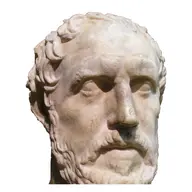
hstry

Thucydides on a possession for all time

c. 431–400 BCE, Greece. His own words.

Where and when

c. 431–400 BCEGreece, not on the map

about 2,440 years ago

Explore
Thucydides, c. 460 – c. 400 BCE3000 BCE2900 BCE2800 BCE2700 BCE2600 BCE2500 BCE2400 BCE2300 BCE2200 BCE2100 BCE2000 BCE1900 BCE1800 BCE1700 BCE1600 BCE1500 BCE1400 BCE1300 BCE1200 BCE1100 BCE1000 BCE900 BCE800 BCE700 BCE600 BCE500 BCE400 BCE300 BCE200 BCE100 BCE1 CE100 CE200 CE300 CE400 CE500 CE600 CE700 CE800 CE900 CE1000 CE1100 CE1200 CE1300 CE1400 CE1500 CE1600 CE1700 CE1800 CE1900 CE2000 CEGreat Pyramid of Giza built, c. 2600 BCERome founded (traditional date), 753 BCELast western Roman emperor deposed, 476 CEGutenberg's printing press, c. 1440 CEColumbus reaches the Americas, 1492 CEFirst people on the Moon, 1969 CEToday, 2026sometime in these 31 years

Swipe the line. Bars: entries. Dots: events.

In plain words, ours

My history may be less fun without legends. But if it helps people understand the future, which will look a lot like the past, that's enough. I wrote it to last.

The absence of romance in my history will, I fear, detract somewhat from its interest; but if it be judged useful by those inquirers who desire an exact knowledge of the past as an aid to the interpretation of the future, which in the course of human things must resemble if it does not reflect it, I shall be content. In fine, I have written my work, not as an essay which is to win the applause of the moment, but as a possession for all time.

Thucydides, History of the Peloponnesian War 1.22.4Translated by Richard Crawley (1874)Read the full passage (Thucydides, History of the Peloponnesian War 1.22.4, opens scaife.perseus.org)
What was going on, our summary

Thucydides, exiled for twenty years after Amphipolis, is explaining how he wrote his history: he did not trust the first source or even his own impressions, and checked eyewitnesses who often disagreed. Next he says no war brought more misfortune on Greece.

Checked claim by claim against: Thucydides fails to save Amphipolis and is exiled, the passage around the quote.

Why it matters

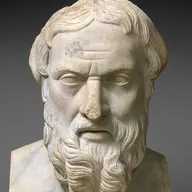
The passage belongs to his famous introductory statement, which is thought to refer to a fellow historian without naming him.

Based on Wikipedia: Thucydides

Thucydides does not mention his counterpart by name, but his famous introductory statement is thought to refer to him

And it is compiled rather for an everlasting possession than to be rehearsed for a prize. (1:22)

Wikipedia, Thucydides (opens en.wikipedia.org), as of 2026-06-23. Text CC BY-SA 4.0. Our line is checked against these sentences only.

Related moments

In time order, with this one in its place. Each says why it is here.

  1. c. 430–425 BCEabout 12 years earlier Herodotus on why he wrote his Histories Also about how history gets told
  2. 424/423 BCEabout 9 years earlier Thucydides fails to save Amphipolis and is exiled The event behind itAlso about how history gets told
  3. 416 BCE1 year earlier Athens takes Melos and kills its men Same years
  4. 416 BCE, written later1 year earlier The Athenian envoys to Melos on power More from Thucydides
  5. 416 BCE, written later1 year earlier Athenian envoys to Melos on the strong and weak More from Thucydides
  6. 415 BCE0.10000000000002274 years earlier Statues of Hermes are smashed across Athens Same years
  7. 415 BCEAbout the same year The great fleet sails for Sicily Same years
  8. c. 431–400 BCEThis momentThucydides on a possession for all time
  9. c. 420–410 BCEDuring it Socrates on why he stays in the city Same years
  10. c. 431–400 BCEDuring it Thucydides on how he wrote the speeches Same passageMore from Thucydides
  11. 413 BCEabout 2 years later The Athenian army is destroyed in Sicily Same years

Just before and after

The text around the quote, word for word from the same translation.

Show the passageHide the passage

And with reference to the narrative of events, far from permitting myself to derive it from the first source that came to hand, I did not even trust my own impressions, but it rests partly on what I saw myself, partly on what others saw for me, the accuracy of the report being always tried by the most severe and detailed tests possible. My conclusions have cost me some labour from the want of coincidence between accounts of the same occurrences by different eye-witnesses, arising sometimes from imperfect memory, sometimes from undue partiality for one side or the other.

The quote: The absence of romance in my history will, I fear, detract somewhat from its interest; but if it be judged useful by those inquirers who desire an exact knowledge of the past as an aid to the interpretation of the future, which in the course of human things must resemble if it does not reflect it, I shall be content. In fine, I have written my work, not as an essay which is to win the applause of the moment, but as a possession for all time.

The Median war, the greatest achievement of past times, yet found a speedy decision in two actions by sea and two by land. The Peloponnesian war was prolonged to an immense length, and long as it was it was short without parallel for the misfortunes that it brought upon Hellas. Never had so many cities been taken and laid desolate, here by the barbarians, here by the parties contending (the old inhabitants being sometimes removed to make room for others); never was there so much banishing and blood-shedding, now on the field of battle, now in the strife of action.

Thucydides, History of the Peloponnesian War 1.22.2–1.23.2Translated by Richard Crawley (1874)Read the full passage (opens scaife.perseus.org)

When, and whose words

Date
c. 431–400 BCE. A note on his method, written at some point between the war's start in 431 BCE and his death c. 400 BCE.
Whose words
His own words. Who was Thucydides?
How this post was checked
  • The plain-words line was read against the quote alone by a second, independent pass, which found it adds no claim the quote does not make (2026-10-03).
  • Each claim in the summary was checked by an independent pass against only the material it cites.
  • The quote itself is checked by the build: word for word, once, at the cited section of the stored translation.

See it among its momentsMore from ThucydidesSee it in the feed