hstry

Herodotus on why he wrote his Histories

c. 430–425 BCE, Greece. His own words.

Where and when

c. 430–425 BCEGreece, not on the map

about 2,452 years ago

Explore
Herodotus, c. 484 – c. 425 BCE3000 BCE2900 BCE2800 BCE2700 BCE2600 BCE2500 BCE2400 BCE2300 BCE2200 BCE2100 BCE2000 BCE1900 BCE1800 BCE1700 BCE1600 BCE1500 BCE1400 BCE1300 BCE1200 BCE1100 BCE1000 BCE900 BCE800 BCE700 BCE600 BCE500 BCE400 BCE300 BCE200 BCE100 BCE1 CE100 CE200 CE300 CE400 CE500 CE600 CE700 CE800 CE900 CE1000 CE1100 CE1200 CE1300 CE1400 CE1500 CE1600 CE1700 CE1800 CE1900 CE2000 CEGreat Pyramid of Giza built, c. 2600 BCERome founded (traditional date), 753 BCELast western Roman emperor deposed, 476 CEGutenberg's printing press, c. 1440 CEColumbus reaches the Americas, 1492 CEFirst people on the Moon, 1969 CEToday, 2026sometime in these 5 years

Swipe the line. Bars: entries. Dots: events.

In plain words, ours

I wrote this so people won't forget what humans did: the great deeds of Greeks and non-Greeks alike, and why they went to war.

…so that things done by man not be forgotten in time, and that great and marvelous deeds, some displayed by the Hellenes, some by the barbarians, not lose their glory, including among others what was the cause of their waging war on each other.

Herodotus, Histories 1.1.prTranslated by A. D. Godley (1920)Read the full passage (Herodotus, Histories 1.1.pr, opens scaife.perseus.org)
What was going on, our summary

These are the opening words of Herodotus' Histories, where he presents his inquiry. Right after, he begins with what Persian learned men say about how the quarrel between Greeks and foreigners started.

Checked claim by claim against: the passage around the quote.

Why it matters

These words open the Histories, which is considered the founding work of history in Western literature and established the genre and study of history in the West.

Based on Wikipedia: Histories (Herodotus)

is considered the founding work of history in Western literature.

It established the genre and study of history in the Western world.

Wikipedia, Histories (Herodotus) (opens en.wikipedia.org), as of 2026-09-03. Text CC BY-SA 4.0. Our line is checked against these sentences only.

Related moments

In time order, with this one in its place. Each says why it is here.

  1. 430 BCEabout 3 years earlier Plague breaks out in Athens Same years
  2. 431/430 BCEabout 3 years earlier Athens holds a public funeral for its first war dead Same years
  3. 430 BCE, written laterabout 3 years earlier Thucydides on the plague he caught Also about how history gets told
  4. 429 BCEabout 2 years earlier Pericles dies Same years
  5. 427 BCEAbout the same year Athens votes to kill Mytilene's men, then relents Also about war and empire
  6. c. 430–425 BCEThis momentHerodotus on why he wrote his Histories
  7. c. 430–425 BCEDuring it Herodotus says custom is lord of all More from Herodotus
  8. c. 430–425 BCEDuring it Herodotus on every nation's own customs More from Herodotus
  9. c. 430–425 BCEDuring it Herodotus on telling versus believing More from Herodotus
  10. 427 BCE, written laterAbout the same year Thucydides on revolution in the cities Also about war and empire
  11. 425 BCEabout 2 years later Spartans surrender on Sphacteria Same years
  12. 424/423 BCEabout 3 years later Thucydides fails to save Amphipolis and is exiled Also about how history gets told

Just before and after

The text around the quote, word for word from the same translation.

Show the passageHide the passage

This is the display of the inquiry of Herodotus of Halicarnassus ,

The quote: so that things done by man not be forgotten in time, and that great and marvelous deeds, some displayed by the Hellenes, some by the barbarians, not lose their glory, including among others what was the cause of their waging war on each other.

The Persian learned men say that the Phoenicians were the cause of the dispute. These (they say) came to our seas from the sea which is called Red, and having settled in the country which they still occupy, at once began to make long voyages. Among other places to which they carried Egyptian and Assyrian merchandise, they came to Argos , which was at that time preeminent in every way among the people of what is now called Hellas . The Phoenicians came to Argos , and set out their cargo.

Herodotus, Histories 1.1.pr–2Translated by A. D. Godley (1920)Read the full passage (opens scaife.perseus.org)

When, and whose words

Date
c. 430–425 BCE. When the Histories were being completed (c. 430–425 BCE); this is his opening statement of purpose.
Whose words
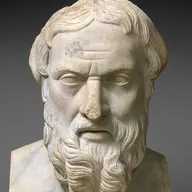
His own words. Who was Herodotus?
How this post was checked
  • The plain-words line was read against the quote alone by a second, independent pass, which found it adds no claim the quote does not make (2026-10-03).
  • Each claim in the summary was checked by an independent pass against only the material it cites.
  • The quote itself is checked by the build: word for word, once, at the cited section of the stored translation.

See it among its momentsMore from HerodotusSee it in the feed