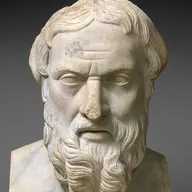
What was going on: These are the opening words of Herodotus' Histories, where he presents his inquiry. Right after, he begins with what Persian learned men say about how the quarrel between Greeks and foreigners started.
Why it matters: These words open the Histories, which is considered the founding work of history in Western literature and established the genre and study of history in the West.
I wrote this so people won't forget what humans did: the great deeds of Greeks and non-Greeks alike, and why they went to war.
…so that things done by man not be forgotten in time, and that great and marvelous deeds, some displayed by the Hellenes, some by the barbarians, not lose their glory, including among others what was the cause of their waging war on each other.
His own words. Herodotus, Histories 1.1.pr, translated by A. D. Godley (1920)
What was going on: Herodotus has just described Cambyses at Memphis opening ancient coffins and mocking temple images, which he takes as proof Cambyses was insane. Next he tells how Darius asked some Greeks what price would make them eat their dead fathers.
Ask every people on earth to pick the best customs, and each would pick its own. Everyone is sure their ways are best.
For if it were proposed to all nations to choose which seemed best of all customs, each, after examination, would place its own first; so well is each convinced that its own are by far the best.
His own words. Herodotus, Histories 3.38.1, translated by A. D. Godley (1920)
What was going on: Herodotus has just said that Cambyses must have been insane to mock other peoples' religion and customs, since every people thinks its own customs are the best. As proof, he tells how King Darius asked some Greeks what price would make them eat their dead fathers, and they said no price would.
A people who ate their dead parents were horrified at the idea of burning them. Beliefs run that deep. Custom rules everyone, I think.
Then Darius summoned those Indians who are called Callatiae, who eat their parents, and asked them (the Greeks being present and understanding through interpreters what was said) what would make them willing to burn their fathers at death. The Indians cried aloud, that he should not speak of so horrid an act. So firmly rooted are these beliefs; and it is, I think, rightly said in Pindar's poem that custom is lord of all.
His own words. Herodotus, Histories 3.38.4, translated by A. D. Godley (1920)
What was going on: Herodotus has just told a story about the city of Argos, Xerxes and Artoxerxes, and admits he cannot say for sure that it is true. Another tale he knows says the Argives invited the Persian into Greece.
My job is to write down what people told me. Believing it is not my job.
As for myself, although it is my business to set down that which is told me, to believe it is none at all of my business.
His own words. Herodotus, Histories 7.152.3, translated by A. D. Godley (1920)
What was going on: Herodotus has finished describing the Nile and turns to Egypt, which he says has more wonders than anywhere else. He goes on to list more Egyptian customs that run opposite to everyone else's.
Egypt has its own weather and its own river, and mostly the opposite customs. Women trade at the market; men stay home and weave.
Just as the Egyptians have a climate peculiar to themselves, and their river is different in its nature from all other rivers, so, too, have they instituted customs and laws contrary for the most part to those of the rest of mankind. Among them, the women buy and sell, the men stay at home and weave; and whereas in weaving all others push the woof upwards, the Egyptians push it downwards.
His own words. Herodotus, Histories 2.35.2, translated by A. D. Godley (1920)
What was going on: Herodotus is in Egypt, at the field where Persian invaders beat the Egyptians after a fierce fight. Locals told him about the bones, and said the difference came from Egyptians shaving their heads and Persians wearing felt hats.
I saw something strange where the battle was fought: the Persian skulls are so brittle a pebble would go through them, while the Egyptian ones barely crack under a stone.
I saw a strange thing on the site of the battle, of which the people of the country had told me. The bones of those killed on either side in this fight lying scattered separately (for the Persian bones lay in one place and the Egyptian in another, where the armies had first separately stood), the skulls of the Persians are so brittle that if you throw no more than a pebble it will pierce them, but the Egyptian skulls are so strong that a blow of a stone will hardly crack them.
His own words. Herodotus, Histories 3.12.1, translated by A. D. Godley (1920)
What was going on: In a story Herodotus tells, the Athenian Solon is a guest of Croesus, a very rich king. Croesus is annoyed that Solon ranks ordinary men above him in happiness, and Solon answers by counting up the days in a seventy-year life.
In a seventy-year life, no two days bring the same thing. A human life is all chance.
Out of all these days in the seventy years, all twenty-six thousand, two hundred and fifty of them, not one brings anything at all like another. So, Croesus, man is entirely chance.
Solon speaking, as Herodotus tells it. Herodotus, Histories 1.32.4, translated by A. D. Godley (1920)
What was going on: As Herodotus tells it, Solon is at Sardis with a king who is very rich and rules many people. The king has asked him a question, and Solon says he cannot answer until he knows how the king's life ends.
Only someone whose life also ends well deserves to be called fortunate. Until they die, just call them lucky.
If besides all this he ends his life well, then he is the one whom you seek, the one worthy to be called fortunate. But refrain from calling him fortunate before he dies; call him lucky.
Solon speaking, as Herodotus tells it. Herodotus, Histories 1.32.7, translated by A. D. Godley (1920)
What was going on: As Herodotus tells it, Croesus was on a burning pyre when a sudden storm put out the fire. Cyrus had him brought down and asked who persuaded him to make war on him; this is part of Croesus' answer.
Nobody is foolish enough to choose war over peace. In peace, children bury their parents. In war, parents bury their children.
No one is so foolish as to choose war over peace. In peace sons bury their fathers, in war fathers bury their sons.
Croesus speaking, as Herodotus tells it. Herodotus, Histories 1.87.4, translated by A. D. Godley (1920)
What was going on: Herodotus is describing the battle of Marathon. The Athenians, few and with no cavalry or archers, charged the Persians at a run, and the Persians thought them crazy. The Athenians and Plataeans then won on both wings and chased the Persians to their ships.
They were the first Greeks we know of to charge the enemy at a run, and the first to face the Medes without panicking at their name.
These are the first Hellenes whom we know of to use running against the enemy. They are also the first to endure looking at Median dress and men wearing it, for up until then just hearing the name of the Medes caused the Hellenes to panic.
His own words. Herodotus, Histories 6.112.3, translated by A. D. Godley (1920)
What was going on: Herodotus is describing the last stand of the Greeks at Thermopylae. After a fierce fight over the body of Leonidas, enemy troops led by Epialtes arrived, and the Spartans and Thespians fell back behind the wall to a small hill at the mouth of the pass.
They fought with swords if they still had them, and with hands and teeth. The enemy buried them under missiles from the front and from all sides.
In that place they defended themselves with swords, if they still had them, and with hands and teeth. The barbarians buried them with missiles, some attacking from the front and throwing down the defensive wall, others surrounding them on all sides.
His own words. Herodotus, Histories 7.225.3, translated by A. D. Godley (1920)
What was going on: Herodotus is describing the graves at Thermopylae, where the Greeks who fought the Medes were buried where they fell. Several inscriptions were set over them: one for all of them, and another for the seer Megistias.
The Spartans' own epitaph: Stranger, go tell the Spartans that we lie here, obedient to their orders.
That inscription is for them all, but the Spartans have their own: Foreigner, go tell the Spartans that we lie here obedient to their commands.
The Spartans' epitaph at Thermopylae, as Herodotus records it. Herodotus, Histories 7.228.2, translated by A. D. Godley (1920)
What was going on: As Herodotus tells it, Xerxes sat above the shore at Abydos watching his army and fleet fill the Hellespont. He called himself blessed, then wept, and his uncle Artabanus questioned him about it.
Xerxes said he felt pity: life is so short that of all these men, not one will be alive in a hundred years.
Xerxes said, “I was moved to compassion when I considered the shortness of all human life, since of all this multitude of men not one will be alive a hundred years from now.”
Xerxes speaking, as Herodotus tells it. Herodotus, Histories 7.46.2, translated by A. D. Godley (1920)