hstry

Herodotus on the Athenian charge at Marathon

c. 430–425 BCE, Marathon. His own words.

Where and when

c. 430–425 BCEMarathon

about 2,452 years ago

Explore
Herodotus, c. 484 – c. 425 BCE3000 BCE2900 BCE2800 BCE2700 BCE2600 BCE2500 BCE2400 BCE2300 BCE2200 BCE2100 BCE2000 BCE1900 BCE1800 BCE1700 BCE1600 BCE1500 BCE1400 BCE1300 BCE1200 BCE1100 BCE1000 BCE900 BCE800 BCE700 BCE600 BCE500 BCE400 BCE300 BCE200 BCE100 BCE1 CE100 CE200 CE300 CE400 CE500 CE600 CE700 CE800 CE900 CE1000 CE1100 CE1200 CE1300 CE1400 CE1500 CE1600 CE1700 CE1800 CE1900 CE2000 CEGreat Pyramid of Giza built, c. 2600 BCERome founded (traditional date), 753 BCELast western Roman emperor deposed, 476 CEGutenberg's printing press, c. 1440 CEColumbus reaches the Americas, 1492 CEFirst people on the Moon, 1969 CEToday, 2026sometime in these 5 years

Swipe the line. Bars: entries. Dots: events.

In plain words, ours

They were the first Greeks we know of to charge the enemy at a run, and the first to face the Medes without panicking at their name.

These are the first Hellenes whom we know of to use running against the enemy. They are also the first to endure looking at Median dress and men wearing it, for up until then just hearing the name of the Medes caused the Hellenes to panic.

Herodotus, Histories 6.112.3Translated by A. D. Godley (1920)Read the full passage (Herodotus, Histories 6.112.3, opens scaife.perseus.org)

What was going on, our summary

Herodotus is describing the battle of Marathon. The Athenians, few and with no cavalry or archers, charged the Persians at a run, and the Persians thought them crazy. The Athenians and Plataeans then won on both wings and chased the Persians to their ships.

Checked claim by claim against: the passage around the quote.

Related moments

In time order, with this one in its place. Each says why it is here.

  1. 430 BCEabout 3 years earlier Plague breaks out in Athens Same years
  2. 431/430 BCEabout 3 years earlier Athens holds a public funeral for its first war dead Same years
  3. 429 BCEabout 2 years earlier Pericles dies Same years
  4. 427 BCEAbout the same year Athens votes to kill Mytilene's men, then relents Also about war and empire
  5. c. 430–425 BCEThis momentHerodotus on the Athenian charge at Marathon
  6. c. 430–425 BCEDuring it Herodotus says custom is lord of all More from Herodotus
  7. c. 430–425 BCEDuring it Herodotus on every nation's own customs More from Herodotus
  8. c. 430–425 BCEDuring it Herodotus on why he wrote his Histories More from Herodotus
  9. 427 BCE, written laterAbout the same year Thucydides on revolution in the cities Also about war and empire
  10. 425 BCEabout 2 years later Spartans surrender on Sphacteria Same years

Just before and after

The text around the quote, word for word from the same translation.

Show the passageHide the passage

As the Athenians were marshalled at Marathon, it happened that their line of battle was as long as the line of the Medes. The center, where the line was weakest, was only a few ranks deep, but each wing was strong in numbers. When they had been set in order and the sacrifices were favorable, the Athenians were sent forth and charged the foreigners at a run. The space between the armies was no less than eight stadia. The Persians saw them running to attack and prepared to receive them, thinking the Athenians absolutely crazy, since they saw how few of them there were and that they ran up so fast without either cavalry or archers. So the foreigners imagined, but when the Athenians all together fell upon the foreigners they fought in a way worthy of record.

The quote: These are the first Hellenes whom we know of to use running against the enemy. They are also the first to endure looking at Median dress and men wearing it, for up until then just hearing the name of the Medes caused the Hellenes to panic.

They fought a long time at Marathon. In the center of the line the foreigners prevailed, where the Persians and Sacae were arrayed. The foreigners prevailed there and broke through in pursuit inland, but on each wing the Athenians and Plataeans prevailed. In victory they let the routed foreigners flee, and brought the wings together to fight those who had broken through the center. The Athenians prevailed, then followed the fleeing Persians and struck them down. When they reached the sea they demanded fire and laid hold of the Persian ships.

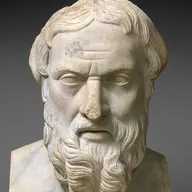
Herodotus, Histories 6.111.3–6.113.2Translated by A. D. Godley (1920)Read the full passage (opens scaife.perseus.org)

When, and whose words

Date
c. 430–425 BCE. When the Histories were being completed (c. 430–425 BCE); the battle he describes, Marathon, was in 490 BCE.
Whose words
His own words. Who was Herodotus?
How this post was checked
  • The plain-words line was read against the quote alone by a second, independent pass, which found it adds no claim the quote does not make (2026-10-03).
  • Each claim in the summary was checked by an independent pass against only the material it cites.
  • The quote itself is checked by the build: word for word, once, at the cited section of the stored translation.

See it among its momentsMore from HerodotusSee it in the feed