hstry

Herodotus on Persian and Egyptian skulls

c. 430–425 BCE, Egypt. His own words.

Where and when

c. 430–425 BCEEgypt, off the map

about 2,452 years ago

Explore
Herodotus, c. 484 – c. 425 BCE3000 BCE2900 BCE2800 BCE2700 BCE2600 BCE2500 BCE2400 BCE2300 BCE2200 BCE2100 BCE2000 BCE1900 BCE1800 BCE1700 BCE1600 BCE1500 BCE1400 BCE1300 BCE1200 BCE1100 BCE1000 BCE900 BCE800 BCE700 BCE600 BCE500 BCE400 BCE300 BCE200 BCE100 BCE1 CE100 CE200 CE300 CE400 CE500 CE600 CE700 CE800 CE900 CE1000 CE1100 CE1200 CE1300 CE1400 CE1500 CE1600 CE1700 CE1800 CE1900 CE2000 CEGreat Pyramid of Giza built, c. 2600 BCERome founded (traditional date), 753 BCELast western Roman emperor deposed, 476 CEGutenberg's printing press, c. 1440 CEColumbus reaches the Americas, 1492 CEFirst people on the Moon, 1969 CEToday, 2026sometime in these 5 years

Swipe the line. Bars: entries. Dots: events.

In plain words, ours

I saw something strange where the battle was fought: the Persian skulls are so brittle a pebble would go through them, while the Egyptian ones barely crack under a stone.

I saw a strange thing on the site of the battle, of which the people of the country had told me. The bones of those killed on either side in this fight lying scattered separately (for the Persian bones lay in one place and the Egyptian in another, where the armies had first separately stood), the skulls of the Persians are so brittle that if you throw no more than a pebble it will pierce them, but the Egyptian skulls are so strong that a blow of a stone will hardly crack them.

Herodotus, Histories 3.12.1Translated by A. D. Godley (1920)Read the full passage (Herodotus, Histories 3.12.1, opens scaife.perseus.org)

What was going on, our summary

Herodotus is in Egypt, at the field where Persian invaders beat the Egyptians after a fierce fight. Locals told him about the bones, and said the difference came from Egyptians shaving their heads and Persians wearing felt hats.

Checked claim by claim against: the passage around the quote.

Related moments

In time order, with this one in its place. Each says why it is here.

  1. 430 BCEabout 3 years earlier Plague breaks out in Athens Same years
  2. 431/430 BCEabout 3 years earlier Athens holds a public funeral for its first war dead Same years
  3. 429 BCEabout 2 years earlier Pericles dies Same years
  4. 427 BCEAbout the same year Athens votes to kill Mytilene's men, then relents Same years
  5. c. 430–425 BCEThis momentHerodotus on Persian and Egyptian skulls
  6. c. 430–425 BCEDuring it Herodotus says custom is lord of all More from Herodotus
  7. c. 430–425 BCEDuring it Herodotus on every nation's own customs More from Herodotus
  8. c. 430–425 BCEDuring it Herodotus on why he wrote his Histories More from Herodotus
  9. 425 BCEabout 2 years later Spartans surrender on Sphacteria Same years
  10. 48 BCEabout 379 years later Caesar on Pompey's killing in Egypt Also in Egypt

Just before and after

The text around the quote, word for word from the same translation.

Show the passageHide the passage

When the Persians had crossed the waterless country and encamped near the Egyptians intending to engage them, the Egyptian mercenaries, Greeks and Carians, devised a plan to punish Phanes, angered at him for leading a foreign army into Egypt . Phanes had left sons in Egypt ; these they brought to the camp, into their father's sight, and set a great bowl between the two armies; then they brought the sons one by one and cut their throats over the bowl. When all the sons had been slaughtered, they poured wine and water into the bowl, and the mercenaries drank this and then gave battle. The fighting was fierce, and many of both armies fell; but at last the Egyptians were routed.

The quote: I saw a strange thing on the site of the battle, of which the people of the country had told me. The bones of those killed on either side in this fight lying scattered separately (for the Persian bones lay in one place and the Egyptian in another, where the armies had first separately stood), the skulls of the Persians are so brittle that if you throw no more than a pebble it will pierce them, but the Egyptian skulls are so strong that a blow of a stone will hardly crack them.

And this, the people said (which for my own part I readily believed), is the explanation of it: the Egyptians shave their heads from childhood, and the bone thickens by exposure to the sun. This also is the reason why they do not grow bald; for nowhere can one see so few bald heads as in Egypt . Their skulls then are strong for this reason; while the Persian skulls are weak because they cover their heads throughout their lives with the felt hats (called tiaras) which they wear. Such is the truth of the matter.

Herodotus, Histories 3.11.1–3.12.4Translated by A. D. Godley (1920)Read the full passage (opens scaife.perseus.org)

When, and whose words

Date
c. 430–425 BCE. When the Histories were being completed (c. 430–425 BCE); he describes his own visit to an old battlefield in Egypt.
Whose words
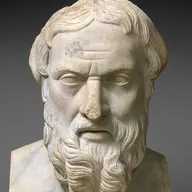
His own words. Who was Herodotus?
How this post was checked
  • The plain-words line was read against the quote alone by a second, independent pass, which found it adds no claim the quote does not make (2026-10-03).
  • Each claim in the summary was checked by an independent pass against only the material it cites.
  • The quote itself is checked by the build: word for word, once, at the cited section of the stored translation.

See it among its momentsMore from HerodotusSee it in the feed