hstry

Athenian envoys to Melos on the strong and weak

416 BCE, written later, Melos. The Athenian envoys speaking, as Thucydides writes it.

Where and when

416 BCE, written laterMelos

2,441 years ago

Explore
Thucydides, c. 460 – c. 400 BCE3000 BCE2900 BCE2800 BCE2700 BCE2600 BCE2500 BCE2400 BCE2300 BCE2200 BCE2100 BCE2000 BCE1900 BCE1800 BCE1700 BCE1600 BCE1500 BCE1400 BCE1300 BCE1200 BCE1100 BCE1000 BCE900 BCE800 BCE700 BCE600 BCE500 BCE400 BCE300 BCE200 BCE100 BCE1 CE100 CE200 CE300 CE400 CE500 CE600 CE700 CE800 CE900 CE1000 CE1100 CE1200 CE1300 CE1400 CE1500 CE1600 CE1700 CE1800 CE1900 CE2000 CEGreat Pyramid of Giza built, c. 2600 BCERome founded (traditional date), 753 BCELast western Roman emperor deposed, 476 CEGutenberg's printing press, c. 1440 CEColumbus reaches the Americas, 1492 CEFirst people on the Moon, 1969 CEToday, 2026

Swipe the line. Bars: entries. Dots: events.

Thucydides

, MelosThe Athenian envoys speaking, as Thucydides writes it

In plain words, ours

In the real world, fairness only comes up between equals in power. Otherwise the strong do what they can and the weak put up with what they must.

…since you know as well as we do that right, as the world goes, is only in question between equals in power, while the strong do what they can and the weak suffer what they must.

Thucydides, History of the Peloponnesian War 5.89.1Translated by Richard Crawley (1874)Read the full passage (Thucydides, History of the Peloponnesian War 5.89.1, opens scaife.perseus.org)

What was going on, our summary

As Thucydides writes it, Athenian envoys are talking with the people of Melos, a neutral island that refuses to join Athens, in 416 BCE. The Athenians say they will skip fine speeches about their right to an empire. After a siege, Athens killed Melos' men and enslaved the women and children.

Checked claim by claim against: Athens takes Melos and kills its men, the passage around the quote.

Why it matters

The Melian dialogue is regarded as a seminal text of international relations theory, and this line in particular is taken as an appeal to political power as opposed to justice.

Based on Wikipedia: Thucydides, Siege of Melos

The Melian dialogue is regarded as a seminal text of international relations theory

In particular, the quotation "the strong do what they can and the weak suffer what they must" is taken as an appeal to political power as opposed to justice.

Wikipedia, Thucydides (opens en.wikipedia.org), as of 2026-06-23; Wikipedia, Siege of Melos (opens en.wikipedia.org), as of 2026-08-10. Text CC BY-SA 4.0. Our line is checked against these sentences only.

Related moments

In time order, with this one in its place. Each says why it is here.

  1. 423 BCE7 years earlier The Unjust Cause on making the worse cause win Also about justice and law
  2. c. 430–405 BCEDuring it Socrates would rather suffer wrong than do it Also about justice and law
  3. 416 BCESame year Athens takes Melos and kills its men The event behind itAlso in MelosAlso about war and empire
  4. 416 BCE, written laterThis momentAthenian envoys to Melos on the strong and weak
  5. 416 BCE, written laterSame year The Athenian envoys to Melos on power Same passageMore from Thucydides
  6. 415 BCE0.8999999999999773 years later Statues of Hermes are smashed across Athens Same years
  7. 415 BCE1 year later The great fleet sails for Sicily Also about war and empire
  8. c. 431–400 BCEDuring it Thucydides on how he wrote the speeches More from Thucydides
  9. c. 431–400 BCEDuring it Thucydides on a possession for all time More from Thucydides
  10. 413 BCE3 years later The Athenian army is destroyed in Sicily Same years

Just before and after

The text around the quote, word for word from the same translation.

Show the passageHide the passage

‘It is natural and excusable for men in our position to turn more ways than one both in thought and utterance. However, the question in this conference is, as you say, the safety of our country; and the discussion, if you please, can proceed in the way which you propose.’ ‘For ourselves, we shall not trouble you with specious pretences—either of how we have a right to our empire because we overthrew the Mede, or are now attacking you because of wrong that you have done us—and make a long speech which would not be believed; and in return we hope that you, instead of thinking to influence us by saying that you did not join the Lacedaemonians, although their colonists, or that you have done us no wrong, will aim at what is feasible, holding in view the real sentiments of us both;

The quote: since you know as well as we do that right, as the world goes, is only in question between equals in power, while the strong do what they can and the weak suffer what they must.

’ ‘As we think, at any rate, it is expedient—we speak as we are obliged, since you enjoin us to let right alone and talk only of interest—that you should not destroy what is our common protection, the privilege of being allowed in danger to invoke what is fair and right, and even to profit by arguments not strictly valid if they can be got to pass current.

Thucydides, History of the Peloponnesian War 5.88.1–5.90.1Translated by Richard Crawley (1874)Read the full passage (opens scaife.perseus.org)

When, and whose words

Date
416 BCE, written later. The Athenian expedition against Melos was in 416 BCE; Thucydides wrote the dialogue during or after the war.
Whose words
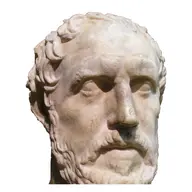
The Athenian envoys speaking, as Thucydides writes it. Who was Thucydides?
How this post was checked
  • The plain-words line was read against the quote alone by a second, independent pass, which found it adds no claim the quote does not make (2026-10-03).
  • Each claim in the summary was checked by an independent pass against only the material it cites.
  • The quote itself is checked by the build: word for word, once, at the cited section of the stored translation.

See it among its momentsMore from ThucydidesSee it in the feed