hstry

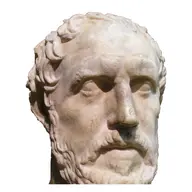
Thucydides opens his history of the war

431 BCE, written later, Athens. His own words.

Where and when

431 BCE, written laterAthens

2,456 years ago

Explore
Thucydides, c. 460 – c. 400 BCE3000 BCE2900 BCE2800 BCE2700 BCE2600 BCE2500 BCE2400 BCE2300 BCE2200 BCE2100 BCE2000 BCE1900 BCE1800 BCE1700 BCE1600 BCE1500 BCE1400 BCE1300 BCE1200 BCE1100 BCE1000 BCE900 BCE800 BCE700 BCE600 BCE500 BCE400 BCE300 BCE200 BCE100 BCE1 CE100 CE200 CE300 CE400 CE500 CE600 CE700 CE800 CE900 CE1000 CE1100 CE1200 CE1300 CE1400 CE1500 CE1600 CE1700 CE1800 CE1900 CE2000 CEGreat Pyramid of Giza built, c. 2600 BCERome founded (traditional date), 753 BCELast western Roman emperor deposed, 476 CEGutenberg's printing press, c. 1440 CEColumbus reaches the Americas, 1492 CEFirst people on the Moon, 1969 CEToday, 2026

Swipe the line. Bars: entries. Dots: events.

In plain words, ours

I started writing about this war the moment it began, because I thought it would be a great war, more worth telling than any before it.

Thucydides, an Athenian, wrote the history of the war between the Peloponnesians and the Athenians, beginning at the moment that it broke out, and believing that it would be a great war, and more worthy of relation than any that had preceded it.

Thucydides, History of the Peloponnesian War 1.1.1Translated by Richard Crawley (1874)Read the full passage (Thucydides, History of the Peloponnesian War 1.1.1, opens scaife.perseus.org)
What was going on, our summary

Thucydides opens his history here. The war began in 431 BCE when a Theban force slipped into Plataea, an ally of Athens, at night, and soon a Spartan army invaded the farmland around Athens.

Checked claim by claim against: Thebans attack Plataea and the war begins, Spartan army invades Attica, the passage around the quote.

Why it matters

These are the opening words of a history widely considered a classic and one of the earliest scholarly works of history, which has been enormously influential in ancient and modern historiography.

Based on Wikipedia: History of the Peloponnesian War

His account of the conflict is widely considered to be a classic and regarded as one of the earliest scholarly works of history.

Thucydides' History has been enormously influential in both ancient and modern historiography.

Wikipedia, History of the Peloponnesian War (opens en.wikipedia.org), as of 2026-09-14. Text CC BY-SA 4.0. Our line is checked against these sentences only.

Related moments

In time order, with this one in its place. Each says why it is here.

  1. 431 BCESame year Thebans attack Plataea and the war begins The event behind itAlso about war and empire
  2. 431 BCE, written laterThis momentThucydides opens his history of the war
  3. 431 BCESame year Medea on childbirth and battle Also in Athens
  4. 431 BCESame year Medea on being too clever Also in Athens
  5. 431 BCESame year Medea on the lot of women Also in Athens
  6. 431 BCE0.10000000000002274 years later Spartan army invades Attica The event behind itAlso about war and empire
  7. 430 BCE1 year later Plague breaks out in Athens Same years
  8. 431/430 BCEBegins this year Athens holds a public funeral for its first war dead Same years
  9. 430 BCE, written later1 year later Thucydides on the plague he caught More from Thucydides
  10. 430 BCE, written later1 year later Thucydides on the plague in Athens More from Thucydides
  11. 430 BCE, written later1 year later Thucydides on how the plague changed people More from Thucydides
  12. 429 BCE2 years later Pericles dies Same years
  13. c. 430–425 BCEabout 4 years later Herodotus on why he wrote his Histories Also about how history gets told
  14. 424/423 BCE7 years later Thucydides fails to save Amphipolis and is exiled Also about how history gets told

Just before and after

The text around the quote, word for word from the same translation.

Show the passageHide the passage

The quote: Thucydides, an Athenian, wrote the history of the war between the Peloponnesians and the Athenians, beginning at the moment that it broke out, and believing that it would be a great war, and more worthy of relation than any that had preceded it.

This belief was not without its grounds. The preparations of both the combatants were in every department in the last state of perfection; and he could see the rest of the Hellenic race taking sides in the quarrel; those who delayed doing so at once having it in contemplation. Indeed this was the greatest movement yet known in history, not only of the Hellenes, but of a large part of the barbarian world—I had almost said of mankind.

Thucydides, History of the Peloponnesian War 1.1.1–2Translated by Richard Crawley (1874)Read the full passage (opens scaife.perseus.org)

When, and whose words

Date
431 BCE, written later. He says he began when the war broke out in 431 BCE; he kept writing during and after the war and died c. 400 BCE.
Whose words
His own words. Who was Thucydides?
How this post was checked
  • The plain-words line was read against the quote alone by a second, independent pass, which found it adds no claim the quote does not make (2026-10-03).
  • Each claim in the summary was checked by an independent pass against only the material it cites.
  • The quote itself is checked by the build: word for word, once, at the cited section of the stored translation.

See it among its momentsMore from ThucydidesSee it in the feed