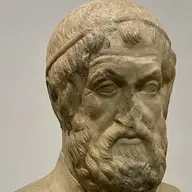
What was going on: In a Sophocles play, Creon has just stormed out, threatening a guard unless the culprits of a crime are found, and the guard leaves glad to be alive. The Chorus then sings of human power: crossing the stormy sea, plowing the earth, trapping birds and beasts.
The world is full of amazing things, and nothing is more amazing than human beings.
Wonders are many, and none is more wonderful than man.
The Chorus speaking, in Sophocles’ play. Sophocles, Antigone line 332, translated by Richard Jebb (1891)
What was going on: In Sophocles' play, Antigone has been caught giving her dead brother burial against a public order from Creon. Creon asks if she knew of the ban; she says yes, and that the order did not come from Zeus.
I didn't think your orders were strong enough for a human to override the gods' unwritten laws. Those laws are forever, and nobody knows where they began.
Nor did I think that your decrees were of such force, that a mortal could override the unwritten and unfailing statutes given us by the gods. For their life is not of today or yesterday, but for all time, and no man knows when they were first put forth.
Antigone speaking, in Sophocles’ play. Sophocles, Antigone lines 450–455, translated by Richard Jebb (1891)
What was going on: In Sophocles' play, Antigone faces Creon, ruler of Thebes, over her burial rites for her dead brother. Creon says that brother died attacking the land, while their other brother died defending it.
I was not made to share in hating, but in loving.
It is not my nature to join in hate, but in love.
Antigone speaking, in Sophocles’ play. Sophocles, Antigone line 523, translated by Richard Jebb (1891)
What was going on: In Sophocles' play Antigone, King Creon is arguing with his son Haemon. Haemon says the people of Thebes deny the woman is wicked, and Creon asks whether Thebes should tell him how to rule.
A city that belongs to just one man is not really a city.
That is no city, which belongs to one man.
Haemon speaking, in Sophocles’ play. Sophocles, Antigone line 737, translated by Richard Jebb (1891)
What was going on: In Sophocles' play, Haemon tells his father that the city quietly mourns a girl condemned to die for refusing to leave her fallen brother unburied. He begs his father not to think that his own word alone must be right.
Even a wise person loses nothing by learning and bending a little. Trees that bend in a flood survive; stiff ones are torn out by the roots.
No, even when a man is wise, it brings him no shame to learn many things, and not to be too rigid. You see how the trees that stand beside the torrential streams created by a winter storm yield to it and save their branches, while the stiff and rigid perish root and all?
Haemon speaking, in Sophocles’ play. Sophocles, Antigone line 710, translated by Richard Jebb (1891)
What was going on: In Sophocles' play, Creon has caught Antigone, a member of his own family, openly defying him, and says he will kill her. He argues that whoever the city puts in charge must be obeyed, in just and unjust things alike. His son Haemon then answers him.
Why it matters: Creon's view here is one side of the play's contrast over civil disobedience: he demands obedience to the law above all else, right or wrong, while Antigone holds that state law is not absolute and can be broken in extreme cases.
Nothing is worse than disobedience. It wrecks cities, ruins homes and makes armies break and run.
But there is no evil worse than disobedience. This destroys cities; this overturns homes; this breaks the ranks of allied spears into headlong rout.
Creon speaking, in Sophocles’ play. Sophocles, Antigone lines 670–675, translated by Richard Jebb (1891)
What was going on: In Sophocles' play, the seer Teiresias warns Creon that the city's altars are tainted and the gods refuse its sacrifices, because birds and dogs have fed on the body of Oedipus's fallen son.
Everyone makes mistakes. The one who fixes his mistake instead of digging in is not a fool; stubbornness is what looks foolish.
All men are liable to err. But when an error is made, that man is no longer unwise or unblessed who heals the evil into which he has fallen and does not remain stubborn. Self-will, we know, invites the charge of foolishness.
Teiresias speaking, in Sophocles’ play. Sophocles, Antigone lines 1020–1025, translated by Richard Jebb (1891)
What was going on: In Sophocles' play, Oedipus rules a city in trouble, and its people have come begging him to save it. He says he has already sent Creon to Apollo's oracle to learn how to protect the city.
You are all suffering, but none of you as much as I am. You each feel your own pain; I feel the city’s, my own and yours at once.
I know well that you all are sick, and though you are sick I know well that there is not one of you who is as sick as I. Your pain comes on each of you for himself alone, and for no other, but my soul is in pain at once for the city, for myself, and for you.
Oedipus speaking, in Sophocles’ play. Sophocles, Oedipus Tyrannus lines 58–60, translated by Richard Jebb (1887)
What was going on: In Sophocles' play, Oedipus is searching out the secret of his birth. Iocasta begs him to stop, then rushes into the palace in grief; Oedipus calls for the herdsman and guesses she is ashamed his origins may be lowly.
Let whatever happens happen. Even if I come from nothing, I need to know where I come from.
Break forth what will! Be my race ever so lowly, I crave to learn it.
Oedipus speaking, in Sophocles’ play. Sophocles, Oedipus Tyrannus line 1076, translated by Richard Jebb (1887)
What was going on: In Sophocles' play, a messenger brings news that Polybus, the father an oracle said Oedipus would kill, has died of sickness and old age. Oedipus is relieved but still fears the part of the oracle about his mother, and his wife Iocasta answers him.
Why should a person be afraid, if luck rules everything and nobody can see what is coming? Better to just live as it comes.
What should a mortal man fear, for whom the decrees of Fortune are supreme, and who has clear foresight of nothing? It is best to live at random, as one may.
Iocasta speaking, in Sophocles’ play. Sophocles, Oedipus Tyrannus line 977, translated by Richard Jebb (1887)
What was going on: In Sophocles' play Oedipus Tyrannus, the Chorus speaks as Creon leads Oedipus, once envied by all of Thebes, into the house. Oedipus has asked to be sent out of the land and begged not to lose his children.
Look how far he has fallen. So until someone’s last day has come and gone without disaster, do not call them happy.
See into what a stormy sea of troubles he has come! Therefore, while our eyes wait to see the final destined day, we must call no mortal happy until he has crossed life’s border free from pain.
The Chorus speaking, in Sophocles’ play. Sophocles, Oedipus Tyrannus lines 1525–1530, translated by Richard Jebb (1887)
What was going on: In Sophocles' play Oedipus at Colonus, staged after his death, Theseus has just promised an old man his life is safe. The Chorus then sings that long life brings more pain than joy, and that death comes to all.
Best of all is never to be born. Second best, once you are born, is to go back where you came from as fast as you can.
Not to be born is, beyond all estimation, best; but when a man has seen the light of day, this is next best by far, that with utmost speed he should go back from where he came.
The Chorus speaking, in Sophocles’ play. Sophocles, Oedipus at Colonus line 1225, translated by Richard Jebb (1889)
What was going on: In Sophocles' play, Oedipus, driven from his country by his own sons, speaks to Theseus. He goes on to warn that time turns friendship to hostility, between people and between cities, even between Thebes and Theseus.
Only the gods never grow old or die. Everything else is worn down into ruin by time, which beats everything.
Dearest son of Aegeus, to the gods alone old age and death never come, but everything else sinks into chaos from time which overpowers all.
Oedipus speaking, in Sophocles’ play. Sophocles, Oedipus at Colonus line 607, translated by Richard Jebb (1889)