hstry

Haemon begs his father to bend

c. 441 BCE, Athens (Theatre of Dionysus). Haemon speaking, in Sophocles’ play.

Where and when

c. 441 BCEAthens (Theatre of Dionysus)

about 2,466 years ago

Explore
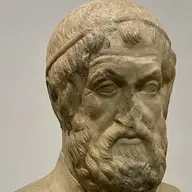
Sophocles, c. 497 – 406 BCE3000 BCE2900 BCE2800 BCE2700 BCE2600 BCE2500 BCE2400 BCE2300 BCE2200 BCE2100 BCE2000 BCE1900 BCE1800 BCE1700 BCE1600 BCE1500 BCE1400 BCE1300 BCE1200 BCE1100 BCE1000 BCE900 BCE800 BCE700 BCE600 BCE500 BCE400 BCE300 BCE200 BCE100 BCE1 CE100 CE200 CE300 CE400 CE500 CE600 CE700 CE800 CE900 CE1000 CE1100 CE1200 CE1300 CE1400 CE1500 CE1600 CE1700 CE1800 CE1900 CE2000 CEGreat Pyramid of Giza built, c. 2600 BCERome founded (traditional date), 753 BCELast western Roman emperor deposed, 476 CEGutenberg's printing press, c. 1440 CEColumbus reaches the Americas, 1492 CEFirst people on the Moon, 1969 CEToday, 2026

Swipe the line. Bars: entries. Dots: events.

Sophocles

, Athens (Theatre of Dionysus)Haemon speaking, in Sophocles’ play

In plain words, ours

Even a wise person loses nothing by learning and bending a little. Trees that bend in a flood survive; stiff ones are torn out by the roots.

No, even when a man is wise, it brings him no shame to learn many things, and not to be too rigid. You see how the trees that stand beside the torrential streams created by a winter storm yield to it and save their branches, while the stiff and rigid perish root and all?

Sophocles, Antigone line 710Translated by Richard Jebb (1891)Read the full passage (Sophocles, Antigone line 710, opens scaife.perseus.org)

What was going on, our summary

In Sophocles' play, Haemon tells his father that the city quietly mourns a girl condemned to die for refusing to leave her fallen brother unburied. He begs his father not to think that his own word alone must be right.

Checked claim by claim against: the passage around the quote.

Related moments

In time order, with this one in its place. Each says why it is here.

  1. 447 BCEabout 6 years earlier Work begins on the Parthenon Also in Athens
  2. set in c. 447 BCEabout 6 years earlier Pericles counsels waiting for Time Also in Athens
  3. 446/445 BCEabout 5 years earlier Athens and Sparta agree a Thirty Years' Peace Also in Athens
  4. c. 441 BCEThis momentHaemon begs his father to bend
  5. c. 441 BCEAbout the same year Haemon on a city ruled by one man Same passage
  6. c. 441 BCEAbout the same year Creon on disobedience Same passage
  7. c. 441 BCEAbout the same year Antigone on love, not hate More from Sophocles
  8. c. 441 BCEAbout the same year Antigone defies Creon More from Sophocles
  9. c. 441 BCEAbout the same year Sophocles' Chorus on the wonder of man More from Sophocles
  10. c. 433 BCEabout 8 years later Socrates says no one does evil willingly Also about how to live well
  11. 431 BCEabout 10 years later Medea on passion over reason Also about how to live well
  12. 431 BCEabout 10 years later Medea on being too clever Also about teaching and learning
  13. c. 420–410 BCEabout 26 years later Socrates on why he stays in the city Also about teaching and learning

Just before and after

The text around the quote, word for word from the same translation.

Show the passageHide the passage

Haemon: But I can hear these murmurs in the dark, how the city moans for this girl, saying: No woman ever merited death less— none ever died so shamefully for deeds so glorious as hers, who, when her own brother had fallen in bloody battle, would not leave him unburied to be devoured by savage dogs, or by any bird. Does she not deserve to receive golden honor? Such is the rumor shrouded in darkness that silently spreads. For me, father, no treasure is more precious than your prosperity. What, indeed, is a nobler ornament for children than the fair fame of a thriving father, or for a father than that of his children? Do not, then, bear one mood only in yourself: do not think that your word and no other, must be right. For if any man thinks that he alone is wise—that in speech or in mind he has no peer—such a soul, when laid open, is always found empty.

The quote: Haemon: No, even when a man is wise, it brings him no shame to learn many things, and not to be too rigid. You see how the trees that stand beside the torrential streams created by a winter storm yield to it and save their branches, while the stiff and rigid perish root and all?

Haemon: And in the same way the pilot who keeps the sheet of his sail taut and never slackens it, upsets his boat, and voyages thereafter with his decking underwater. Father, give way and allow a change from your rage. For if even from me, a younger man, a worthy thought may be supplied, by far the best thing, I believe, would be for men to be all-wise by nature. Otherwise—since most often it does not turn out that way—it is good to learn in addition from those who advise you well.

Sophocles, Antigone lines 690–720Translated by Richard Jebb (1891)Read the full passage (opens scaife.perseus.org)

When, and whose words

Date
c. 441 BCE. Antigone is usually dated to about 441 BCE from ancient notices; the exact year of its first staging is not recorded.
Whose words
Haemon speaking, in Sophocles’ play.
How this post was checked
  • The plain-words line was read against the quote alone by a second, independent pass, which found it adds no claim the quote does not make (2026-10-03).
  • Each claim in the summary was checked by an independent pass against only the material it cites.
  • The quote itself is checked by the build: word for word, once, at the cited section of the stored translation.

See it among its momentsMore from SophoclesSee it in the feed