What was going on:Rome, 62 CE. As Tacitus tells it, Nero's old tutor Seneca, made rich by Nero's gifts, asks to hand that wealth over and give his time to his mind instead. Three years later Nero ordered him to die.
Why it matters:Tacitus reports that Nero refused this request, and another in 64. In these final years Seneca wrote two of his greatest works, among them his Letters to Lucilius.
I am old and cannot carry the weight of my wealth any more. Please take my property into your estate. I need relief.
Just as I should implore support if exhausted by warfare or travel, so in this journey of life, old as I am and unequal even to the lightest cares, since I cannot any longer bear the burden of my wealth, I crave assistance. Order my property to be managed by your agents and to be included in your estate.
As Tacitus tells it. Tacitus, Annals 14.54, translated by A. J. Church and W. J. Brodribb (1876)
What was going on: A letter from Seneca to Lucilius, written in his last years, c. 62–65 CE, before Nero ordered him to die. Seneca has been urging Lucilius to hold on to every hour and not put things off.
Why it matters: Seneca's calm Stoic suicide later became the subject of numerous paintings.
Time is the only thing that is really ours, and it is so slippery that anyone who wants to can take it from us.
Nothing, Lucilius, is ours, except time. We were entrusted by nature with the ownership of this single thing, so fleeting and slippery that anyone who will can oust us from possession.
His own words, in a letter to Lucilius. Seneca, Moral Letters to Lucilius 1.3, translated by Richard M. Gummere (1917)
What was going on: Seneca, in a letter to Lucilius written around 62–65 CE, is urging him to stop letting his time slip away through carelessness. In 65 CE Nero ordered Seneca to kill himself.
Why it matters: Seneca's observation that we are dying every day sums up the concern with death that underlies a large number of his letters.
Who values each day and sees that he is dying a little every day? Death is not only ahead of us: the years behind us already belong to it.
What man can you show me who places any value on his time, who reckons the worth of each day, who understands that he is dying daily? For we are mistaken when we look forward to death; the major portion of death has already passed. Whatever years lie behind us are in death’s hands.
His own words, in a letter to Lucilius. Seneca, Moral Letters to Lucilius 1.2, translated by Richard M. Gummere (1917)
What was going on: In a letter to Lucilius, c. 62-65 CE, Seneca answers the question of what to avoid most. He admits his own weakness: he never comes home with the same character he went out with.
Crowds are bad for you: someone always makes a bad habit look good or rubs it off on you without you noticing. The bigger the crowd, the bigger the risk.
To consort with the crowd is harmful; there is no person who does not make some vice attractive to us, or stamp it upon us, or taint us unconsciously therewith. Certainly, the greater the mob with which we mingle, the greater the danger.
His own words, in a letter to Lucilius. Seneca, Moral Letters to Lucilius 7.2, translated by Richard M. Gummere (1917)
What was going on: Seneca, in a letter to Lucilius written c. 62–65 CE. He went to a midday show at the arena expecting fun and relaxation. Instead he saw men with no armour or shields made to fight until they died, a show many people liked better than the usual bouts.
Why it matters: Seneca's letter on this visit to the arena is the first surviving record of a pre-Christian writer expressing moral qualms about fights to the death.
Armour and skill would only put off the deaths. In the morning men are thrown to lions and bears; at noon, to the crowd.
What is the need of defensive armour, or of skill? All these mean delaying death. In the morning they throw men to the lions and the bears; at noon, they throw them to the spectators.
His own words, in a letter to Lucilius. Seneca, Moral Letters to Lucilius 7.4, translated by Richard M. Gummere (1917)
What was going on: A letter from Seneca to Lucilius, c. 62–65 CE. Seneca has heard that Lucilius lives on friendly terms with his slaves and praises him for it, then turns on masters who think it degrading to dine with a slave.
People say: they are slaves. No, they are human beings, companions, humble friends. Even fellow slaves, since luck rules the free and the enslaved alike.
“They are slaves,” people declare. Nay, rather they are men. “Slaves!” No, comrades. “Slaves!” No, they are unpretentious friends. “Slaves!” No, they are our fellow-slaves, if one reflects that Fortune has equal rights over slaves and free men alike.
His own words, in a letter to Lucilius. Seneca, Moral Letters to Lucilius 47.1, translated by Richard M. Gummere (1917)
What was going on: In a letter to Lucilius around 62–65 CE, Seneca writes about slaves: the man you call a slave comes from the same stock as you, and fortune has turned well-born men into shepherds and caretakers.
We Romans are far too proud, cruel and insulting toward slaves. My advice in short: treat those below you the way you would want those above you to treat you.
I do not wish to involve myself in too large a question, and to discuss the treatment of slaves, towards whom we Romans are excessively haughty, cruel, and insulting. But this is the kernel of my advice: Treat your inferiors as you would be treated by your betters.
His own words, in a letter to Lucilius. Seneca, Moral Letters to Lucilius 47.11, translated by Richard M. Gummere (1917)
What was going on: In a letter to Lucilius, Seneca answers a complaint that a long journey did not help. He backs his point with lines from Vergil and a remark Socrates made to a man with the same complaint.
Surprised that all that travel and new scenery did not lift your gloom? You need to change what is inside you, not where you are.
Are you surprised, as if it were a novelty, that after such long travel and so many changes of scene you have not been able to shake off the gloom and heaviness of your mind? You need a change of soul rather than a change of climate.
His own words, in a letter to Lucilius. Seneca, Moral Letters to Lucilius 28.1, translated by Richard M. Gummere (1917)
What was going on: In a letter to Lucilius, c. 62–65 CE, Seneca reminds him that Fortune has often knocked him down and he has got up again. Now Seneca offers some extra advice for facing fear, in his own milder style rather than the stern Stoic way.
More things scare us than actually hurt us. We suffer more often in our heads than in real life.
There are more things, Lucilius, likely to frighten us than there are to crush us; we suffer more often in imagination than in reality.
His own words, in a letter to Lucilius. Seneca, Moral Letters to Lucilius 13.4, translated by Richard M. Gummere (1917)
What was going on: A letter from Seneca to Lucilius, c. 62–65 CE. Seneca is trying to study and describes the racket around him, from men grunting as they lift lead weights to the slap of a hand giving someone a rubdown.
Why it matters: Letters like this one, On Noise, give valuable insights into daily life in ancient Rome as well as Seneca's Stoic philosophy.
Nothing matters more than quiet when you shut yourself away to study. Imagine the noise in my ears: I live right above a bathhouse.
Beshrew me if I think anything more requisite than silence for a man who secludes himself in order to study! Imagine what a variety of noises reverberates about my ears! I have lodgings right over a bathing establishment.
His own words, in a letter to Lucilius. Seneca, Moral Letters to Lucilius 56.1, translated by Richard M. Gummere (1917)
What was going on: Seneca writes to Lucilius around 62–65 CE, calling himself old. He says he has stopped wanting what he wanted as a boy, and writes this letter as if death might call him away while he writes. In 65 CE Nero ordered him to kill himself.
Why it matters: Seneca's calm Stoic suicide later became the subject of numerous paintings.
I try to live each day as if it were a whole life. I do not grab at it as if it were my last, but I keep in mind that it might be.
I am endeavouring to live every day as if it were a complete life. I do not indeed snatch it up as if it were my last; I do regard it, however, as if it might even be my last.
His own words, in a letter to Lucilius. Seneca, Moral Letters to Lucilius 61.1, translated by Richard M. Gummere (1917)
What was going on: In a late letter to Lucilius, Seneca writes about death, comparing life to a voyage that ends in a harbour every ship must reach. In 65 CE, accused of a plot, he was told by Nero to kill himself.
Why it matters: Seneca's calm Stoic suicide later became the subject of numerous paintings.
You should not always cling to a life like that. Just being alive is not the good thing; living well is. A wise person lives as long as he should, not as long as he can.
To such a life, as you are aware, one should not always cling. For mere living is not a good, but living well. Accordingly, the wise man will live as long as he ought, not as long as he can.
His own words, in a letter to Lucilius. Seneca, Moral Letters to Lucilius 70.4, translated by Richard M. Gummere (1917)
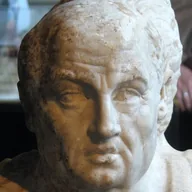
Portrait: Seneca's face on a Roman double herm with Socrates, his name SENECA inscribed beneath it, Antikensammlung Berlin (Sk 397); the inscription is what makes this identification secure. Mark Landon, CC BY 4.0 (opens commons.wikimedia.org)