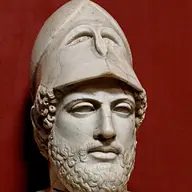
What was going on: As Plutarch tells it, centuries later, Pericles was known as a cautious general. Tolmides was about to raid Boeotia with a thousand volunteers. A few days after Pericles warned him, news came that Tolmides was dead after a defeat near Coroneia.
Why it matters: The raid Pericles warned against ended in defeat at Coronea, after which Pericles was forced to concede the loss of Boeotia to recover the prisoners.
If you won't listen to me, at least wait for the wisest adviser of all: time.
…he tried to restrain and dissuade him in the popular assembly, uttering then that well remembered saying, to wit, that if he would not listen to Pericles, he would yet do full well to wait for that wisest of all counsellors, Time.
As Plutarch tells it, centuries later. Plutarch, Life of Pericles 18.2, translated by Bernadotte Perrin (1916)
What was going on: As Thucydides tells it, Pericles is addressing the Athenians in 432 BCE, arguing that their strength is ruling the sea and that they should think of themselves as islanders. A year later the war between Athens and Sparta began.
Why it matters: Pericles set a defensive strategy for the war, aiming to exhaust the enemy and preserve the status quo; its critics have been just as numerous as its supporters.
Forget our farms and houses. Guard the sea and the city, and don't let anger over our land drag us into a battle against bigger armies.
Dismissing all thought of our land and houses, we must vigilantly guard the sea and the city. No irritation that we may feel for the former must provoke us to a battle with the numerical superiority of the Peloponnesians.
As Thucydides tells it. Thucydides, History of the Peloponnesian War 1.143.5, translated by Richard Crawley (1874)
What was going on: As Thucydides tells it, Pericles is speaking to the Athenians in 432 BCE, before war with Sparta begins. He urges them to give up their land and houses, guard the sea and the city, and not fight the larger Peloponnesian army in open battle.
Why it matters: Avoiding overextension was one of the two basic principles of his war strategy; some scholars argue Athens kept to it until the Sicilian Expedition.
I have good reason to hope we'll come through, if we don't chase new conquests or extra risks during the war. I fear our own mistakes more than the enemy's plans.
I have many other reasons to hope for a favorable issue, if you can consent not to combine schemes of fresh conquest with the conduct of the war, and will abstain from willfully involving yourselves in other dangers; indeed, I am more afraid of our own blunders than of the enemy's devices.
As Thucydides tells it. Thucydides, History of the Peloponnesian War 1.144.1, translated by Richard Crawley (1874)
What was going on: As Thucydides tells it, Athens is holding a public funeral for those who first fell in the war, and Pericles has been chosen to speak. Before praising the dead, he describes the kind of government under which Athens grew great.
Why it matters: The funeral oration is the most famous speech in Thucydides' History, and it is nowadays synonymous with the struggle for participatory democracy and civic pride.
We don't copy other states; they copy us. Our government serves the many, not the few. That's why it's called a democracy.
Our constitution does not copy the laws of neighboring states; we are rather a pattern to others than imitators ourselves. Its administration favors the many instead of the few; this is why it is called a democracy.
As Thucydides tells it. Thucydides, History of the Peloponnesian War 2.37.1, translated by Richard Crawley (1874)
What was going on: As Thucydides tells it, Pericles is praising Athens in a speech early in the war with Sparta. He has just described its democracy, where laws give equal justice and poverty does not stop a capable man from serving.
Why it matters: The lines these words come from, on equal justice under the laws and freedom in private life, form the roots of the famous phrase equal justice under law.
Our freedom reaches daily life too. We don't spy on each other or get angry at a neighbor for living as he likes, not even with dirty looks.
The freedom which we enjoy in our government extends also to our ordinary life. There, far from exercising a jealous surveillance over each other, we do not feel called upon to be angry with our neighbor for doing what he likes, or even to indulge in those injurious looks which cannot fail to be offensive, although they inflict no positive penalty.
As Thucydides tells it. Thucydides, History of the Peloponnesian War 2.37.2, translated by Richard Crawley (1874)
What was going on: As Thucydides tells it, Pericles is praising Athens and its way of life to his fellow citizens, early in the war with Sparta. He says ordinary Athenians, busy with work, still judge public matters, and see discussion as needed before any wise action.
Why it matters: The Theban attack on Plataea was the first attack of the war, in which Athens lost its Aegean empire and its maritime dominance and Sparta became the leading power of Greece.
We love beauty without waste and learning without going soft. Money is for using, not showing off. Being poor isn't shameful; not trying to escape it is.
We cultivate refinement without extravagance and knowledge without effeminacy; wealth we employ more for use than for show, and place the real disgrace of poverty not in owning to the fact but in declining the struggle against it.
As Thucydides tells it. Thucydides, History of the Peloponnesian War 2.40.1, translated by Richard Crawley (1874)
What was going on: In a speech Thucydides writes for Pericles, set in Athens in 431/430 BCE, early in the war with Sparta, Pericles praises the Athenian way of life, its courage and its generosity to friends. He goes on to say Athens alone proves greater than its reputation.
Why it matters: The Theban attack on Plataea was the first attack of the war, in which Athens lost its Aegean empire and its maritime dominance and Sparta became the leading power of Greece.
Our city is the school of Greece. I doubt anyone anywhere can handle as much on their own, and as gracefully, as an Athenian.
In short, I say that as a city we are the school of Hellas; while I doubt if the world can produce a man, who where he has only himself to depend upon, is equal to so many emergencies, and graced by so happy a versatility as the Athenian.
As Thucydides tells it. Thucydides, History of the Peloponnesian War 2.41.1, translated by Richard Crawley (1874)
What was going on: As Thucydides tells it, Pericles is speaking at the public funeral for those who first fell in the war. He is praising men who gave their lives together and urging the living to take them as their model.
Why it matters: Scholars have drawn parallels between this funeral oration and Lincoln's Gettysburg Address, though it is uncertain whether Lincoln was directly influenced by it.
Heroes are buried everywhere. Even far from home, with no stone to mark them, people remember them in their hearts.
For heroes have the whole earth for their tomb; and in lands far from their own, where the column with its epitaph declares it, there is enshrined in every breast a record unwritten with no tablet to preserve it, except that of the heart.
As Thucydides tells it. Thucydides, History of the Peloponnesian War 2.43.3, translated by Richard Crawley (1874)
What was going on: As Thucydides tells it, Pericles speaks to the Athenians in 430 BCE, the year plague broke out in the city. He tells them they cannot refuse the burdens of their empire and still share its honors.
Why it matters: Pericles's emotional final speech, given amid uproar over the plague, is considered a monumental oration, revealing his virtues but also his bitterness at his compatriots' ingratitude.
We can't back out now. To be blunt, what you hold is a tyranny. Taking it may have been wrong, but letting it go is dangerous.
Besides, to recede is no longer possible, if indeed any of you in the alarm of the moment has become enamored of the honesty of such an unambitious part. For what you hold is, to speak somewhat plainly, a tyranny; to take it perhaps was wrong, but to let it go is unsafe.
As Thucydides tells it. Thucydides, History of the Peloponnesian War 2.63.2, translated by Richard Crawley (1874)
What was going on: As Plutarch tells it, centuries later, Pericles is dying in 429 BCE. The leading citizens and his surviving friends sit around his bed listing his achievements, including nine victory trophies, thinking he can no longer hear them.
Why it matters: The historian Donald Kagan argues that Pericles's war strategy depended on Pericles himself to carry it out, and so was bound to be abandoned after his death.
Why praise what I owe as much to luck as to myself, and what other generals did too? My best claim is this: no Athenian alive ever had to mourn because of me.
He had been attending to it all, however, and speaking out among them said he was amazed at their praising and commemorating that in him which was due as much to fortune as to himself, and which had fallen to the lot of many generals besides, instead of mentioning his fairest and greatest title to their admiration; for, said he, no living Athenian ever put on mourning because of me.
As Plutarch tells it, centuries later. Plutarch, Life of Pericles 38.4, translated by Bernadotte Perrin (1916)