hstry

Pericles urges Athens to guard the sea

set in 432 BCE, Athens. As Thucydides tells it.

Where and when

set in 432 BCEAthens

2,457 years ago

Explore
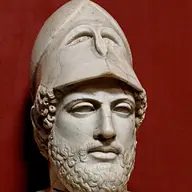
Pericles, c. 495 – 429 BCE3000 BCE2900 BCE2800 BCE2700 BCE2600 BCE2500 BCE2400 BCE2300 BCE2200 BCE2100 BCE2000 BCE1900 BCE1800 BCE1700 BCE1600 BCE1500 BCE1400 BCE1300 BCE1200 BCE1100 BCE1000 BCE900 BCE800 BCE700 BCE600 BCE500 BCE400 BCE300 BCE200 BCE100 BCE1 CE100 CE200 CE300 CE400 CE500 CE600 CE700 CE800 CE900 CE1000 CE1100 CE1200 CE1300 CE1400 CE1500 CE1600 CE1700 CE1800 CE1900 CE2000 CEGreat Pyramid of Giza built, c. 2600 BCERome founded (traditional date), 753 BCELast western Roman emperor deposed, 476 CEGutenberg's printing press, c. 1440 CEColumbus reaches the Americas, 1492 CEFirst people on the Moon, 1969 CEToday, 2026

Swipe the line. Bars: entries. Dots: events.

Pericles

, AthensAs Thucydides tells it

In plain words, ours

Forget our farms and houses. Guard the sea and the city, and don't let anger over our land drag us into a battle against bigger armies.

Dismissing all thought of our land and houses, we must vigilantly guard the sea and the city. No irritation that we may feel for the former must provoke us to a battle with the numerical superiority of the Peloponnesians.

Thucydides, History of the Peloponnesian War 1.143.5Translated by Richard Crawley (1874)Read the full passage (Thucydides, History of the Peloponnesian War 1.143.5, opens scaife.perseus.org)

What was going on, our summary

As Thucydides tells it, Pericles is addressing the Athenians in 432 BCE, arguing that their strength is ruling the sea and that they should think of themselves as islanders. A year later the war between Athens and Sparta began.

Checked claim by claim against: Thebans attack Plataea and the war begins, the passage around the quote.

Why it matters

Pericles set a defensive strategy for the war, aiming to exhaust the enemy and preserve the status quo; its critics have been just as numerous as its supporters.

Based on Wikipedia: Pericles

During the Peloponnesian War, Pericles initiated a defensive "grand strategy" whose aim was the exhaustion of the enemy and the preservation of the status quo.

Critics of Pericles's strategy, however, have been just as numerous as its supporters.

Wikipedia, Pericles (opens en.wikipedia.org), as of 2026-09-27. Text CC BY-SA 4.0. Our line is checked against these sentences only.

Related moments

In time order, with this one in its place. Each says why it is here.

  1. c. 433 BCE1 year earlier Socrates says no one does evil willingly Also in Athens
  2. set in 432 BCEThis momentPericles urges Athens to guard the sea
  3. set in 432 BCESame year Pericles warns Athens of its own blunders Same passageMore from Pericles
  4. 431 BCE1 year later Thebans attack Plataea and the war begins The event behind itAlso about war and empire
  5. 431 BCE1 year later Medea on childbirth and battle Also in Athens
  6. 431 BCE1 year later Medea on the lot of women Also in Athens
  7. 431 BCE, written later1 year later Thucydides opens his history of the war Also about war and empire
  8. 431 BCE1.1000000000000227 years later Spartan army invades Attica Same years
  9. 430 BCE2 years later Plague breaks out in Athens Same years
  10. 431/430 BCE2 years later Athens holds a public funeral for its first war dead Same years
  11. set in 431/430 BCE2 years later Pericles on Athenian democracy More from Pericles
  12. set in 431/430 BCE2 years later Pericles on freedom in daily life More from Pericles
  13. 429 BCE3 years later Pericles dies Same years

Just before and after

The text around the quote, word for word from the same translation.

Show the passageHide the passage

This, I think, is a tolerably fair account of the position of the Peloponnesians; that of Athens is free from the defects that I have criticized in them, and has other advantages of its own, which they can show nothing to equal. If they march against our country we will sail against theirs, and it will then be found that the desolation of the whole of Attica is not the same as that of even a fraction of Peloponnese; for they will not be able to supply the deficiency except by a battle, while we have plenty of land both on the islands and the continent. The rule of the sea is indeed a great matter. Consider for a moment. Suppose that we were islanders: can you conceive a more impregnable position? Well, this in future should, as far as possible, be our conception of our position.

The quote: Dismissing all thought of our land and houses, we must vigilantly guard the sea and the city. No irritation that we may feel for the former must provoke us to a battle with the numerical superiority of the Peloponnesians.

A victory would only be succeeded by another battle against the same superiority: a reverse involves the loss of our allies, the source of our strength, who will not remain quiet a day after we become unable to march against them. We must cry not over the loss of houses and land but of men's lives; since houses and land do not gain men, but men them. And if I had thought that I could persuade you, I would have bid you go out and lay them waste with your own hands, and show the Peloponnesians that this at any rate will not make you submit.

Thucydides, History of the Peloponnesian War 1.143.3–5Translated by Richard Crawley (1874)Read the full passage (opens scaife.perseus.org)

When, and whose words

Date
set in 432 BCE. Set in the Athenian assembly in 432 BCE, before the war; Thucydides wrote it later.
Whose words
As Thucydides tells it. Who was Pericles?
How this post was checked
  • The plain-words line was read against the quote alone by a second, independent pass, which found it adds no claim the quote does not make (2026-10-03).
  • Each claim in the summary was checked by an independent pass against only the material it cites.
  • The quote itself is checked by the build: word for word, once, at the cited section of the stored translation.

See it among its momentsMore from PericlesSee it in the feed