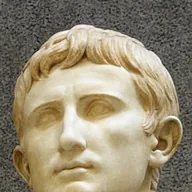
What was going on: Tacitus sums up how Augustus gained power. Brutus and Cassius had been destroyed and Antony was dead; Augustus dropped the title of triumvir and called himself consul. No one opposed him, Tacitus says, because the boldest men had fallen.
He won soldiers with gifts, the people with cheap grain and everyone with peace, and bit by bit took the powers of Senate, officials and laws.
Augustus won over the soldiers with gifts, the populace with cheap corn, and all men with the sweets of repose, and so grew greater by degrees, while he concentrated in himself the functions of the Senate, the magistrates, and the laws.
His own words. Tacitus, Annals 1.2, translated by A. J. Church and W. J. Brodribb (1876)
, Germania
Three Roman legions are destroyed in Germany
Germanic tribes led by Arminius ambush Varus and his three legions in the Teutoburg Forest. Rome stops pushing east of the Rhine.
What was going on: 9 CE: Germanic tribes have wiped out Varus and three legions in Germany. Suetonius, writing over a century later, says that when the news came, Augustus put a watch on Rome against unrest and vowed great games to Jupiter.
Why it matters: It is considered one of the most important defeats in Roman history, abruptly ending expansion under Augustus. Despite revenge campaigns, the Rhine became the border between the Empire and the rest of Germania.
We are told he was so shaken that he let his hair and beard grow for months and sometimes banged his head on the door, crying: Varus, give me back my legions!
In short, we are informed that he was in such consternation at this event, that he let the hair of his head and beard grow for several months, and sometimes knocked his head against the door-posts, crying out, “O, Quintilius Varus! Give me back my legions!”
As Suetonius tells it, over a century later. Suetonius, Life of Augustus 23, translated by Alexander Thomson, revised by T. Forester (1889)T
What was going on: Tacitus describes Rome in Augustus' last years. Augustus was old, the only war was in Germany after Varus lost his army, and at his death in 14 CE his stepson Tiberius took over.
Why it matters: By then Augustus had established the principate, a government in which the emperor showed nominal deference to the Senate. It lasted until the Crisis of the Third Century.
All was calm and the old titles remained, but a generation had grown up since the victory at Actium. So few had ever seen the republic!
At home all was tranquil, and there were magistrates with the same titles; there was a younger generation, sprung up since the victory of Actium, and even many of the older men had been born during the civil wars. How few were left who had seen the republic!
His own words. Tacitus, Annals 1.3, translated by A. J. Church and W. J. Brodribb (1876)
, Campania
Augustus dies at Nola after 41 years in power
Augustus dies at 75, near Naples. Suetonius says he asked his friends whether he had played his part well.
“Do ye think that I have acted my part on the stage of life well?”
What was going on: Suetonius, writing over a century later, gives no date. This comes in his account of Augustus and his soldiers: just before, how sparingly he gave the highest military honours; just after, his view that a war is worth fighting only if the hoped-for gain outweighs the fear of loss.
He thought rushing was the worst fault in a general. His sayings: hurry slowly; a careful captain beats a bold one; done well is done fast enough.
He thought nothing more derogatory to the character of an accomplished general than precipitancy and rashness; on which account he had frequently in his mouth those proverbs: Speude bradeos, Hasten slowly, And ‘Asphalaes gar est’ ameinon, hae erasus strataelataes. The cautious captain’s better than the bold. And “That is done fast enough, which is done well enough.”
As Suetonius tells it, over a century later. Suetonius, Life of Augustus 25, translated by Alexander Thomson, revised by T. Forester (1889)
What was going on: Suetonius, writing over a century later and giving no date, collects Augustus' sayings about war. He says Augustus thought rashness the worst fault in a general and often quoted proverbs such as Hasten slowly.
Never start a fight unless what you can win outweighs what you can lose. Risking a lot for a little is fishing with a golden hook.
He was wont to say also, that “a battle or a war ought never to be undertaken, unless the prospect of gain overbalanced the fear of loss. For,” said he, “men who pursue small advantages with no small hazard, resemble those who fish with a golden hook, the loss of which, if the line should happen to break, could never be compensated by all the fish they might take.”
As Suetonius tells it, over a century later. Suetonius, Life of Augustus 25, translated by Alexander Thomson, revised by T. Forester (1889)
What was going on: Suetonius, writing over a century later, describes Augustus choosing to keep power in his own hands rather than return it to the people. He then lists the buildings Augustus put up in Rome, among them a new forum with a temple of Mars the Avenger. Augustus held power for 41 years, until he died in 14 CE.
Why it matters: Marble was found in Roman buildings before Augustus, but it was not used widely as a building material until his reign.
The city was not grand enough for the empire and was prone to floods and fires. He improved it so much that he boasted he found it brick and left it marble.
The city, which was not built in a manner suitable to the grandeur of the empire, and was liable to inundations of the Tiber, as well as to fires, was so much improved under his administration, that he boasted, not without reason, that he “found it of brick, but left it of marble.”
As Suetonius tells it, over a century later. Suetonius, Life of Augustus 29, translated by Alexander Thomson, revised by T. Forester (1889)
What was going on: Suetonius, writing over a century later, says Augustus twice thought of handing power back and restoring the republic, but chose to keep it in his own hands. He then quotes an edict Augustus published about his intentions.
Let me set the state on solid ground, be remembered for shaping it for these times, and die hoping what I built will last.
May it be permitted me to have the happiness of establishing the commonwealth on a safe and sound basis, and thus enjoy the reward of which I am ambitious, that of being celebrated for moulding it into the form best adapted to present circumstances; so that, on my leaving the world, I may carry with me the hope that the foundations which I have laid for its future government, will stand firm and stable.
As Suetonius tells it, over a century later. Suetonius, Life of Augustus 28, translated by Alexander Thomson, revised by T. Forester (1889)
What was going on: Nola, 14 CE, the day Augustus died, as Suetonius tells it over a century later. Ill, he had stopped at Nola after games at Naples and talked privately with Tiberius. That day he asked for a mirror and had his hair combed before his friends came in.
Why it matters: The question whether he had played his part well is remembered as Augustus's famous last words.
Did I play my part in life well? If so, clap for the actor, and do it gladly.
Then asking his friends who were admitted into the room, “Do ye think that I have acted my part on the stage of life well?” he immediately subjoined, Ei de pan echei kalos, to paignio Dote kroton, kai pantes umeis meta charas ktupaesate. If all be right, with joy your voices raise, In loud applauses to the actor’s praise.
As Suetonius tells it, over a century later. Suetonius, Life of Augustus 99, translated by Alexander Thomson, revised by T. Forester (1889)
What was going on: Campania, 14 CE: the day Augustus died, at 75, after 41 years in power. As Suetonius tells it, over a century later, he had his hair combed, asked his friends whether he had played his part well, then sent them out.
He died suddenly while Livia kissed him: Livia, remember our marriage, and goodbye. It was the easy death he had always wanted.
…he expired suddenly, amidst the kisses of Livia, and with these words: “Livia! live mindful of our union; and now, farewell!” dying a very easy death, and such as he himself had always wished for.
As Suetonius tells it, over a century later. Suetonius, Life of Augustus 99, translated by Alexander Thomson, revised by T. Forester (1889)T
What was going on: Tacitus is laying out the case against Augustus, who died in 14 CE after 41 years in power: citizens proscribed, lands divided, Antony lured on by treaties and a marriage. Next he turns to Augustus' family life.
Yes, peace came after all that, but it was a peace soaked in blood, with disasters, and murders in Rome itself.
No doubt, there was peace after all this, but it was a peace stained with blood; there were the disasters of Lollius and Varus, the murders at Rome of the Varros, Egnatii, and Juli.
His own words. Tacitus, Annals 1.10, translated by A. J. Church and W. J. Brodribb (1876)
, Rome
Caligula is killed by his own guards
Officers of the Praetorian Guard stab the emperor Caligula at the Palatine games. The guards make his uncle Claudius emperor.
Respecting what followed, two different accounts are given. Some say, that, whilst he was speaking to the boys, Chaerea came behind him, and gave him a heavy blow on the neck with his sword
Claudius sends an army under Aulus Plautius to Britain and crosses over himself for a few days. Suetonius says part of the island gave in without a fight.
he thence passed over to Britain, and part of the island submitting to him, within a few days after his arrival, without battle or bloodshed, he returned to Rome in less than six months from the time of his departure