hstry

Tacitus on how Augustus won power

c. 30–20 BCE, Rome. His own words.

Where and when

c. 30–20 BCERome

about 2,050 years ago

Explore
Tacitus, c. 56 – c. 120 CE3000 BCE2900 BCE2800 BCE2700 BCE2600 BCE2500 BCE2400 BCE2300 BCE2200 BCE2100 BCE2000 BCE1900 BCE1800 BCE1700 BCE1600 BCE1500 BCE1400 BCE1300 BCE1200 BCE1100 BCE1000 BCE900 BCE800 BCE700 BCE600 BCE500 BCE400 BCE300 BCE200 BCE100 BCE1 CE100 CE200 CE300 CE400 CE500 CE600 CE700 CE800 CE900 CE1000 CE1100 CE1200 CE1300 CE1400 CE1500 CE1600 CE1700 CE1800 CE1900 CE2000 CEGreat Pyramid of Giza built, c. 2600 BCERome founded (traditional date), 753 BCELast western Roman emperor deposed, 476 CEGutenberg's printing press, c. 1440 CEColumbus reaches the Americas, 1492 CEFirst people on the Moon, 1969 CEToday, 2026sometime in these 10 years

Swipe the line. Bars: entries. Dots: events.

In plain words, ours

He won soldiers with gifts, the people with cheap grain and everyone with peace, and bit by bit took the powers of Senate, officials and laws.

Augustus won over the soldiers with gifts, the populace with cheap corn, and all men with the sweets of repose, and so grew greater by degrees, while he concentrated in himself the functions of the Senate, the magistrates, and the laws.

Tacitus, Annals 1.2Translated by A. J. Church and W. J. Brodribb (1876)Read the full passage (Tacitus, Annals 1.2, opens scaife.perseus.org)

What was going on, our summary

Tacitus sums up how Augustus gained power. Brutus and Cassius had been destroyed and Antony was dead; Augustus dropped the title of triumvir and called himself consul. No one opposed him, Tacitus says, because the boldest men had fallen.

Checked claim by claim against: the passage around the quote.

Related moments

In time order, with this one in its place. Each says why it is here.

  1. 44 BCEabout 19 years earlier Caesar and the soothsayer, in Suetonius Also in Rome
  2. 44 BCEabout 19 years earlier Caesar on the best death, as Plutarch tells it Also in Rome
  3. 30 BCEabout 5 years earlier Antony and Cleopatra take their own lives Same years
  4. 27 BCEabout 2 years earlier Octavian takes the name Augustus Also in Rome
  5. c. 30–20 BCEThis momentTacitus on how Augustus won power
  6. c. 10–14 CEabout 36 years later Tacitus on how few had seen the republic Same passageMore from Tacitus
  7. set in 14 CEabout 38 years later Tacitus on Augustus' peace stained with blood More from Tacitus
  8. 62 CEabout 86 years later Tacitus on Nero's answer to Seneca More from Tacitus
  9. c. 115–120 CEabout 141 years later Tacitus on writing without bitterness Same passage

Just before and after

The text around the quote, word for word from the same translation.

Show the passageHide the passage

The histories of Tiberius, Caius, Claudius, and Nero, while they were in power, were falsified through terror, and after their death were written under the irritation of a recent hatred. Hence my purpose is to relate a few facts about Augustus—more particularly his last acts, then the reign of Tiberius, and all which follows, without either bitterness or partiality, from any motives to which I am far removed. When after the destruction of Brutus and Cassius there was no longer any army of the Commonwealth, when Pompeius was crushed in Sicily, and when, with Lepidus pushed aside and Antonius slain, even the Julian faction had only Cæsar left to lead it, then, dropping the title of triumvir, and giving out that he was a Consul, and was satisfied with a tribune's authority for the protection of the people,

The quote: Augustus won over the soldiers with gifts, the populace with cheap corn, and all men with the sweets of repose, and so grew greater by degrees, while he concentrated in himself the functions of the Senate, the magistrates, and the laws.

He was wholly unopposed, for the boldest spirits had fallen in battle, or in the proscription, while the remaining nobles, the readier they were to be slaves, were raised the higher by wealth and promotion, so that, aggrandised by revolution, they preferred the safety of the present to the dangerous past.

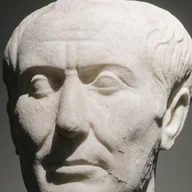
Tacitus, Annals 1.1–2Translated by A. J. Church and W. J. Brodribb (1876)Read the full passage (opens scaife.perseus.org)

When, and whose words

Date
c. 30–20 BCE. Tacitus describes Augustus' rise after Antonius died in 30 BCE; he wrote c. 115–120 CE.
Whose words
His own words.
How this post was checked
  • The plain-words line was read against the quote alone by a second, independent pass, which found it adds no claim the quote does not make (2026-10-03).
  • Each claim in the summary was checked by an independent pass against only the material it cites.
  • The quote itself is checked by the build: word for word, once, at the cited section of the stored translation.

See it among its momentsMore from TacitusSee it in the feed