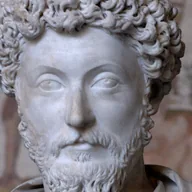
What was going on: Marcus Aurelius, keeping a private notebook while at war on the Danube frontier around 170–180 CE, lists what he learned from each of his teachers. Here it is Rusticus, who taught him to write plain letters and to forgive easily.
Why it matters: Rusticus, the teacher Marcus thanks here, would have the strongest influence on him; Fronto saw him as the man who drew Marcus away from oratory.
“He” here is Rusticus.
He taught me to read carefully, not skim, and not to agree too fast with people who talk a lot. And he gave me the discourses of Epictetus from his own collection.
…and to read carefully, and not to be satisfied with a superficial understanding of a book; nor hastily to give my assent to those who talk overmuch; and I am indebted to him for being acquainted with the discourses of Epictetus, which he communicated to me out of his own collection.
His own words, in the Meditations, notes written for himself. Marcus Aurelius, Meditations 1.7, translated by George Long (1862)
What was going on: From the Meditations, the private notebook in Greek that Marcus kept while fighting tribes on the Danube. Here he lists what he learned from people in his life: his grandfather, his father, then his mother.
Why it matters: The Meditations became one of the most important sources for the modern understanding of ancient Stoic philosophy, and many commentators count it among the greatest works of philosophy.
From my mother: devotion and kindness, keeping away from bad deeds and even bad thoughts, and living simply, far from the ways of the rich.
From my mother, piety and beneficence, and abstinence, not only from evil deeds, but even from evil thoughts; and further, simplicity in my way of living, far removed from the habits of the rich.
His own words, in the Meditations, notes written for himself. Marcus Aurelius, Meditations 1.3, translated by George Long (1862)
What was going on: This opens Book 2 of the Meditations, the private notebook Marcus Aurelius kept in Greek while at war on the Danube, c. 170–180 CE. Some books of the notebook end with where he was, such as Carnuntum.
Why it matters: The Meditations became one of the most important sources for the modern understanding of ancient Stoic philosophy, and many commentators count it among the greatest works of philosophy.
Start each morning telling yourself: today I will meet nosy, ungrateful, arrogant, lying, jealous, unfriendly people. They are like that because they do not know good from bad.
Begin the morning by saying to thyself, I shall meet with the busybody, the ungrateful, arrogant, deceitful, envious, unsocial. All these things happen to them by reason of their ignorance of what is good and evil.
His own words, in the Meditations, notes written for himself. Marcus Aurelius, Meditations 2.1, translated by George Long (1862)
What was going on: Marcus Aurelius wrote this in his private notebook at Carnuntum, at the front while fighting the tribes along the Danube. He starts the day bracing himself to meet rude, ungrateful and envious people.
Why it matters: The Meditations became one of the most important sources for the modern understanding of ancient Stoic philosophy, and many commentators count it among the greatest works of philosophy.
We are made to work together, like feet, hands, eyelids, upper and lower teeth. Working against each other goes against nature, and getting annoyed and turning away counts.
For we are made for co-operation, like feet, like hands, like eyelids, like the rows of the upper and lower teeth. To act against one another, then, is contrary to nature; and it is acting against one another to be vexed and to turn away.
His own words, in the Meditations, notes written for himself. Marcus Aurelius, Meditations 2.1, translated by George Long (1862)
What was going on: Marcus Aurelius wrote this in his private notebook at Carnuntum, while fighting the tribes along the Danube around 170–180 CE. Just before, he tells himself to tend the spirit within him and not pry into what others think.
Why it matters: The Meditations became one of the most important sources for the modern understanding of ancient Stoic philosophy, and many commentators count it among the greatest works of philosophy.
Even if you lived thousands of years, you only ever lose the life you are living now. So the longest and the shortest life come to the same.
Though thou shouldest be going to live three thousand years and as many times ten thousand years, still remember that no man loses any other life than this which he now lives, nor lives any other than this which he now loses. The longest and shortest are thus brought to the same.
His own words, in the Meditations, notes written for himself. Marcus Aurelius, Meditations 2.14, translated by George Long (1862)
What was going on:Carnuntum, about 170–180 CE. Marcus is at war along the Danube and writing notes to himself. Just before this, he lists the ways the soul does violence to itself.
Why it matters: The Meditations became one of the most important sources for the modern understanding of ancient Stoic philosophy, and many commentators count it among the greatest works of philosophy.
A human life is a dot in time. Everything in it keeps changing, our senses are dull, the body rots, the mind spins, luck is hard to read and fame is thoughtless.
Of human life the time is a point, and the substance is in a flux, and the perception dull, and the composition of the whole body subject to putrefaction, and the soul a whirl, and fortune hard to divine, and fame a thing devoid of judgment.
His own words, in the Meditations, notes written for himself. Marcus Aurelius, Meditations 2.17, translated by George Long (1862)
What was going on: From the Meditations, the notebook Marcus Aurelius kept for himself around 170-180 CE, much of it on campaign along the Danube. Around this line he tells himself to see the universe as one living being, where all things change and every cause works with every other.
Why it matters: The Meditations became one of the most important sources for the modern understanding of ancient Stoic philosophy, and many commentators count it among the greatest works of philosophy.
Time is a river of events, a rushing one. As soon as something shows up it is swept away, the next thing takes its place, and that goes too.
Time is like a river made up of the events which happen, and a violent stream; for as soon as a thing has been seen, it is carried away, and another comes in its place, and this will be carried away too.
His own words, in the Meditations, notes written for himself. Marcus Aurelius, Meditations 4.43, translated by George Long (1862)
What was going on: From the private notebook the emperor Marcus Aurelius kept while fighting tribes along the Danube. Here he reminds himself that he will soon be gone, like one grain of incense falling on an altar after another.
Why it matters: The Meditations became one of the most important sources for the modern understanding of ancient Stoic philosophy, and many commentators count it among the greatest works of philosophy.
Do not act as if you will live ten thousand years. Death hangs over you. While you are alive and still can, be good.
Do not act as if thou wert going to live ten thousand years. Death hangs over thee. While thou livest, while it is in thy power, be good.
His own words, in the Meditations, notes written for himself. Marcus Aurelius, Meditations 4.17, translated by George Long (1862)
What was going on: A note Marcus Aurelius wrote to himself around 170–180 CE, in the private notebook he kept in the years he was at war on the Danube. Just before, he tells himself to love his craft, however humble. Next he does the same with the times of Trajan.
Why it matters: The Meditations became one of the most important sources for the modern understanding of ancient Stoic philosophy, and many commentators count it among the greatest works of philosophy.
Think back to Vespasian’s time: people marrying, raising kids, getting sick, fighting, feasting, plotting, grumbling, chasing power. All of that life is gone now.
Consider, for example, the times of Vespasian. Thou wilt see all these things, people marrying, bringing up children, sick, dying, warring, feasting, trafficking, cultivating the ground, flattering, obstinately arrogant, suspecting, plotting, wishing for some to die, grumbling about the present, loving, heaping up treasure, desiring consulship, kingly power. Well, then, that life of these people no longer exists at all.
His own words, in the Meditations, notes written for himself. Marcus Aurelius, Meditations 4.32, translated by George Long (1862)
What was going on: From the private notebook Marcus kept around 170-180 CE, much of it while fighting on the Danube. Just before this, he writes that a life is a tiny gap between two endless stretches of time.
Why it matters: The Meditations became one of the most important sources for the modern understanding of ancient Stoic philosophy, and many commentators count it among the greatest works of philosophy.
When you do not want to get up, think: I am getting up to do a human being’s work, what I exist for. Was I made to lie under the covers keeping warm?
In the morning when thou risest unwillingly, let this thought be present,--I am rising to the work of a human being. Why then am I dissatisfied if I am going to do the things for which I exist and for which I was brought into the world? Or have I been made for this, to lie in the bed-clothes and keep myself warm?
His own words, in the Meditations, notes written for himself. Marcus Aurelius, Meditations 5.1, translated by George Long (1862)
What was going on: From the private notebook in Greek that Marcus Aurelius kept while fighting along the Danube. The lines before this tell him to do his duty whether cold or warm, praised or insulted, and to look within.
Why it matters: The Meditations became one of the most important sources for the modern understanding of ancient Stoic philosophy, and many commentators count it among the greatest works of philosophy.
The best way to get back at someone who wronged you is not to become like them.
The best way of avenging thyself is not to become like [the wrong-doer].
His own words, in the Meditations, notes written for himself. Marcus Aurelius, Meditations 6.6, translated by George Long (1862)