hstry

Marcus Aurelius on life as a point

c. 170–180 CE, Carnuntum. His own words, in the Meditations, notes written for himself.

Where and when

c. 170–180 CECarnuntum

about 1,851 years ago

Explore
Marcus Aurelius, 121 – 180 CE3000 BCE2900 BCE2800 BCE2700 BCE2600 BCE2500 BCE2400 BCE2300 BCE2200 BCE2100 BCE2000 BCE1900 BCE1800 BCE1700 BCE1600 BCE1500 BCE1400 BCE1300 BCE1200 BCE1100 BCE1000 BCE900 BCE800 BCE700 BCE600 BCE500 BCE400 BCE300 BCE200 BCE100 BCE1 CE100 CE200 CE300 CE400 CE500 CE600 CE700 CE800 CE900 CE1000 CE1100 CE1200 CE1300 CE1400 CE1500 CE1600 CE1700 CE1800 CE1900 CE2000 CEGreat Pyramid of Giza built, c. 2600 BCERome founded (traditional date), 753 BCELast western Roman emperor deposed, 476 CEGutenberg's printing press, c. 1440 CEColumbus reaches the Americas, 1492 CEFirst people on the Moon, 1969 CEToday, 2026sometime in these 10 years

Swipe the line. Bars: entries. Dots: events.

Marcus Aurelius

, CarnuntumHis own words, in the Meditations, notes written for himself

In plain words, ours

A human life is a dot in time. Everything in it keeps changing, our senses are dull, the body rots, the mind spins, luck is hard to read and fame is thoughtless.

Of human life the time is a point, and the substance is in a flux, and the perception dull, and the composition of the whole body subject to putrefaction, and the soul a whirl, and fortune hard to divine, and fame a thing devoid of judgment.

Marcus Aurelius, Meditations 2.17Translated by George Long (1862)Read the full passage (Marcus Aurelius, Meditations 2.17, opens gutenberg.org)

What was going on, our summary

Carnuntum, about 170–180 CE. Marcus is at war along the Danube and writing notes to himself. Just before this, he lists the ways the soul does violence to itself.

Checked claim by claim against: Marcus Aurelius writes notes to himself at the front, the passage around the quote.

Why it matters

About the event it belongs to: Marcus Aurelius writes notes to himself at the front

The Meditations became one of the most important sources for the modern understanding of ancient Stoic philosophy, and many commentators count it among the greatest works of philosophy.

Based on Wikipedia: Marcus Aurelius

As a philosopher, his work Meditations is one of the most important sources for the modern understanding of ancient Stoic philosophy.

It has been considered by many commentators to be one of the greatest works of philosophy.

Wikipedia, Marcus Aurelius (opens en.wikipedia.org), as of 2026-09-06. Text CC BY-SA 4.0. Our line is checked against these sentences only.

Related moments

In time order, with this one in its place. Each says why it is here.

  1. 170–180 CEDuring it Marcus Aurelius writes notes to himself at the front The event behind itAlso in Carnuntum
  2. c. 170–180 CEThis momentMarcus Aurelius on life as a point
  3. c. 170–180 CEDuring it Marcus Aurelius on how to begin the morning More from Marcus Aurelius
  4. c. 170–180 CEDuring it Marcus Aurelius on what his mother taught More from Marcus Aurelius
  5. c. 170–180 CEDuring it Marcus Aurelius on what Rusticus taught him More from Marcus Aurelius
  6. c. 170–180 CEDuring it Marcus Aurelius on the only life we lose Same passage
  7. 180 CEabout 5 years later Marcus Aurelius dies on campaign Same years

Just before and after

The text around the quote, word for word from the same translation.

Show the passageHide the passage

For to be vexed at anything which happens is a separation of ourselves from nature, in some part of which the natures of all other things are contained. In the next place, the soul does violence to itself when it turns away from any man, or even moves towards him with the intention of injuring, such as are the souls of those who are angry. In the third place, the soul does violence to itself when it is overpowered by pleasure or by pain. Fourthly, when it plays a part, and does or says anything insincerely and untruly. Fifthly, when it allows any act of its own and any movement to be without an aim, and does anything thoughtlessly and without considering what it is, it being right that even the smallest things be done with reference to an end; and the end of rational animals is to follow the reason and the law of the most ancient city and polity.

The quote: Of human life the time is a point, and the substance is in a flux, and the perception dull, and the composition of the whole body subject to putrefaction, and the soul a whirl, and fortune hard to divine, and fame a thing devoid of judgment.

And, to say all in a word, everything which belongs to the body is a stream, and what belongs to the soul is a dream and vapor, and life is a warfare and a stranger's sojourn, and after fame is oblivion. What then is that which is able to conduct a man? One thing, and only one, philosophy.

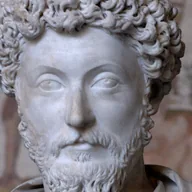
Marcus Aurelius, Meditations 2.16–17Translated by George Long (1862)Read the full passage (opens gutenberg.org)

When, and whose words

Date
c. 170–180 CE. Written late in his life on campaign; Book 2 ends “This in Carnuntum”, the army base on the Danube.
Whose words
His own words, in the Meditations, notes written for himself.
How this post was checked
  • The plain-words line was read against the quote alone by a second, independent pass, which found it adds no claim the quote does not make (2026-10-03).
  • Each claim in the summary was checked by an independent pass against only the material it cites.
  • The quote itself is checked by the build: word for word, once, at the cited section of the stored translation.

See it among its momentsMore from Marcus AureliusSee it in the feed