hstry

Marcus Aurelius on what his mother taught

c. 170–180 CE, the Danube frontier. His own words, in the Meditations, notes written for himself.

Where and when

c. 170–180 CEthe Danube frontier

about 1,851 years ago

Explore
Marcus Aurelius, 121 – 180 CE3000 BCE2900 BCE2800 BCE2700 BCE2600 BCE2500 BCE2400 BCE2300 BCE2200 BCE2100 BCE2000 BCE1900 BCE1800 BCE1700 BCE1600 BCE1500 BCE1400 BCE1300 BCE1200 BCE1100 BCE1000 BCE900 BCE800 BCE700 BCE600 BCE500 BCE400 BCE300 BCE200 BCE100 BCE1 CE100 CE200 CE300 CE400 CE500 CE600 CE700 CE800 CE900 CE1000 CE1100 CE1200 CE1300 CE1400 CE1500 CE1600 CE1700 CE1800 CE1900 CE2000 CEGreat Pyramid of Giza built, c. 2600 BCERome founded (traditional date), 753 BCELast western Roman emperor deposed, 476 CEGutenberg's printing press, c. 1440 CEColumbus reaches the Americas, 1492 CEFirst people on the Moon, 1969 CEToday, 2026sometime in these 10 years

Swipe the line. Bars: entries. Dots: events.

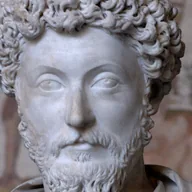
Marcus Aurelius

, the Danube frontierHis own words, in the Meditations, notes written for himself

In plain words, ours

From my mother: devotion and kindness, keeping away from bad deeds and even bad thoughts, and living simply, far from the ways of the rich.

From my mother, piety and beneficence, and abstinence, not only from evil deeds, but even from evil thoughts; and further, simplicity in my way of living, far removed from the habits of the rich.

Marcus Aurelius, Meditations 1.3Translated by George Long (1862)Read the full passage (Marcus Aurelius, Meditations 1.3, opens gutenberg.org)
What was going on, our summary

From the Meditations, the private notebook in Greek that Marcus kept while fighting tribes on the Danube. Here he lists what he learned from people in his life: his grandfather, his father, then his mother.

Checked claim by claim against: Marcus Aurelius writes notes to himself at the front, the passage around the quote.

Why it matters

About the event it belongs to: Marcus Aurelius writes notes to himself at the front

The Meditations became one of the most important sources for the modern understanding of ancient Stoic philosophy, and many commentators count it among the greatest works of philosophy.

Based on Wikipedia: Marcus Aurelius

As a philosopher, his work Meditations is one of the most important sources for the modern understanding of ancient Stoic philosophy.

It has been considered by many commentators to be one of the greatest works of philosophy.

Wikipedia, Marcus Aurelius (opens en.wikipedia.org), as of 2026-09-06. Text CC BY-SA 4.0. Our line is checked against these sentences only.

Related moments

In time order, with this one in its place. Each says why it is here.

  1. c. 62–65 CEabout 112 years earlier Seneca on time, the only thing we own Also about how to live well
  2. by c. 135 CEabout 40 years earlier Epictetus on what is in our power Also about how to live well
  3. 170–180 CEDuring it Marcus Aurelius writes notes to himself at the front The event behind it
  4. c. 170–180 CEThis momentMarcus Aurelius on what his mother taught
  5. c. 170–180 CEDuring it Marcus Aurelius on how to begin the morning More from Marcus Aurelius
  6. c. 170–180 CEDuring it Marcus Aurelius on what Rusticus taught him Same passageMore from Marcus Aurelius
  7. c. 170–180 CEDuring it Marcus Aurelius on working together More from Marcus Aurelius
  8. 180 CEabout 5 years later Marcus Aurelius dies on campaign Also in the Danube frontier

Just before and after

The text around the quote, word for word from the same translation.

Show the passageHide the passage

From my grandfather Verus [I learned] good morals and the government of my temper. From the reputation and remembrance of my father, modesty and a manly character.

The quote: From my mother, piety and beneficence, and abstinence, not only from evil deeds, but even from evil thoughts; and further, simplicity in my way of living, far removed from the habits of the rich.

From my great-grandfather, not to have frequented public schools, and to have had good teachers at home, and to know that on such things a man should spend liberally. From my governor, to be neither of the green nor of the blue party at the games in the Circus, nor a partisan either of the Parmularius or the Scutarius at the gladiators' fights; from him too I learned endurance of labor, and to want little, and to work with my own hands, and not to meddle with other people's affairs, and not to be ready to listen to slander.

Marcus Aurelius, Meditations 1.1–5Translated by George Long (1862)Read the full passage (opens gutenberg.org)

When, and whose words

Date
c. 170–180 CE. Written late in his life on campaign; Book 1 ends “Among the Quadi at the Granua”, a river on the Danube frontier.
Whose words
His own words, in the Meditations, notes written for himself.
How this post was checked
  • The plain-words line was read against the quote alone by a second, independent pass, which found it adds no claim the quote does not make (2026-10-03).
  • Each claim in the summary was checked by an independent pass against only the material it cites.
  • The quote itself is checked by the build: word for word, once, at the cited section of the stored translation.

See it among its momentsMore from Marcus AureliusSee it in the feed