hstry

Marcus Aurelius on what Rusticus taught him

c. 170–180 CE, the Danube frontier. His own words, in the Meditations, notes written for himself.

Where and when

c. 170–180 CEthe Danube frontier

about 1,851 years ago

Explore
Marcus Aurelius, 121 – 180 CE3000 BCE2900 BCE2800 BCE2700 BCE2600 BCE2500 BCE2400 BCE2300 BCE2200 BCE2100 BCE2000 BCE1900 BCE1800 BCE1700 BCE1600 BCE1500 BCE1400 BCE1300 BCE1200 BCE1100 BCE1000 BCE900 BCE800 BCE700 BCE600 BCE500 BCE400 BCE300 BCE200 BCE100 BCE1 CE100 CE200 CE300 CE400 CE500 CE600 CE700 CE800 CE900 CE1000 CE1100 CE1200 CE1300 CE1400 CE1500 CE1600 CE1700 CE1800 CE1900 CE2000 CEGreat Pyramid of Giza built, c. 2600 BCERome founded (traditional date), 753 BCELast western Roman emperor deposed, 476 CEGutenberg's printing press, c. 1440 CEColumbus reaches the Americas, 1492 CEFirst people on the Moon, 1969 CEToday, 2026sometime in these 10 years

Swipe the line. Bars: entries. Dots: events.

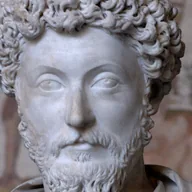
Marcus Aurelius

, the Danube frontierHis own words, in the Meditations, notes written for himself

In plain words, ours

“He” here is Rusticus.

He taught me to read carefully, not skim, and not to agree too fast with people who talk a lot. And he gave me the discourses of Epictetus from his own collection.

…and to read carefully, and not to be satisfied with a superficial understanding of a book; nor hastily to give my assent to those who talk overmuch; and I am indebted to him for being acquainted with the discourses of Epictetus, which he communicated to me out of his own collection.

Marcus Aurelius, Meditations 1.7Translated by George Long (1862)Read the full passage (Marcus Aurelius, Meditations 1.7, opens gutenberg.org)

What was going on, our summary

Marcus Aurelius, keeping a private notebook while at war on the Danube frontier around 170–180 CE, lists what he learned from each of his teachers. Here it is Rusticus, who taught him to write plain letters and to forgive easily.

Checked claim by claim against: Marcus Aurelius writes notes to himself at the front, the passage around the quote.

Why it matters

Rusticus, the teacher Marcus thanks here, would have the strongest influence on him; Fronto saw him as the man who drew Marcus away from oratory.

Based on Wikipedia: Marcus Aurelius

Quintus Junius Rusticus would have the strongest influence on the boy

He was the man Fronto recognised as having 'wooed Marcus away' from oratory.

Wikipedia, Marcus Aurelius (opens en.wikipedia.org), as of 2026-09-06. Text CC BY-SA 4.0. Our line is checked against these sentences only.

Related moments

In time order, with this one in its place. Each says why it is here.

  1. c. 335–322 BCEabout 502 years earlier Aristotle on becoming just by just acts Also about teaching and learning
  2. c. 108 CEabout 67 years earlier Epictetus on chains and the will About Epictetus
  3. c. 108 CEabout 67 years earlier Epictetus on habit and practice Also about teaching and learning
  4. 170–180 CEDuring it Marcus Aurelius writes notes to himself at the front The event behind it
  5. c. 170–180 CEThis momentMarcus Aurelius on what Rusticus taught him
  6. c. 170–180 CEDuring it Marcus Aurelius on how to begin the morning More from Marcus Aurelius
  7. c. 170–180 CEDuring it Marcus Aurelius on what his mother taught Same passageMore from Marcus Aurelius
  8. c. 170–180 CEDuring it Marcus Aurelius on working together More from Marcus Aurelius
  9. 180 CEabout 5 years later Marcus Aurelius dies on campaign Also in the Danube frontier

Just before and after

The text around the quote, word for word from the same translation.

Show the passageHide the passage

From Rusticus I received the impression that my character required improvement and discipline; and from him I learned not to be led astray to sophistic emulation, nor to writing on speculative matters, nor to delivering little hortatory orations, nor to showing myself off as a man who practises much discipline, or does benevolent acts in order to make a display; and to abstain from rhetoric, and poetry, and fine writing; and not to walk about in the house in my outdoor dress, nor to do other things of the kind; and to write my letters with simplicity, like the letter which Rusticus wrote from Sinuessa to my mother; and with respect to those who have offended me by words, or done me wrong, to be easily disposed to be pacified and reconciled, as soon as they have shown a readiness to be reconciled;

The quote: and to read carefully, and not to be satisfied with a superficial understanding of a book; nor hastily to give my assent to those who talk overmuch; and I am indebted to him for being acquainted with the discourses of Epictetus, which he communicated to me out of his own collection.

Antoninus says, [Greek: tois Epikteteiois hypomnemasin] which must not be translated, "the writings of Epictetus," for Epictetus wrote nothing. His pupil Arrian, who has preserved for us all that we know of Epictetus, says, [Greek: tauta epeirathen hypomnemata emauto diaphylaxai tes ekeinou dianoias] (_Ep. ad.

Marcus Aurelius, Meditations 1.7Translated by George Long (1862)Read the full passage (opens gutenberg.org)

When, and whose words

Date
c. 170–180 CE. Written late in his life on campaign; Book 1 ends “Among the Quadi at the Granua”, a river on the Danube frontier.
Whose words
His own words, in the Meditations, notes written for himself.
How this post was checked
  • The plain-words line was read against the quote alone by a second, independent pass, which found it adds no claim the quote does not make (2026-10-03).
  • Each claim in the summary was checked by an independent pass against only the material it cites.
  • The quote itself is checked by the build: word for word, once, at the cited section of the stored translation.

See it among its momentsMore from Marcus AureliusSee it in the feed