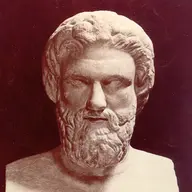
What was going on: In Aristophanes' comedy the Clouds, Strepsiades comes looking for Socrates and finds him hanging overhead in a basket. Asked what he is doing, this stage Socrates answers, then says thought must be suspended in the air to discover things above.
Why it matters: The basket-borne Socrates is part of the play's notorious caricature of him, and Plato cites the play in the Apology as a contributing factor to Socrates' trial and execution.
I am up here in the air, thinking about the sun.
I am walking in the air, and speculating about the sun.
Aristophanes’ Socrates, in the Clouds. Aristophanes, Clouds line 225, translated by William James Hickie (1853)
What was going on: In Aristophanes' play, the old countryman Strepsiades knocks at the door of Socrates' thinking-shop, hoping to be taught. A student inside scolds him for making an idea miscarry, then shares one of the school's secrets.
Socrates recently asked Chaerephon how many of its own feet a flea can jump, after one bit Chaerephon and leapt onto Socrates’ head.
Socrates lately asked Chaerephon about a flea, how many of its own feet it jumped; for after having bit the eyebrow of Chaerephon, it leaped away onto the head of Socrates.
A disciple of Socrates speaking, in Aristophanes’ play. Aristophanes, Clouds line 143, translated by William James Hickie (1853)
What was going on: In Aristophanes' comedy Clouds, a student of Socrates is telling Strepsiades about his teacher's discoveries, like measuring a flea with tiny wax slippers. Next comes the question of how gnats buzz.
So a gnat's backside is a trumpet! What insight. Surely anyone who understands gnat guts could easily get off in court.
The rump of the gnats then is a trumpet! Oh, thrice happy he for his sharp-sightedness! Surely a defendant might easily get acquitted who understands the intestine of the gnat.
Strepsiades speaking, in Aristophanes’ play. Aristophanes, Clouds line 165, translated by William James Hickie (1853)
What was going on: In Aristophanes' comedy Clouds, Strepsiades, plundered by his creditors, has come to the play's Socrates to learn how to speak. He offers to swear by the gods that he will pay any fee.
Which gods will you swear by? Gods are not the currency we use around here.
By what gods will you swear? For, in the first place, gods are not a current coin with us.
Aristophanes’ Socrates, in the Clouds. Aristophanes, Clouds line 247, translated by William James Hickie (1853)
What was going on: In Aristophanes' play the Clouds, the Chorus of Clouds has just greeted Strepsiades and the stage Socrates. Socrates then tells Strepsiades there is no Jupiter, and that the Clouds make the rain.
These are the only real goddesses. Everything else is nonsense.
For, in fact, these alone are goddesses; and all the rest is nonsense.
Aristophanes’ Socrates, in the Clouds. Aristophanes, Clouds line 365, translated by William James Hickie (1853)
What was going on: In Aristophanes' play, Socrates is teaching Strepsiades about the weather. He tells him there is no Jupiter, that clouds make the rain, and that clouds crashing together make the thunder.
Vortex? I somehow missed that Zeus does not exist and Vortex rules in his place.
Vortex? It had escaped my notice that Jupiter did not exist, and that Vortex now reigned in his stead.
Strepsiades speaking, in Aristophanes’ play. Aristophanes, Clouds line 380, translated by William James Hickie (1853)
What was going on: In Aristophanes' comedy Clouds, Strepsiades, in debt on his son's account, urges him to join a thinking-shop whose men teach anyone who pays to win arguments, right or wrong. His son Phidippides refuses.
They say these people have two arguments, the better and the worse, and that the worse one wins even though it argues for what is unjust.
They say that among them are both the two causes—the better cause, whichever that is, and the worse: they say that the one of these two causes, the worse, prevails, though it speaks on the unjust side.
Strepsiades speaking, in Aristophanes’ play. Aristophanes, Clouds lines 112–115, translated by William James Hickie (1853)
What was going on: In Aristophanes' comedy Clouds, two characters, the Just Cause and the Unjust Cause, argue in front of the Chorus. The Unjust Cause, known as the worse cause, now sets out to beat his rival.
I was the first to argue against law and justice. Being able to take the worse side and still win is worth a fortune.
I first contrived how to speak against both law and justice; and this art is worth more than ten thousand staters, that one should choose the worse cause, and nevertheless be victorious.
The Unjust Cause speaking, in Aristophanes’ play. Aristophanes, Clouds lines 1036–1040, translated by William James Hickie (1853)
What was going on: In Aristophanes' Clouds, Phidippides is arguing with his father Strepsiades, who admits beating him as a boy out of goodwill. Strepsiades objects that no law says a father should suffer that. Phidippides then points to roosters, who punish their fathers.
Wasn’t that law first proposed by a man like you or me? So why can’t I propose a new law that sons get to beat their fathers?
Was it not then a man like you and me, who first proposed this law, and by speaking persuaded the ancients? Why then is it less lawful for me also in turn to propose henceforth a new law for the sons, that they should beat their fathers in turn?
Phidippides speaking, in Aristophanes’ play. Aristophanes, Clouds line 1421, translated by William James Hickie (1853)
What was going on: This comes at the very end of Aristophanes' play. Strepsiades has climbed onto the roof of Socrates' thinking-shop and set it on fire, while Socrates and his students cry out from inside.
What got into you, insulting the gods and snooping around the moon?
For what has come into your heads that you acted insolently toward the gods, and pried into the seat of the moon?
Strepsiades speaking, in Aristophanes’ play. Aristophanes, Clouds line 1506, translated by William James Hickie (1853)