hstry

Plato's Seventh Letter on what words cannot hold

c. 353 BCE, Athens. Seventh Letter; authorship disputed.

Where and when

c. 353 BCEAthens

about 2,378 years ago

Explore
Plato, c. 428 – 348 BCE3000 BCE2900 BCE2800 BCE2700 BCE2600 BCE2500 BCE2400 BCE2300 BCE2200 BCE2100 BCE2000 BCE1900 BCE1800 BCE1700 BCE1600 BCE1500 BCE1400 BCE1300 BCE1200 BCE1100 BCE1000 BCE900 BCE800 BCE700 BCE600 BCE500 BCE400 BCE300 BCE200 BCE100 BCE1 CE100 CE200 CE300 CE400 CE500 CE600 CE700 CE800 CE900 CE1000 CE1100 CE1200 CE1300 CE1400 CE1500 CE1600 CE1700 CE1800 CE1900 CE2000 CEGreat Pyramid of Giza built, c. 2600 BCERome founded (traditional date), 753 BCELast western Roman emperor deposed, 476 CEGutenberg's printing press, c. 1440 CEColumbus reaches the Americas, 1492 CEFirst people on the Moon, 1969 CEToday, 2026

Swipe the line. Bars: entries. Dots: events.

Plato

, AthensSeventh Letter; authorship disputed

In plain words, ours

I have never written a book on this and never will. It can't be put in words; after long work on it, it lights up in the mind all at once, like a spark.

There does not exist, nor will there ever exist, any treatise of mine dealing therewith. For it does not at all admit of verbal expression like other studies, but, as a result of continued application to the subject itself and communion therewith, it is brought to birth in the soul on a sudden, as light that is kindled by a leaping spark, and thereafter it nourishes itself.

Plato, Letters 7.341c–dTranslated by R. G. Bury (1929)Read the full passage (Plato, Letters 7.341c–d, opens scaife.perseus.org)

What was going on, our summary

In a letter credited to Plato, though its authorship is disputed, the writer says others have written about the subjects he studies most seriously, and that he is told a man he once taught has too. He says such writers cannot understand those subjects at all.

Checked claim by claim against: the passage around the quote.

Why it matters

Here the Seventh Letter, which many scholars reject as Plato's, voices his so-called unwritten doctrine, that nothing of importance should be committed to writing.

Based on Wikipedia: Epistles (Plato)

It also espouses the so-called "unwritten doctrine" of Plato which urges that nothing of importance should be committed to writing.

With the exception of the Seventh Letter, they are generally considered to be forgeries; many scholars even reject the seventh.

Wikipedia, Epistles (Plato) (opens en.wikipedia.org), as of 2025-11-15. Text CC BY-SA 4.0. Our line is checked against these sentences only.

Related moments

In time order, with this one in its place. Each says why it is here.

  1. by c. 354 BCE1 year earlier Ischomachus on pots and pans Also in Athens
  2. c. 353 BCEThis momentPlato's Seventh Letter on what words cannot hold
  3. c. 353 BCEAbout the same year Plato's Seventh Letter on Socrates in court More from Plato
  4. c. 353 BCEAbout the same year Plato's Seventh Letter on the Thirty More from Plato
  5. c. 353 BCEAbout the same year Plato's Seventh Letter on entering public life More from Plato
  6. by 348 BCEabout 5 years later Diogenes and the plucked chicken Also in AthensAlso about knowing and not knowing
  7. by 348 BCEabout 5 years later Diogenes tramples Plato's carpets Also in Athens
  8. 334–323 BCEabout 24 years later Alexander writes to Aristotle Also about knowing and not knowing

Just before and after

The text around the quote, word for word from the same translation.

Show the passageHide the passage

And I am even told that later on he himself wrote a treatise on the subjects in which I then instructed him, composing it as though it were something of his own invention and quite different from what he had heard; but of all this I know nothing. I know indeed that certain others have written about these same subjects; but what manner of men they are not even themselves know. But thus much I can certainly declare concerning all these writers, or prospective writers, who claim to know the subjects which I seriously study, whether as hearers of mine or of other teachers, or from their own discoveries; it is impossible, in my judgement at least, that these men should understand anything about this subject.

The quote: There does not exist, nor will there ever exist, any treatise of mine dealing therewith. For it does not at all admit of verbal expression like other studies, but, as a result of continued application to the subject itself and communion therewith, it is brought to birth in the soul on a sudden, as light that is kindled by a leaping spark, and thereafter it nourishes itself.

Notwithstanding, of thus much I am certain, that the best statement of these doctrines in writing or in speech would be my own statement; and further, that if they should be badly stated in writing, it is I who would be the person most deeply pained. And if I had thought that these subjects ought to be fully stated in writing or in speech to the public, what nobler action could I have performed in my life than that of writing what is of great benefit to mankind and bringing forth to the light for all men the nature of reality?

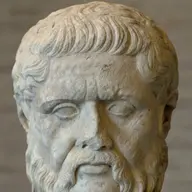
Plato, Letters 7.341b–eTranslated by R. G. Bury (1929)Read the full passage (opens scaife.perseus.org)

When, and whose words

Date
c. 353 BCE. The Seventh Letter is conventionally dated c. 353 BCE, soon after Dion's death (354 BCE), which it mentions.
Whose words
Seventh Letter; authorship disputed. Who was Plato?
How this post was checked
  • The plain-words line was read against the quote alone by a second, independent pass, which found it adds no claim the quote does not make (2026-10-03).
  • Each claim in the summary was checked by an independent pass against only the material it cites.
  • The quote itself is checked by the build: word for word, once, at the cited section of the stored translation.

See it among its momentsMore from PlatoSee it in the feed