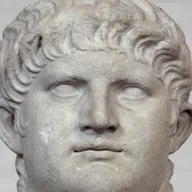
What was going on: As Suetonius tells it, over a century later, Nero declared he would govern on the model of Augustus. He cut heavy taxes, gave money to the people and to poor senators, and greeted people by name.
When the Senate thanked him for ruling well, he said: thank me when I have earned it.
When the senate returned him their thanks for his good government, he replied to them, “It will be time enough to do so when I shall have deserved it.”
As Suetonius tells it, over a century later. Suetonius, Life of Nero 10, translated by Alexander Thomson, revised by T. Forester (1889)
What was going on: As Suetonius tells it over a century later, Nero is making a show of generosity: cutting taxes, giving money to the people and allowances to poor senators, and promising to govern on the model of Augustus.
Asked to sign a death sentence, he said he wished he had never learned to read and write.
When called upon to subscribe the sentence, according to custom, of a criminal condemned to die, “I wish,” said he, “I had never learnt to read and write.”
As Suetonius tells it, over a century later. Suetonius, Life of Nero 10, translated by Alexander Thomson, revised by T. Forester (1889)
What was going on: As Tacitus tells it, Nero is answering his old tutor Seneca, who wants to give back the riches Nero gave him and step away. Tacitus adds that Nero hid his hatred under flattery. In 65 CE Nero ordered Seneca to kill himself.
Why it matters:Seneca's calm Stoic suicide later became the subject of numerous paintings.
Why not stay and guide me if I go wrong? If you hand back your wealth and leave, people will not praise you. They will talk of my greed and cruelty.
Why not rather, if the frailty of my youth goes in any respect astray, call me back and guide yet more zealously with your help the manhood which you have instructed? It will not be your moderation, if you restore me your wealth, not your love of quiet, if you forsake your emperor, but my avarice, the fear of my cruelty, which will be in all men's mouths.
As Tacitus tells it. Tacitus, Annals 14.56, translated by A. J. Church and W. J. Brodribb (1876)
What was going on: Suetonius, writing over a century later, tells this just before the great fire of Rome in 64 CE, in a list of Nero's boasts and scorn for the Senate. Right after, he claims Nero set the city alight; Tacitus says no one knew if the fire was an accident or set.
Why it matters: The fire destroyed nearly three quarters of Rome, and by Tacitus' account Nero's blaming of the Christians began the empire's first persecution of them.
Someone quoted a line: when I am dead, let fire swallow the world. He answered: no, let it happen while I am alive.
Somebody in conversation saying-- Emou thanontos gaia michthaeto pyri When I am dead let fire devour the world-- “Nay,” said he, “let it be while I am living” [emou xontos].
As Suetonius tells it, over a century later. Suetonius, Life of Nero 38, translated by Alexander Thomson, revised by T. Forester (1889)
What was going on:Rome, 64 CE: the Great Fire burned for six days and seven nights, as Suetonius tells it over a century later, and people fled to shelter among the tombs. Tacitus says no one knew whether it was an accident or set by Nero.
Why it matters: Suetonius' story of Nero singing of Troy as he watched Rome burn is where the legend that Nero fiddled as Rome burned begins.
He watched the fire from a tower, said he loved how beautiful the flames looked, and sang a poem about the fall of Troy in stage costume.
This fire he beheld from a tower in the house of Mecaenas, and “being greatly delighted,” as he said, “with the beautiful effects of the conflagration,” he sung a poem on the ruin of Troy, in the tragic dress he used on the stage.
As Suetonius tells it, over a century later. Suetonius, Life of Nero 38, translated by Alexander Thomson, revised by T. Forester (1889)
What was going on: Suetonius, writing over a century later, describes the huge house Nero built in Rome: fields, vineyards and woods inside its grounds, rooms covered in gold and jewels, and a round banquet hall that turned day and night.
Why it matters: Suetonius says many Romans believed Nero started the Great Fire of Rome to clear land for this house, the Golden House.
When his grand new house was finished, all the praise he gave it was that now he had a home fit for a human being.
Upon the dedication of this magnificent house after it was finished, all he said in approval of it was, “that he had now a dwelling fit for a man.”
As Suetonius tells it, over a century later. Suetonius, Life of Nero 31, translated by Alexander Thomson, revised by T. Forester (1889)
What was going on: 68 CE. With the armies in revolt and the Senate against him, Nero has fled Rome and crawled through a hole in the wall into a freedman's villa. The people with him urge him to save himself from the shame that awaits. Suetonius tells it over a century later.
Why it matters: Nero was the last emperor of the Julio-Claudian dynasty, and his death set off the brief civil war known as the Year of the Four Emperors.
He had his own grave dug in front of him, crying at every step and saying again and again: what an artist is about to die!
…he ordered a pit to be sunk before his eyes, of the size of his body, and the bottom to be covered with pieces of marble put together, if any could be found about the house; and water and wood, to be got ready for immediate use about his corpse; weeping at every thing that was done, and frequently saying, “What an artist is now about to perish!”
As Suetonius tells it, over a century later. Suetonius, Life of Nero 49, translated by Alexander Thomson, revised by T. Forester (1889)
What was going on: 68 CE, the day Nero died, as Suetonius tells it. With the Senate against him, Nero had fled Rome to a freedman's villa. As horsemen sent to bring him back alive came near, he drove a dagger into his throat, helped by his secretary Epaphroditus.
Why it matters: Nero was the last emperor of the Julio-Claudian dynasty, and his death set off the brief civil war known as the Year of the Four Emperors.
Half dead, as a soldier pressed a cloak to his wound pretending to help, he said only: too late. Is this your loyalty?
A centurion bursting in just as he was half-dead, and applying his cloak to the wound, pretending that he was come to his assistance, he made no other reply but this, “‘Tis too late;” and “Is this your loyalty?”
As Suetonius tells it, over a century later. Suetonius, Life of Nero 49, translated by Alexander Thomson, revised by T. Forester (1889)