hstry

Nero's last hours, as Suetonius tells it

set in 68 CE, Italy. As Suetonius tells it, over a century later.

Where and when

set in 68 CEItaly

1,958 years ago

Explore
Nero, 37 – 68 CE3000 BCE2900 BCE2800 BCE2700 BCE2600 BCE2500 BCE2400 BCE2300 BCE2200 BCE2100 BCE2000 BCE1900 BCE1800 BCE1700 BCE1600 BCE1500 BCE1400 BCE1300 BCE1200 BCE1100 BCE1000 BCE900 BCE800 BCE700 BCE600 BCE500 BCE400 BCE300 BCE200 BCE100 BCE1 CE100 CE200 CE300 CE400 CE500 CE600 CE700 CE800 CE900 CE1000 CE1100 CE1200 CE1300 CE1400 CE1500 CE1600 CE1700 CE1800 CE1900 CE2000 CEGreat Pyramid of Giza built, c. 2600 BCERome founded (traditional date), 753 BCELast western Roman emperor deposed, 476 CEGutenberg's printing press, c. 1440 CEColumbus reaches the Americas, 1492 CEFirst people on the Moon, 1969 CEToday, 2026

Swipe the line. Bars: entries. Dots: events.

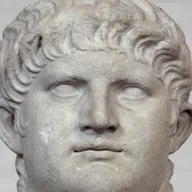
Nero

, ItalyAs Suetonius tells it, over a century later

In plain words, ours

He had his own grave dug in front of him, crying at every step and saying again and again: what an artist is about to die!

…he ordered a pit to be sunk before his eyes, of the size of his body, and the bottom to be covered with pieces of marble put together, if any could be found about the house; and water and wood, to be got ready for immediate use about his corpse; weeping at every thing that was done, and frequently saying, “What an artist is now about to perish!”

Suetonius, Life of Nero 49Translated by Alexander Thomson, revised by T. Forester (1889)Read the full passage (Suetonius, Life of Nero 49, opens gutenberg.org)
What was going on, our summary

68 CE. With the armies in revolt and the Senate against him, Nero has fled Rome and crawled through a hole in the wall into a freedman's villa. The people with him urge him to save himself from the shame that awaits. Suetonius tells it over a century later.

Checked claim by claim against: Nero kills himself as the Senate declares him an enemy, the passage around the quote.

Why it matters

About the event it belongs to: Nero kills himself as the Senate declares him an enemy

Nero was the last emperor of the Julio-Claudian dynasty, and his death set off the brief civil war known as the Year of the Four Emperors.

Based on Wikipedia: Nero

was Roman emperor from AD 54 until his suicide in AD 68, as the final emperor of the Julio-Claudian dynasty.

His death sparked a brief period of civil war known as the Year of the Four Emperors.

Wikipedia, Nero (opens en.wikipedia.org), as of 2026-09-26. Text CC BY-SA 4.0. Our line is checked against these sentences only.

Related moments

In time order, with this one in its place. Each says why it is here.

  1. 43 BCE110 years earlier Cicero is killed on Antony's orders Also in Italy
  2. 43 BCE110 years earlier The death of Cicero, as Plutarch tells it Also in Italy
  3. by 64 CEabout 4 years earlier Nero on fire devouring the world, in Suetonius More from Nero
  4. 65 CE3 years earlier Nero orders his old tutor Seneca to die Same years
  5. 66 CE2 years earlier Judaea rises against Rome Same years
  6. c. 64–68 CEDuring it Nero on his new house, as Suetonius tells it More from Nero
  7. 68 CESame year Nero kills himself as the Senate declares him an enemy The event behind itAlso in ItalyAlso about death
  8. set in 68 CEThis momentNero's last hours, as Suetonius tells it
  9. set in 68 CESame year The death of Nero, as Suetonius tells it Same passageMore from Nero
  10. 69 CE1 year later Four emperors in one year Same years
  11. 70 CE2 years later Titus takes Jerusalem and the Temple burns Same years
  12. set in 70 CE2 years later Josephus on the famine in besieged Jerusalem Also about death

Just before and after

The text around the quote, word for word from the same translation.

Show the passageHide the passage

Staying there some little time, while preparations were made for bringing him privately into the villa, he took up some water out of a neighbouring tank in his hand, to drink, saying, “This is Nero’s distilled water.” Then his cloak having been torn by the brambles, he pulled out the thorns which stuck in it. At last, being admitted, creeping upon his hands and knees, through a hole made for him in the wall, he lay down in the first closet he came to, upon a miserable pallet, with an old coverlet thrown over it; and being both hungry and thirsty, though he refused some coarse bread that was brought him, he drank a little warm water. All who surrounded him now pressing him to save himself from the indignities which were ready to befall him,

The quote: he ordered a pit to be sunk before his eyes, of the size of his body, and the bottom to be covered with pieces of marble put together, if any could be found about the house; and water and wood, to be got ready for immediate use about his corpse; weeping at every thing that was done, and frequently saying, “What an artist is now about to perish!”

Suetonius, Life of Nero 48–49Translated by Alexander Thomson, revised by T. Forester (1889)Read the full passage (opens gutenberg.org)

When, and whose words

Date
set in 68 CE. Set on the day of his death in 68 CE. Suetonius wrote c. 120 CE.
Whose words
As Suetonius tells it, over a century later.
How this post was checked
  • The plain-words line was read against the quote alone by a second, independent pass, which found it adds no claim the quote does not make (2026-10-03).
  • Each claim in the summary was checked by an independent pass against only the material it cites.
  • The quote itself is checked by the build: word for word, once, at the cited section of the stored translation.

See it among its momentsMore from NeroSee it in the feed