hstry

The death of Nero, as Suetonius tells it

set in 68 CE, Italy. As Suetonius tells it, over a century later.

Where and when

set in 68 CEItaly

1,958 years ago

Explore
Nero, 37 – 68 CE3000 BCE2900 BCE2800 BCE2700 BCE2600 BCE2500 BCE2400 BCE2300 BCE2200 BCE2100 BCE2000 BCE1900 BCE1800 BCE1700 BCE1600 BCE1500 BCE1400 BCE1300 BCE1200 BCE1100 BCE1000 BCE900 BCE800 BCE700 BCE600 BCE500 BCE400 BCE300 BCE200 BCE100 BCE1 CE100 CE200 CE300 CE400 CE500 CE600 CE700 CE800 CE900 CE1000 CE1100 CE1200 CE1300 CE1400 CE1500 CE1600 CE1700 CE1800 CE1900 CE2000 CEGreat Pyramid of Giza built, c. 2600 BCERome founded (traditional date), 753 BCELast western Roman emperor deposed, 476 CEGutenberg's printing press, c. 1440 CEColumbus reaches the Americas, 1492 CEFirst people on the Moon, 1969 CEToday, 2026

Swipe the line. Bars: entries. Dots: events.

Nero

, ItalyAs Suetonius tells it, over a century later

In plain words, ours

Half dead, as a soldier pressed a cloak to his wound pretending to help, he said only: too late. Is this your loyalty?

A centurion bursting in just as he was half-dead, and applying his cloak to the wound, pretending that he was come to his assistance, he made no other reply but this, “‘Tis too late;” and “Is this your loyalty?”

Suetonius, Life of Nero 49Translated by Alexander Thomson, revised by T. Forester (1889)Read the full passage (Suetonius, Life of Nero 49, opens gutenberg.org)

What was going on, our summary

68 CE, the day Nero died, as Suetonius tells it. With the Senate against him, Nero had fled Rome to a freedman's villa. As horsemen sent to bring him back alive came near, he drove a dagger into his throat, helped by his secretary Epaphroditus.

Checked claim by claim against: Nero kills himself as the Senate declares him an enemy, the passage around the quote.

Why it matters

About the event it belongs to: Nero kills himself as the Senate declares him an enemy

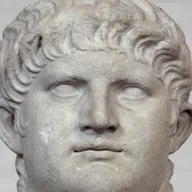
Nero was the last emperor of the Julio-Claudian dynasty, and his death set off the brief civil war known as the Year of the Four Emperors.

Based on Wikipedia: Nero

was Roman emperor from AD 54 until his suicide in AD 68, as the final emperor of the Julio-Claudian dynasty.

His death sparked a brief period of civil war known as the Year of the Four Emperors.

Wikipedia, Nero (opens en.wikipedia.org), as of 2026-09-26. Text CC BY-SA 4.0. Our line is checked against these sentences only.

Related moments

In time order, with this one in its place. Each says why it is here.

  1. 43 BCE110 years earlier Cicero is killed on Antony's orders Also in Italy
  2. 43 BCE110 years earlier The death of Cicero, as Plutarch tells it Also in Italy
  3. by 64 CEabout 4 years earlier Nero on fire devouring the world, in Suetonius More from Nero
  4. 65 CE3 years earlier Nero orders his old tutor Seneca to die Same years
  5. 66 CE2 years earlier Judaea rises against Rome Same years
  6. c. 64–68 CEDuring it Nero on his new house, as Suetonius tells it More from Nero
  7. 68 CESame year Nero kills himself as the Senate declares him an enemy The event behind itAlso in ItalyAlso about death
  8. set in 68 CEThis momentThe death of Nero, as Suetonius tells it
  9. set in 68 CESame year Nero's last hours, as Suetonius tells it Same passageMore from Nero
  10. 69 CE1 year later Four emperors in one year Same years
  11. 70 CE2 years later Titus takes Jerusalem and the Temple burns Same years
  12. set in 70 CE2 years later Josephus on the famine in besieged Jerusalem Also about death

Just before and after

The text around the quote, word for word from the same translation.

Show the passageHide the passage

One while, he begged of Sporus to begin to wail and lament; another while, he entreated that one of them would set him an example by killing himself; and then again, he condemned his own want of resolution in these words: “I yet live to my shame and disgrace: this is not becoming for Nero: it is not becoming. Thou oughtest in such circumstances to have a good heart: Come, then: courage, man!” The horsemen who had received orders to bring him away alive, were now approaching the house. As soon as he heard them coming, he uttered with a trembling voice the following verse, Hippon m’ okupodon amphi ktupos ouata ballei; The noise of swift-heel’d steeds assails my ears; he drove a dagger into his throat, being assisted in the act by Epaphroditus, his secretary.

The quote: A centurion bursting in just as he was half-dead, and applying his cloak to the wound, pretending that he was come to his assistance, he made no other reply but this, “‘Tis too late;” and “Is this your loyalty?”

Immediately after pronouncing these words, he expired, with his eyes fixed and starting out of his head, to the terror of all who beheld him. He had requested of his attendants, as the most essential favour, that they would let no one have his head, but that by all means his body might be burnt entire. And this, Icelus, Galba’s freedman, granted. He had but a little before been discharged from the prison into which he had been thrown, when the disturbances first broke out.

Suetonius, Life of Nero 49Translated by Alexander Thomson, revised by T. Forester (1889)Read the full passage (opens gutenberg.org)

When, and whose words

Date
set in 68 CE. Set on the day of his death in 68 CE. Suetonius wrote c. 120 CE.
Whose words
As Suetonius tells it, over a century later.
How this post was checked
  • The plain-words line was read against the quote alone by a second, independent pass, which found it adds no claim the quote does not make (2026-10-03).
  • Each claim in the summary was checked by an independent pass against only the material it cites.
  • The quote itself is checked by the build: word for word, once, at the cited section of the stored translation.

See it among its momentsMore from NeroSee it in the feed