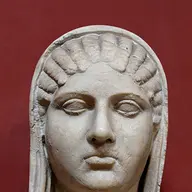
What was going on: As Xenophon tells it, Socrates is talking with Critobulus, who wants help making good friends. Socrates offers to be useful in that search, but cites Aspasia to explain why he will only say true things in his favor.
Matchmaking only works when the good things you say about each side are true. People who were fooled end up hating each other and you.
She once told me that good matchmakers are successful in making marriages only when the good reports they carry to and fro are true; false reports she would not recommend, for the victims of deception hate one another and the matchmaker too.
As Xenophon tells it, through Socrates. Xenophon, Memorabilia 2.6.36, translated by E. C. Marchant (1923)
What was going on: In Plato's Menexenus, which many read as satire, Socrates gives a speech he credits to Aspasia, honoring Athenians who have fallen. It praises the land and the ancestors, and calls Athens' government an aristocracy backed by the people.
A country shapes its people: a good one raises good people, a bad one raises bad people.
For a polity is a thing which nurtures men, good men when it is noble, bad men when it is base.
As Plato tells it, through Socrates; many read the Menexenus as satire. Plato, Menexenus 238c, translated by R. G. Bury (1929)
What was going on: In Plato's Menexenus, which many read as satire, Socrates recites a speech for Athens' fallen soldiers that he credits to Aspasia. At this point the speech praises the city's form of government, which it says some call democracy but is really rule by the best with the people's approval.
The people run most things and give power to whoever seems best. Being poor, weak or of unknown family neither bars you nor lifts you.
And while the most part of civic affairs are in the control of the populace, they hand over the posts of government and the power to those who from time to time are deemed to be the best men; and no man is debarred by his weakness or poverty or by the obscurity of his parentage, or promoted because of the opposite qualities, as is the case in other States. On the contrary, the one principle of selection is this: the man that is deemed to be wise or good rules and governs.
As Plato tells it, through Socrates; many read the Menexenus as satire. Plato, Menexenus 238d, translated by R. G. Bury (1929)
What was going on: In Plato's Menexenus, which many read as satire, Socrates recites a speech given as Aspasia's. In it, men who chose to die bravely rather than live in shame are imagined speaking to their own children.
Money brings a coward no honour. Looks and strength only make a coward easier to notice.
For neither does wealth bring honor to its possessor if combined with cowardice—for such an one is rich for another rather than for himself,—nor do beauty and strength appear comely, but rather uncomely, when they are attached to one that is cowardly and base, since they make their possessor more conspicuous and show up his cowardice;
As Plato tells it, through Socrates; many read the Menexenus as satire. Plato, Menexenus 246e, translated by R. G. Bury (1929)
What was going on: In Plato's Menexenus, which many read as satire, Socrates repeats a speech credited to Aspasia. In it, men who must die speak to their fathers, asking them not to grieve too much.
Someone who relies on himself will not be seen overjoyed or overcome by grief.
…because he puts his trust in himself, he will neither be seen rejoicing nor yet grieving overmuch.
As Plato tells it, through Socrates; many read the Menexenus as satire. Plato, Menexenus 248a, translated by R. G. Bury (1929)